Showing posts with label paper. Show all posts

Scott vs Amundsen: A Study in Polar Exploration

Two of the greatest expeditions in the history of Polar exploration was the race between Amundsen and Scott to reach the South Pole, 100 years ago during the winter of 1911/1912. Although there were similarities between these expeditions, there were also many fundamental differences.
Captain Robert Falcon Scott
Captain Robert Falcon Scott was an English navy officer and explorer. His first expedition was on the Discovery, which included setting a new point of the Farthest South ever reached by man. He returned on the Terra Nova in an attempt to reach the South Pole.
Roald Amundsen
Roald Amundsen was an explorer from Norway. While growing up he desired to become an explorer, and after participating in the first expedition to spend the winter in Antarctica, he led his own expedition to be the first to sail the Northwest Passage. While he was planning a journey to sail over the North Pole, the news was announced that two other explorers claimed to have already reached it. So he secretly changed his plans and sailed south to race Scott to be the first to reach the South Pole.

Similarities

1. Trust in God
Although it appears that neither Scott or Amundsen were Christians, both frequently mentioned in their writings the workings of Providence. Scott's men wrote saying they were willing to die if it was their time. Edward Wilson wrote, “[I]f the end comes to me here or hereabout … All will be as it is meant to be.” Henry Bowers wrote this to his mother just before dying next to Scott, “my trust is still in Him and in the abounding Grace of my Lord and Savior whom you brought me to trust in...” There is a saying that there are no atheists in foxholes, and there were no atheists in Antarctica either. When men are constantly faced with danger and death, they recognize their dependence on God, even if they do not follow Him fully.

2. Courage
Both men were very courageous, although in different ways. It took courage to even venture into Antarctica, far from hope of relief in case anything went wrong. When faced with hard decisions along his journey, Amundsen boldly took the hard course, not faltering or wasting time attempting to find an easier course. Scott, on his fateful journey, set an example of courage that the English would look up to for years. In one of his last letters he wrote, “We are showing that Englishmen can still die with a bold spirit, fighting it out to the end... I think this makes an example for Englishmen of the future.”
The Terra Nova

Differences

1. Motives
Amundsen explored because he loved exploration, but Scott explored because he wanted promotion. As a young man Amundsen heard of the stories of the explorers like Sir John Franklin and Fridtjof Nansen, and wished to follow their footsteps and become an explorer. Scott, a mediocre navy officer, heard of the planning of the Discovery expedition and saw it as a way to gain promotion and riches.
Nansen, Amundsen's hero and supporter
2. Preparation
The different motives of these two men resulted in vastly different methods of preparation. Amundsen gradually worked up to leading an expedition over a decade, first taking long ski trips in his native country of Norway, working on whaling ships which navigate the icy northern seas, and finally participating in someone else's expedition. Scott, on the other hand, was appointed directly to command a large expedition, and only spent a few weeks hearing about what Amundsen had learned first hand for years. On his Discovery expedition Scott admitted this, saying, "Our ignorance was deplorable."

Additionally, Amundsen spent many hours reading the works of previous explorers and analyzing everything to see what he could learn. Scott did not learn from his own experiences, much less those of others. He kept repeating the same mistakes over and over again. On previous journeys he had suffered from not bringing enough provisions, but he made the same mistake in this trip. In his ill fated expedition to reach the pole, he basically followed in the path of Shackleton, but he did not even bring a copy of Shackleton's book. He had to borrow one from another member of the expedition. Amundsen, on the other hand brought along a large polar library to study.

Scott's expedition to the South Pole had scientific aims as well, while Amundsen really did not, but this in no way excuses a lack of preparation.
One of Amundsen's dog sled teams
3. Technology
One of the biggest differences in Scott and Amundsen's journeys was the method of travel they used. Amundsen used dogsleds, while Scott used man hauling. Scott was biased against dog sleds because on the Discovery expedition they were a failure because no one knew how to use them. In the end, Scott did recognize that dog sleds were much quicker and more efficient, but he objected to them because at times the dogs had to be killed. So instead of killing a few dogs, he ended up killing himself because he could not reach his supply depots. He tried horses, but they were completely unsuited for the polar conditions, which he could have learned from the experiences of others. In England some, such as Scott's champion Sir Clements Markham, thought that it was more glorious to march without the assistance of dogs, saying, “People do not understand the greatness of [Scott's] achievement. The sledge journeys without dogs are quite unequalled. It is a very much easier matter when Peary or Nansen or Sverdrup make dogs drag their things, while they stroll along.”
Scott manhauling
The effort required to travel is demonstrated by two quotes. When Amundsen's party arrived, Bjalland, one of the best skiers in the world, wrote, “the skiing was brilliant.” When Scott arrived he said, “Great – God this is an awful place and terrible enough for us to have laboured to it without the reward of priority…Now for the run home and a desperate struggle to get the news through first. I wonder if we can do it.”
Amundsen carefully laying a depot
4. Planning
Amundsen made detailed plans far in advance of setting out on the journey, giving himself plenty of extra provisions in case he hit bad weather. Scott made complicated, last minute plans, making many mistakes in small details that cost him much time and labor. For example, an important element of both of their plans was to leave supply depots on the journey to the South Pole which they would pick up on the way back. Amundsen, having read of other men having problems finding the depots they had left, put markers to the left and right of his depots, giving himself a several mile range to hit. He also built markers at intervals along his route so he could always see one, so he would not have trouble following his tracks. Scott, on the other hand, built only depots, making the same mistake that others had before him, wasting time and effort.

Scott's worst mistake in planning was his provisions. He made allowance for only four days of bad weather in a four month journey, an amount which the journals of previous explorers would have told him was far too low. He ended up dying because of lack of supplies because he hit a blizzard. He was only eleven miles from the next supply depot. Nansen, an explorer himself and Amundsen's mentor, said, “Let no one come and prate about luck. Amundsen's triumph is that of the strong and far seeing.”
One of Scott's depots
5. Leadership
The two men had very different leadership styles. Scott was a naval officer, and a mediocre one at that. He led by enforcing the fact that his word was law, being secretive about his plans, and refusing to listen to suggestions from others. Amundsen, although it was still very clear that he was the leader, was open about his plans, allowed suggestions to be made, intermingled with the men, and shared the worst chores with them. However, both men did have good leadership qualities and both made leadership mistakes.
Amundsen's party at the Pole
6. Popularity
Amundsen ended up reaching the pole first, and returning successfully, with little suffering besides. But when he returned to Europe he was quickly forgotten in favor of Scott, who had died after losing the race to the pole. Although Amundsen was a better explorer, Scott was a better writer. Amundsen's stories did not have the drama which Scott was able to convey. One historian said, “Amundsen had made the conquest of the Pole into something between an art and a sport. Scott had turned Polar exploration into an affair of heroism for heroism's sake.” Scott's popularity in England was much helped by the fact that he did not come back. He had been defeated by Amundsen, and England preferred a dead lion to a live donkey. Even today, Scott remains much more popular than Amundsen, remaining for many the iconic British hero.
Scott finding he had been beaten by Amundsen

Blogging the Reformers: Martin Luther


Martin Luther was born on November 10th, 1483 in Germany. His father was a miner, but he wanted Martin to be a lawyer, so he sent him to the university. But on July 2nd, 1505 as he was riding through a thunderstorm, he was scared by the lightening and thunder so he vowed that if God protected him, he would become a monk. He survived the storm and entered the monastery against his father's wishes. As a monk he worked hard to gain righteousness through good works.

Luther's German Bible
Martin Luther became a doctor at the University of Wittenberg in 1512, and he remained a doctor there for the rest of his life. He began to resist the Catholic church in the matter of indulgences. John Tetzel was traveling through Germany selling indulgences, saying that the pope would forgive your sins if you bought them. Luther disagreed, and he wrote 95 theses in Latin against them and nailed them to the church door as was customary. They were translated into German, and quickly spread all over the country. The 95 theses acknowledged the supremacy of the pope, but Luther gradually began to see that the pope was opposed to the truth of the Bible. He also began to teach justification by faith alone. The pope excommunicated Luther in January 1521 because Luther refused to recant his writings. In April he was ordered to appear before Charles the Emperor at the town of Worms to defend his beliefs. When ordered to recant his writings there, he said,
Unless I am convinced by the testimony of the Scriptures or by clear reason (for I do not trust either in the pope or in councils alone, since it is well known that they have often erred and contradicted themselves), I am bound by the Scriptures I have quoted and my conscience is captive to the Word of God. I cannot and will not recant anything, since it is neither safe nor right to go against conscience. May God help me. Amen.
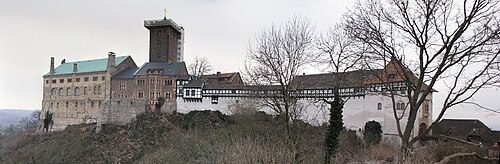
After the Diet of Worms Charles ordered that Luther be arrested. But on the way back to Wittenberg, he was captured by Fredrick the Elector and confined in Wartburg Castle to protect him from his enemies. While there he translated the New Testament into German. In 1522 he returned to Wittenberg and continued to preach and reform the church. He married Katharina von Bora after helping rescue her from a convent, and they had several children. He also finished his translation of the Old Testament into German. He died on February 18th, 1546. He had a great effect in Germany, but his writings were translated and he had a great effect wherever the Reformation penetrated.

Wartburg Castle. Source.

Blogging the Reformers: Jean Merle D’Aubigné

D'Aubigne

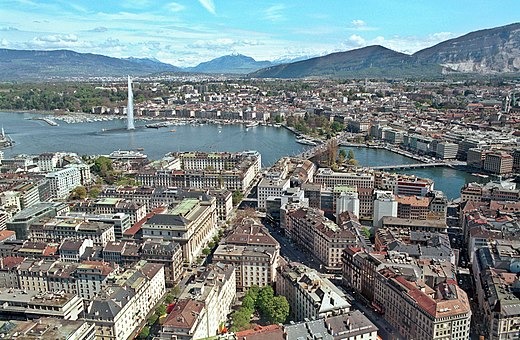
Jean-Henri Merle D'Aubigne was born on August 16th 1794. He lived in Geneva, where the great reformer John Calvin had lived 250 years before. But by the 1800s Calvin's reformation was gone and had been replaced by Unitarianism and other heresies. He was saved while studying for the ministry, and was ordained in 1817. In 1817 on the 300th of anniversary of the Reformation he visited Wartburg Castle where Martin Luther was kept. There he decided that he eventually wanted to write a history of the Reformation. He was a preacher in Hamburg and Brussels until 1831 when he returned to Geneva. There he assisted the establishment of a reformed theological seminary in Geneva. He was professor of Church History there for 41 years until his death. He was a great preacher in Geneva and was one of the leaders of the the reformation there. While he was in Geneva he wrote his two major books on the Reformation, a five volume History of the Reformation of the Sixteenth Century and an eight volume History of the Reformation in Europe in the Time of Calvin. He traveled all over Europe to study the original source documents. These books were very important in the history of the church. “For the first time, the Reformation, with all the various and boundless benefits which it has conferred upon the world, is beginning to be, in some measure, comprehended by mankind.” 1 A historian wrote that his writings “had a wider circulation, at least in the English translations, than any other book on church history.”2 D’Aubigne’s writings are still a great way to learn about church history. You can buy them here.

Geneva Today

1 J. H. Merle D'Aubigne, The Life and Writings of J. H. Merle D'Aubigne – The History of the Reformation in the Sixteenth Century (Harrisonburg, VA: Sprinkle Publications, 2001) volume 1, p. XV
2 http://www.visionforum.com/hottopics/articles/2005-04-14_001.aspx

The Battle of King's Mountain


Prelude
The Battle of King's Mountain was fought inn South Carolina on October 8th, 1780 during the American Revolution. It is very important because it was one of the major turning points of the war. In 1779, with the British northern army holed up in New York by the American army under George Washington, the British decided to turn their focus to the Southern colonies. The British army under Cornwallis moved by sea to Charleston, and captured it and most of its garrison on May 12th, 1780 with a very low number of casualties. He then began moving north through South Carolina, destroying the remnants of the American army as he went. The British were also able to recruit over 1000 Loyalist, and they were placed under the command of Major Patrick Ferguson, a brave officer and one of the best shots in the British army. Cornwallis moved the army up to Charlotte, North Carolina. He placed Ferguson with his militia toward the west to guard his left flank.

At this point, the American army in the South was virtually non-existent. On September 10th, 1780 Ferguson issued a message where he declared to the American farmers that he would, “march his army over the mountains, hang their leaders, and lay waste to their country with fire and sword.” The men he addressed were Scotch-Irish frontiersmen, and his message had the opposite effect of what he hoped. Instead of frightening them into submission, he stirred them up to resistance. The “Over Mountain Men:” the frontiersmen from west of the Allegheny Mountains, began gathering and were joined with other groups of militia from Virginia and elsewhere. They numbered in all around 1,400 men.

When Ferguson heard of their advance, he began falling back towards Charlotte. The Patriots followed, and they heard that he made camp on King's Mountain within one day's march of Charlotte on the night of October 6th. In order to be able to attack them before they reached Charlotte, the Patriot commanders picked 900 men and rode to intercept the British. They reached King's Mountain at 3:00 PM on October 7th, 1780.

Me at the battle marker

Battle
The Patriot militia was able to surround the mountain without the Loyalists being aware of their presence. They were organized into 8 groups of 100 to 150 men. Before they went forward, Colonel Isaac Shelby gave them this order:
When we encounter the enemy, don't wait for the word of command. Let each one of you be your own officer, and do the very best you can, taking every care you can of yourselves, and availing yourselves of every advantage that chance may throw in your way. If in the woods, shelter yourselves, and give them Indian play; advance from tree to tree, pressing the enemy and killing and disabling all you can. Your officers will shrink from no danger-they will be constantly with you, and the moment the enemy give way, be on the alert, and strictly obey orders.1
With this order, the Patriots went forward with a yell. They caught the Loyalists completely by surprise, but they were able to form before they were overrun. The Patriots used the cover of trees and rocks on the mountainside, and shot down many of their opponents. Finally Ferguson ordered a bayonet charge, to drive the Patriots back. They surged forward, and drove the Patriots back, but as soon as they returned from the charge the Patriots returned again, using cover and picking off the Tories.
The slope which they charged up

Several more times the Tories charged, but the Patriots just melted back and then returned again in full strength. After an hour the Loyalists had suffered heavily. They were driven back to their camp at the top of the mountain, and their defense began to break down. The Patriots had already surrounded them, so there was no way to escape. Some of the Tories began to surrender, but Ferguson knocked down their white flags with his sword. Finally Ferguson gathered his men to try to make a last charge to attempt to break the Patriot line and escape, but as they charged the Patriots fired a volley and Ferguson fell from his horse, hit with seven bullets.
The Patriots hid behind rocks and trees

With their leader killed, the Loyalists surrendered and asked for quarter. The militia began shooting the survivors, because of what the British commander Banastre Tarleton had done to a group of defeated Patriots. But finally the officers gained control and the rest of the Tories were taken as prisoners. The battle had lasted on 65 minutes.

Where the British commander, Major Patrick Ferguson was killed
His grave marker

The Loyalists had suffered 244 killed, 163 wounded and had 668 taken prisoner. The Patriots had 29 killed and 58 wounded. Virtually none of the Tories escaped.

The Anniversary monument

Aftermath
The Battle of King's Mountain was crucial to the American cause. First of all, it gave a great boost to the American morale which had fallen greatly with the loss of South Carolina. Second it forced Cornwallis to retreat after it previously appeared that there was nothing stopping him from capturing North Carolina and Virginia. Also through this battle, the Loyalist militia was destroyed as a military force. King's Mountain was the only battle of the American War for Independence with no British troops involved. It was brothers against brothers. That is why Thomas Jefferson said that it was "The turn of the tide of success.” And Theodore Roosevelt said, "This brilliant victory marked the turning point of the American Revolution."

President Herbert Hover said,
This is a place of inspiring memories. Here less than a thousand men, inspired by the urge of freedom, defeated a superior force intrenched in this strategic position. This small band of patriots turned back a dangerous invasion well designed to separate and dismember the united Colonies. It was a little army and a little battle, but it was of mighty portent. History has done scant justice to its significance, which rightly should place it beside Lexington and Bunker Hill, Trenton and Yorktown, as one of the crucial engagements in our long struggle for independence.2


1 King's Mountain and it's Heroes: History of the Battle of King's Mountain. by Lyman C. Draper. (Cincinnati: Peter G. Thomson Publisher, 1881) Google Books. p. 196
2 http://www.presidency.ucsb.edu/ws/index.php?pid=22379


Play the video

Blogging the Reformers: Thomas Cranmer


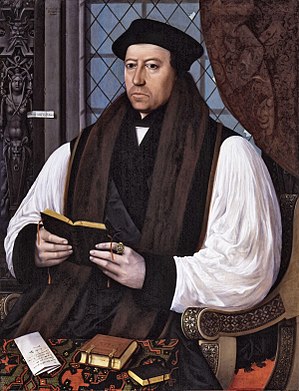
Thomas Cranmer was born in England in 1489. He attended Jesus College in Cambridge, and later taught there. He assisted King Henry VIII in 1527 to make a theological argument for why he could divorce the queen. In 1532 Henry appointed him Archbishop of Canterbury to assist him in reforming the church. The king was not a Christian, but to increase his own power he broke from the Pope and appointed himself as head of the church. At some points he would lean toward the Reformation, and at others toward the Catholics. During his 22 years as Archbishop, Cranmer worked to advance the Reformation, but he was timid and at times went along with the king against the Reformation. In 1553 he was arrested by the Catholic Queen “Bloody” Mary and was tried for heresy. He was convicted to be burnt, but eventually recanted all Lutheran doctrine and acknowledged the pope as head of the church. Instead of absolving him, Mary commanded him to be burnt anyway. Before his execution, he was given the opportunity to preach. He wrote a sermon in which he again recanted, but instead of giving the sermon he renounced the recantations and said that he would rather be burnt than recant. He was pulled from the pulpit and taken to be burnt. As he was burning, he stuck his right hand into the fire because it was the one which he used to sign the recantation. He died March 21, 1556.

D'Aubigne on Cranmer
“Cranmer moved forward slowly: he modified an evangelical movement by a clerical concession. When he had taken a step forward, he stopped suddenly, and apparently drew back; not from cowardice, but because his extreme prudence so urged him. The boldness of a Farel or a Knox is in our opinion far more noble; and yet this extreme moderation saved Cranmer and protestantism with him. ... God gives to every people and to every epoch the man necessary to it. Cranmer was this man for England, at the time of her separation from the papacy.” 1


Cranmer's Last Sermon
“And now forasmuch as I am come to the last end of my life, whereupon hangeth all my life past, and all my life to come, either to live with my master Christ for ever in joy, or else to be in pain for ever with the wicked in hell, and I see before mine eyes presently, either heaven ready to receive me, or else hell ready to swallow me up; I shall therefore declare unto you my very faith how I believe, without any color of dissimulation: for now is no time to dissemble, whatsoever I have said or written in times past.

First, I believe in God the Father Almighty, Maker of heaven and earth, etc. And I believe every article of the Catholic faith, every word and sentence taught by our Savior Jesus Christ, His apostles and prophets, in the New and Old Testament.
And now I come to the great thing which so much troubleth my conscience, more than any thing that ever I did or said in my whole life, and that is the setting abroad of a writing contrary to the truth, which now here I renounce and refuse, as things written with my hand contrary to the truth which I thought in my heart, and written for fear of death, and to save my life, if it might be; and that is, all such bills or papers which I have written or signed with my hand since my degradation, wherein I have written many things untrue. And forasmuch as my hand hath offended, writing contrary to my heart, therefore my hand shall first be punished; for when I come to the fire it shall first be burned.

And as for the pope, I refuse him as Christ's enemy, and Antichrist, with all his false doctrine."2


1 J. H. Merle D'Aubigne, History of the Reformation in Europe in the Time of Calvin (Harrisonburg, VA: Sprinkle Publications, 2000) volume 5, book viii, p. 54

2 Foxe, John Foxe's Book of Martyrs (New York: Eaton and Mains, 1911) Google Books. p. 384-385

Blogging the Reformers: Baudichion de la Maisonneuve

Baudichion de la Maisonneuve was one of the leading men of Geneva in the 16th century. He was very influential in bringing the Reformation to Geneva and defending the city's liberty. He was one of the first men in Geneva to be converted to the Reformed religion. Later in the Reformation his house became one of the meeting places for the Huguenots. The Reformation in Geneva was not peaceful. Several times mobs attacked the Huguenots in Maisonneuve's house. In 1534 he was arrested in France and sentenced to be executed, but finally after the request of the town of Berne, Switzerland the king ordered him to be released and allowed him to return home. He was appointed captain-general of Geneva, and led the army to battle against their enemies. D'Aubigne said that he was “a man of noble and exalted character, bold, welcome everywhere, braving without measure all the traditions of old times, often turbulent, and the person who, more perhaps than any other, served to clear in Geneva the way by which the Reformation was to enter.”1

1 J. H. Merle D'Aubigne, History of the Reformation in Europe in the Time of Calvin (Harrisonburg, VA: Sprinkle Publications, 2000) volume 1, book I, p. 142

Blogging the Reformers: Aime Levet

Aime Levet was an apothecary in Geneva in the 16th century. When Antoine Froment first came and brought the Gospel to Geneva, Levet was against it, but eventually his heart softened. In 1533 he was won over to Christianity by his wife, and he became one of the leading Huguenots. The religious meetings were frequently held in his house. When Froment was attacked by a mob, Levet hid him in his house. A few months after Levet’s salvation the bishop of Geneva forced him and many other Huguenots to flee, but a troop of soldiers pursued and caught him. After beating him, they threw him in prison without a trial. After the overthrow of the bishop, he was released and continued to spread the Reformation. In 1536 he was elected one of the four syndics, or magistrates, of Geneva.

Blogging the Reformers: Pierre Olivetan


by Joshua Horn

Pierre Olivétan was born in France in 1506. He was three years older than his cousin and friend, John Calvin, the famous reformer in Geneva. He knew Latin, Greek and Hebrew. He was converted to Protestantism by Calvin. He was one of the first to bring the gospel to Geneva, and was expelled from the city along with William Feral and others. It was Feral who convinced him to translate the Bible into French. His translation was published in 1535, with a preface by Calvin. It was the first translation into French from the original languages. This translation was very influential in the Reformation. Olivétan died suddenly in 1538 at 32 years of age. Some said he died by poison, but this is probably not true. Calvin was very sad when he heard of his death. D'Aubigne said of Olivétan, “Pierre Robert Olivétan ... was gifted with a solid mind, great perseverance in the discharge of his duties, unshaken fidelity to his confections, and a holy boldness when it became necessary to combat error.” 1

1 J. H. Merle D'Aubigne, History of the Reformation in Europe in the Time of Calvin (Harrisonburg, VA: Sprinkle Publications, 2000) volume 1, book ii, p. 388

Book Report on The Pioneers


by Joshua Horn

The Pioneers contains two of Ballantyne's shorter stories. The first is The Pioneers. It is the tale of Reuben Guff and his son Lawrence as they travel on voyages of discovery in the northern wilderness of Canada in the 1780s. They first go to explore the wilderness with their faithful Indian friend Swiftarrow. Their adventure is cut short when the discover a Indian settlement which was destroyed by smallpox. In 1784 they set off again with the 'King of Pioneers' Alexander Mackenzie, one of the great explorers of Canada. They travel up a great river to discover whether it leads to the Pacific Ocean. They sail along the river in canoes amidst many dangers from ice, the natives and their own men, and they finally discover that the river leads to the Arctic Ocean. Several years later they go on an even more hazardous journey on the Peace River through the Rocky Mountains. They courageously ascend the river braving many dangers and hardships. This story does not contain as much dialog as some of Ballantyne's others, but it is still interesting as it tells the real life adventures in this oft-forgotten chapter of history.

The second story in this book is called, Fast in the Ice. It tells of a voyage of discovery to search for the North Pole. The commander of the Hope is Captain Harvey, and his crew includes his nephew Tom Gregory, Davy Butts, Sam Baker, and many other wonderful characters. When they arrive the the Arctic regions they have many adventures and Ballantyne tells how God protected them through their dangers. Their ship gets stuck fast in the ice during the winter, and they have to live through temperatures at times 60° below zero! They meet with Eskimos, hunt bears and walruses and fight hunger. Finally after many dangerous times the ship comes free in the summer, but the next day it is crushed in the ice and sinks, leaving the men stranded in the Arctic. Ballantyne tells much interesting information about the 'floes' and icebergs, the lives of the Eskimos and how they hunt the wild animals. This story was very interesting, and I would definitely recommend it.

Buy The Pioneers
Read online:
The Pioneers
Fast in the Ice

The Logical Fallacies in Erasmus’ Arguments

Martin Luther, Author of The Bondage of The Will


by Joshua Horn

from Bondage of the Will by Martin Luther

buy The Bondage of the Will


In 1525 Martin Luther published a book entitled, De Servo Arbitrio, or in English, Bondage of the Will. He wrote it in response to On Free Will by Desiderus Erasmus. In his book, Erasmus argued that man has free will and he must chose to be saved. Luther replied to him in Bondage of the Will and pointed out many flaws in his arguments. Three of the most important flaws were that Erasmus twisted scripture to meet his own interpretation, that he rejected the Bible rather than split with the Pope, and lastly that he contradicted himself in his definition for free will.

The first of Erasmus’ flaws was that he frequently twisted scripture to match his own opinions. When he deals with the text where God says that he hardened Pharaoh's heart1, he claims that God really meant that Pharaoh hardened his own heart. Luther says, “When God says: ‘I will harden the heart of Pharaoh’, you change the persons, and take it thus: ‘Pharaoh hardens himself by my long-suffering’!”2 When the Bible says this, I am the vine, ye are the branches: He that abideth in me, and I in him, the same bringeth forth much fruit: for without me ye can do nothing,”3 Erasmus says that “‘nothing’ may mean the same as ‘a little imperfect something.’”4 This is clear twisting of the words of scripture. If you take that nothing means ‘an imperfect little something’, than most of the doctrines of the Bible fall apart. From these two examples it is clear that Erasmus was forced to twist the words of scripture to make them fit with his position.

Erasmus’ second logical fallacy is that he would rather give up the scriptures than contradict the Pope. He was so afraid of contention that he was willing to give up what he knew was true rather than fight for it. Luther says this to Erasmus, “For your teaching is designed to induce us, out of consideration for Popes, princes, and peace, to abandon and yield up … the sure word of God. But when we abandon that, we abandon God, faith, salvation, and all Christianity!”5 The Bible says in Matthew 10:28, “And fear not them which kill the body, but are not able to kill the soul: but rather fear him which is able to destroy both soul and body in hell.6 The basic problem is that Erasmus feared man more than God.

Erasmus admitted in his book that free will is a slave to sin and can not will to do anything good. He says that, “the human will after sin is so depraved that it has lost its freedom and is forced to serve sin, and cannot recall itself to a better state.”7 But later in the book he claims that a human can will to seek God! This is a clear contradiction. Luther says this, “You say that ‘free-will’ is a power of the human will by which a man can apply himself to good; but here you say, and and approve of its being said, that man without grace cannot will good.”8 Erasmus realized that free will could not do any good, but he still contradicted himself and said that it is man who chooses to be saved.

We have just seen Erasmus' three most important mistakes. They are that he twisted the words of scripture, that he rejected the Bible rather than split with the Pope, and thirdly that he contradicted himself in his definition of free will. After Luther pointed out Erasmus' fallacies and destroyed his arguments, there were no good arguments left for free will. Many people today who defend free will have the same problems and make the same logical fallacies as Erasmus did when arguing with Martin Luther. Being able to recognize these problems can help us defend the Biblical doctrine of the will.

1 Exodus 7:13, etc.

2Martin Luther, Bondage of the Will (Grand Rapids, Michigan: Baker Book House Company, 2003) trans. J. I. Packer and O.R. Johnston, p. 195

3 John 15:5, KJV

4 Bondage of the Will, p. 260

5 Ibid, p. 91

6 Matthew 10:28, KJV

7 As quoted in Bondage of the Will, p. 145

8 Ibid, p. 145


Buy The Bondage of the Will Here

Louis de Berquin


Louis de Berquin was a French reformer in the 16th century. He desired to free France from the pope. He started by accusing the divinity professors at the Sorbonne1 of heresy. When his friends thought that he was about to be arrested, they urged him to make his escape. He refused because he thought that flight would be admitting that he committed a crime.2 He was arrested in March of 1529. When one of his friends begged him to ask pardon, he said this: “Truth before all things! We must fear neither man nor torture, but render all obedience to God. I will persevere to the end; I will not pray the leader of this good war for my discharge.”3 He was strangled by order of the court April 22th, 1529.


1 University of Paris

2 As quoted in J. H. Merle D'Aubigne, History of the Reformation in Europe in the Time of Calvin (Harrisonburg, VA: Sprinkle Publications, 2000) volume 1, p. 432

3 As quoted in Ibid, volume 2, p. 40

The Most Common and Disastrous Military Mistakes of History


by Joshua Horn
From 100 Decisive Battles by Paul K. David
In the Bible we learn that God controls every aspect of history. He preordains every victory and defeat that has happened, and will happen, in all of time. God often uses the mistakes that military commanders make, to change the course of history. Now we will examine three of the most common mistakes of military commanders: the problem of relying on numbers too heavily, hesitating whether to attack or not, and not being prepared for an attack by the enemy at any time.
The first common blunder we will consider is relying on numerical superiority and prestige instead of their actual fighting power or tactical superiority. For example, in the battle of Crécy, in 1346, the French had more than five times as many men as the English, but the English longbowmen easily slaughtered the French knights. The proud French knights believed that they could not be stopped by archers, and so they charged headlong at the prepared English position. Another example is the defeat of the Russian fleet by the Japanese at the battle of Tsushima in 1905. The outdated Russian ships were easily defeated by the newer Japanese vessels. The Russians had relied too much on their prestige as having one of the most powerful navies in the world. This mistake of relying too much on numerical superiority has occurred during many battles in history.
Many times battles are lost because of a hesitation on the part of the generals. One example of this is in the Battle of Gettysburg in the American Civil War. On the first day of the battle, July 1, 1863, the Confederate army stumbled upon a few Union brigades. They attacked, and after a hard fight drove the Unions off of the hill. General Richard S. Ewell, who commanded the Confederate forces who were leading the attack, instead of attacking and pressing the retreating Federal army, could not decide whether to attack the Union position, which he probably would have carried. This hesitation on his part probably cost the Confederacy the battle, and possibly even the war. Another example of this same mistake is in the battle of Dunkirk in 1940 during World War II. For some reason, Adolf Hitler delayed pressing his attack on the British at Dunkirk, who he had surrounded, which allowed the British army to escape back to Britain. This allowed England to have trained troops to defeat Hitler's attack in the Battle of Britain. If Hitler had not decided to hold off on his attack on Dunkirk for three days, Britain might very well be part of Germany to this day.
The third common strategic blunder is not always being prepared for an attack. Many times generals feel too secure and do not set out guard to watch for an approaching enemy. One example of this is in the battle of San Jacinto in the war for Texan independence. Santa Anna, the commander of the Mexicans, believed that he had the Texan army trapped between two rivers, and so he allowed his army to take a nap during the midday heat. Sam Houston ordered his outnumbered army of Texans forward against the Mexicans. They were completely surprised, and were easily routed and defeated. George Washington used a similar tactic during his attack on Trenton in the winter of 1776. He chose to attack on the day after Christmas, when the Hessian garrison was sound asleep from parties the night before. He crossed the icy river when no one expected him to be able to, and his army easily overcame the surprised Hessians. This victory at Trenton gave a moral boost to the Americans, and it gave encouragement to soldiers to join the American army, so that they could continue the war. Many surprise attacks such as these two have changed the course of wars, and ultimately of history. One of the most important principles of war is to not let yourself be surprised, and battles and wars have been lost by not paying attention to it.
We have just looked at three of the most common mistakes in military history. These are relying on numerical superiority, not being always prepared for an attack, and hesitating at the critical moment of the battle. God has used them many times in the course of history, and many battles and wars have been lost because the generals did not consider what military mistakes God had ordained to happen in the past, and did not watch out for those mistakes in their own generalship. These mistakes have occurred many times throughout the course of history, and God will probably use them many times more before the end of the world.
Buy the Book - 100 Decisive Battles: From Ancient Times to the Present

Alexander Hamilton Research Paper

I just finished my first research paper called, How God used Alexander Hamilton in Early America. It is for a Constitutional Law course by Dr. Paul Jehle that my father and I are doing on our drive to work. Alexander Hamilton is most known for writing the Federalist Papers, establishing the National Bank, and fighting a duel with Arron Burr.


Here are some of the books I read for it:

Here is a part of my paper:

"After the Constitution was approved by the delegates, it still had to be approved by the states. This is where Alexander Hamilton played his greatest part for the Constitution He, together with James Madison and John Jay, wrote 85 essays to defend the Constitution. They went phase by phase and defeated the arguments of the anti-federalists. They wrote collectively under the name Publius, a Roman who established the Roman republic. They were written "To the People of the State of New York",1 and were published in several different New York newspapers. They were not just read in New York, though that was the place that they played the largest role. Hamilton started them, and asked Madison and Jay to help. Jay did not write many, because he fell sick.

Hamilton states what he planed to write about in No. 1:

"I propose in a series of papers to discuss the following interesting particulars – Then utility of the UNION to your political prosperity---The insufficiency of the present Confederation to preserve that Union---The necessity of a government at least equally energetic with the one proposed to the attainment of the object---The conformity of the proposed constitution to the true principles of republican government---Its analogy to your own state constitutions---and lastly, The additional security, which its adoption will afford to the preservation of that species of government, it liberty and it property.

In the progress of this discussion I shall endeavor to give a satisfactory answer to all the objections which shall have made their appearance that may seem to have any claim to your attention."2

Why did Hamilton write the Federalist papers? He believed it would be best for the people. He says, "I have had my eye, my fellows citizens, to putting you upon guard against all attempts, from whatever quarter, it influence your decision in a matter of the utmost moment to you welfare, by any impressions other than those which may result from the evidence of truth. ... Yes, my countrymen, I own to you that, after having given it an attentive consideration, I am clearly of the opinion it is your interest to adopt it. I am convinced that this is the safest course for you liberty, you dignity, and your happiness."3 As he said himself, Hamilton thought that this was the best path, so he attempted to convince them to take it.

At the Poughkeepsie convention, the delegates from all over New York met to vote on the ratification of the Constitution, and there Hamilton played a predominate role. "Hamilton was at the head of a compact, like-minded, and beleaguered minority, like defense lawyers sitting at the same table. ... He gave [many speeches] day after day. The other side might win, but not until after he had shown them that they were wrong."4 One delegate said that "[Hamilton] changed votes ... and when party lines are drawn there is nothing so rare."5 He had an influence on the ratification of the Constitution in New York, and also had an influence through the Federalist Papers on New Hampshire and Virgina. What Hamilton did for the ratification of the Constitution was more influential than what he did in the Constitutional Convention towards writing it.

1 Alexander Hamilton, James Madison, and John Jay The Federalist: A commentary on the Constitution of the United States being a Collection of Essays written in Support of the Constitution agreed upon September 17, 1787, by the Federal Convention (Birmingham, AL: Palladium Press, 2000) no 1, p. 3

2Ibid, pp. 6-7

3Ibid p. 6

4Alexander Hamilton, American p. 73

5As quoted in Ibid, p. 74"


If you are interested in reading the full paper, please email me (hornj@datatek-net.com). Or click here to download as an odt.