Showing posts with label battle. Show all posts

Chancellorsville 150th Reenactment


At the beginning of this month I went to the reenactment for the 150th Anniversary of the Battle of Chancellorsville. I wasn't able to post right away because we left for the Baltic for two days later (stay tuned for posts on that soon.) But the video I took there is embeded above, and here are some pictures:

Soldiers line up for battle
Skirmishers in front of the Confederate line
Union battle line

Skirmishers
Yankee volley
The main line fires
Union cannon
Confederate courier
Jackson's flank attack

Union troops fire
Confederate charge
Southern volley
Confederate commanders
Union fall back 

Battle of Chancellorsville 150th


This week is the 150th anniversary of the Battle of Chancellorsville. Chancellorsville was one of the most important battles of the entire Civil War. Stonewall Jackson launched one of the greatest attacks of the entire Civil War, routing an entire Union corps. But as he was preparing to launch a follow up attack to seal his victory, he was wounded by friendly fire. He died a few days later. Some say that this was the turning point of the Civil War.

But although the story normally ends with Jackson's fall, that was just the beginning of the battle. The armies continued to fight for several more days, and the Union still had a good chance for victory. But the hard fighting from the Confederates and the mistakes from the Union handed the Confederacy the victory, but at a terrible cost. It was the fourth bloodiest battle of the Civil War, and May 3rd was the second bloodiest day.

Make sure to follow my Civil War 150th Blog for "live" blogging of the battle throughout the week.

There will be a reenactment this weekend in Chancellorsville, Virginia. Thousands of reenactors will be there and it will certainly be an impressive sight. We hope to be there filming, so check back next week for pictures and videos from the event.

Fredericksburg 150th Reenactment Video

Here are two videos from the Fredericksburg reenactment last weekend! Read my posts on the history of the battle on my other blog.

Fredericksburg 150th Reenactment Pictures

Fredericksburg
Today is the 150th Anniversary of the Battle of Fredericksburg during the American Civil War. Last weekend I went with Stephen Breagy to a reenactment of the battle on the actual ground. Pictures are below, and you can watch the videos here. Also see posts about the battle throughout the day on my Civil War blog.

 
Union forming in the street


(L to R) James Longstreet, Robert E. Lee, Stonewall Jackson, JEB Stuart and Stuart's aide to camp


Confederates behind the stone wall
Confederate cannon

Crowd watching the battle


Union casualties


Battle of Fort Donelson


150 years ago today the Battle of Fort Donelson began, a very important battle in the Civil War. You can read about it over the next few days on my civil war blog, civilwar150th.blogspot.com, where I walk through the Civil War as it happened, 150 year later. You can subscribe by RSS, or email.

70th Anniversary of the Attack on Pearl Harbor

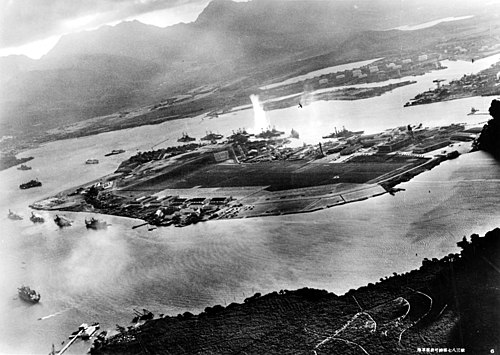
Pearl Harbor before the attack
70 years ago today the Japanese attacked the United States fleet at Pearl Harbor, plunging United States into World War II. President Obama said this in a proclamation yesterday:
On National Pearl Harbor Remembrance Day, we honor the more than 3,500 Americans killed or wounded during that deadly attack and pay tribute to the heroes whose courage ensured our Nation would recover from this vicious blow. Their tenacity helped define the Greatest Generation and their valor fortified all who served during World War II. As a Nation, we look to December 7, 1941, to draw strength from the example set by these patriots and to honor all who have sacrificed for our freedoms.
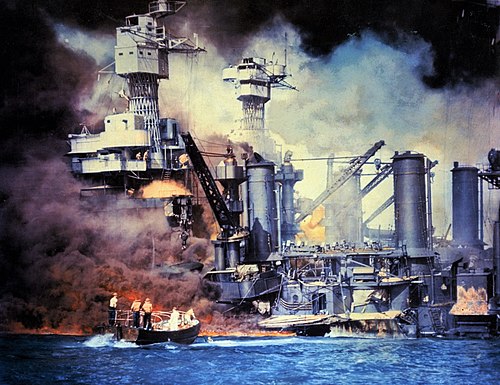
West Virginia sinking
The attack on Pearl Harbor was a major mistake for the Axis. I wrote this in a post about the Mistakes of World War II a few years ago:


Hitler’s policy before and during WW2 was “one at a time.” He would only attack one nation at a time, thus preventing other nations from banding together with them. In this way he was able to easily defeat nations that would have been much more difficult if they had been able to band together. This was what he did to the United States. Eventually he would have attacked them, but he did not want to declare war on them until he had defeated the British Empire and the Soviet Union. Since the US Constitution requires that the President get the Congress to declare war, President Roosevelt was not able to get the Congress to declare war on the Axis until they were actually attacked. Even though they were supposed to be neutral, the USA still helped the British massively by giving them huge amounts of munitions. Germany, however, just ignored this because they did not want to fight the United States until they were done with Britain and the Soviet Union. As Churchill said, “[Hitler] always dreaded the consequences of war with the United States, and insisted that German forces should avoid provocative action.”2

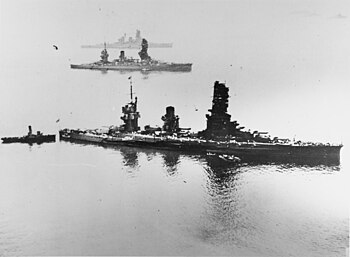
Japanese battleships

But then in 1941 Japan decided that the Axis was going to win the war, so they wanted to join on their side. Japan’s targets were the eastern holdings of Britain, the Netherlands and also the United States. Japan decided that it needed to strike the United States pacific fleet stationed in Pearl Harbor so that they would not be able to resist Japanese conquests. They wrongly thought that if they attacked Britain’s colonies in the east the American fleet would attack them. This would probably not have happened. Hitler disagreed with Japan’s decision to attack the US. He thought that they should first attack and capture the British and Dutch colonies, then attack the United States. “[Germany] urged the Japanese Government to strike without delay at Malaya and Singapore and not to bother about the United States. Hitler had already enough on his shoulders without drawing them in.”3 Winston Churchill, the leader of the English Empire said, “My deepest fear was that the Japanese would attack us or the Dutch, and that constitutional difficulties would prevent the United States from declaring war.”4

Compared to the United States, Japan was nothing. Bringing in Japan on their side and the United States on the other would hurt the Axis greatly. Japan was temporarily in a better position because they were ready for war and closer to where the battles would be fought, but ultimately their strength was not even close to America’s. Churchill said this before Japan attacked,


Viewing the vast, sombre scene as dispassionately as possible, it would seem a very hazardous adventure for the Japanese people to plunge quite needlessly into a world struggle in which they may well find themselves opposed in the Pacific by States whose populations comprise nearly three-quarters of the human race. If steel is the basic foundation of modern war, it would be rather dangerous for a Power like Japan, whose steel production is only about seven million tons a year, to provoke quite gratuitously a struggle with the United states, whose steel production is now about ninety millions; and this would take no account of the powerful contribution which the British Empire can make.5

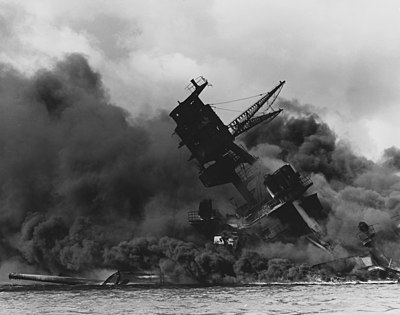
The Japanese did not listen to Hitler, and continued to prepare their attack on Pearl Harbor. They struck without warning on December 7th, 1941. Their attack was mostly successful. Four American battleships were sunk, the other four were disabled. Almost 200 aircraft were destroyed, and 150 more damaged. But even though America’s navy was severally damaged, it still had many more resources than the Japanese. After the attack Germany, Japan and Italy declared war on the United States; Britain declared war on Japan and the United States declared war on Japan, Germany and Italy.

Japanese Planes attack Pearl Harbor
When Churchill heard of the attack on Pearl Harbor he was actually glad. He wrote this later,
[N]ow at this very moment I knew the United States was in the war, up to the neck and in to the death. So we had won after all! … We had won the war. England would live; Britain would live; the Commonwealth of Nations and the Empire would live. How long the war would last or in what fashion it would end no man could tell, nor did I at this moment care. … Hitler’s fate was sealed. Mussolini’s fate was sealed. As for the Japanese, they would be ground to powder. All the rest was merely the proper application of overwhelming force. The British Empire, the Soviet Union, and now the United States, … were, according to my lights, twice or even thrice the force of their antagonists. No doubt it would take a long time. … [B]ut all this would be merely a passing phase. United we could subdue everybody else in the world. May disasters, immeasurable cost and tribulation lay ahead, but there was no more doubt about the end.6
Winston Churchill turned out to be correct. The Axis was not able to defeat the combined strength of the United States, Great Britain and the Soviet Union. Japan’s attack on the United States combined with Germany’s failed attack on Russia destroyed the Axis’ chances for final victory.

USS Arizona burns after the Japanese attack on Pearl Harbor 
2 Churchill, Winston. The Second World War. (London: Cassell & Co. Ltd 1948) volume 3, p. 126
3 Ibid, p. 1604 Ibid, p. 5345 Ibid, p. 528-5296 Ibid, p. 539-540

Civil War Tour - Day 6

On the last day of the tour we went to Federicksburg Battlefield. Our first stop was the Sunken Road/Stone Wall where Burnside's Troops charged fruitlessly against Longstreet, and then we went to Prospect Hill on Jackson's end of the line. There we had another reenactment. We finished off the tour with a closing lunch
Group Picture at Fredericksburg Battlefield
-
Charging Prospect Hill
Opening Fire
Closing Lunch

Plymouth Civil War Reenactment

On April 30th we drove to Plymouth, NC to film a Civil War Reenactment, which included a 3/8 scale replica of an ironclad ship, the C.S.S. Albemarle. In the original battle, the Confederate troops were trying to capture the Union forts, with the aid of the Albemarle. At first the land attack was failing because the troops were being bombarded from Union gunboats in the river. They sent the C.S.S. Albemarle down the river to drive off the gunboats and help to capture the forts. The Unions tried to trap the Albemarle by tying chains between the U.S.S. Miami and the U.S.S. Southfield. The Confederate ram turned and rammed the U.S.S. Southfield. The Southfield began to sink, and the Albemarle began to sink too because her bow stuck into the side of the Southfield. When the Southfield struck the bottom, providentially she rolled, which released the bow of the Albemarle, just as the water began pouring in. The Miami fired a point blank shell round at the Albemarle, but it bounced of her iron plating and exploded, killing the Miami's commander, Captain Charles Flusser. The Miami's crew attempted to board the Albemarle, but were driven back by musket fire. The Miami then untangled herself from the Southfield and escaped into the Albemarle Sound. With the river cleared of enemy ships, the Albemarle helped to bombard the forts,which were captured by the Confederates. Six months later, the Albemarle was sunk at night in her dock by a steam launch armed with a spar torpedo.

The C.S.S. Albemarle
A replica of one of the launches armed with torpedoes that sunk the C.S.S. Albemarle

The Albemarle firing one of her cannons

Union reenactors
Union Reenactors firing
Confederate reenactors firing
A Cannon
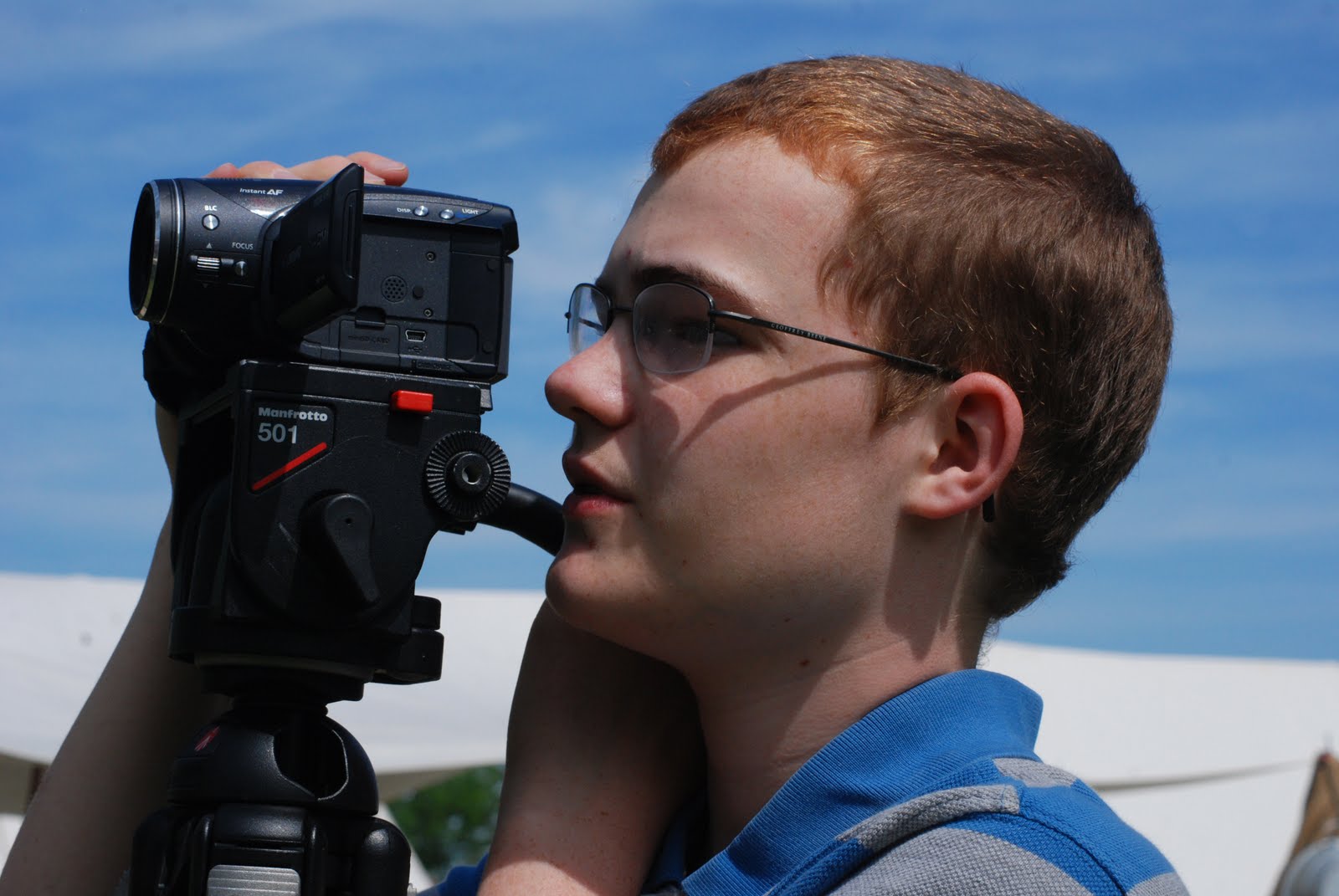
Joshua filming with our camera
A Confederate Battle flag in front of a tent