Showing posts with label Anniversary. Show all posts

70th Anniversary of the Attack on Pearl Harbor

Pearl Harbor before the attack
70 years ago today the Japanese attacked the United States fleet at Pearl Harbor, plunging United States into World War II. President Obama said this in a proclamation yesterday:
On National Pearl Harbor Remembrance Day, we honor the more than 3,500 Americans killed or wounded during that deadly attack and pay tribute to the heroes whose courage ensured our Nation would recover from this vicious blow. Their tenacity helped define the Greatest Generation and their valor fortified all who served during World War II. As a Nation, we look to December 7, 1941, to draw strength from the example set by these patriots and to honor all who have sacrificed for our freedoms.
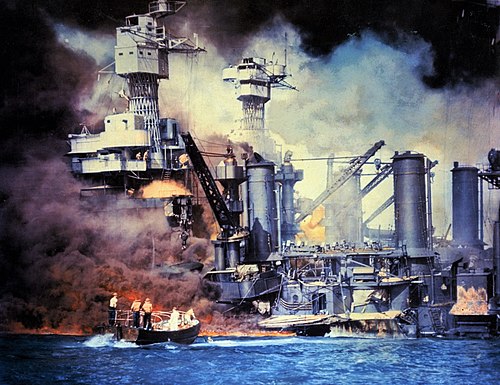
West Virginia sinking
The attack on Pearl Harbor was a major mistake for the Axis. I wrote this in a post about the Mistakes of World War II a few years ago:


Hitler’s policy before and during WW2 was “one at a time.” He would only attack one nation at a time, thus preventing other nations from banding together with them. In this way he was able to easily defeat nations that would have been much more difficult if they had been able to band together. This was what he did to the United States. Eventually he would have attacked them, but he did not want to declare war on them until he had defeated the British Empire and the Soviet Union. Since the US Constitution requires that the President get the Congress to declare war, President Roosevelt was not able to get the Congress to declare war on the Axis until they were actually attacked. Even though they were supposed to be neutral, the USA still helped the British massively by giving them huge amounts of munitions. Germany, however, just ignored this because they did not want to fight the United States until they were done with Britain and the Soviet Union. As Churchill said, “[Hitler] always dreaded the consequences of war with the United States, and insisted that German forces should avoid provocative action.”2
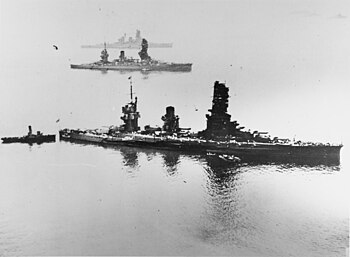
Japanese battleships

But then in 1941 Japan decided that the Axis was going to win the war, so they wanted to join on their side. Japan’s targets were the eastern holdings of Britain, the Netherlands and also the United States. Japan decided that it needed to strike the United States pacific fleet stationed in Pearl Harbor so that they would not be able to resist Japanese conquests. They wrongly thought that if they attacked Britain’s colonies in the east the American fleet would attack them. This would probably not have happened. Hitler disagreed with Japan’s decision to attack the US. He thought that they should first attack and capture the British and Dutch colonies, then attack the United States. “[Germany] urged the Japanese Government to strike without delay at Malaya and Singapore and not to bother about the United States. Hitler had already enough on his shoulders without drawing them in.”3 Winston Churchill, the leader of the English Empire said, “My deepest fear was that the Japanese would attack us or the Dutch, and that constitutional difficulties would prevent the United States from declaring war.”4

Compared to the United States, Japan was nothing. Bringing in Japan on their side and the United States on the other would hurt the Axis greatly. Japan was temporarily in a better position because they were ready for war and closer to where the battles would be fought, but ultimately their strength was not even close to America’s. Churchill said this before Japan attacked,


Viewing the vast, sombre scene as dispassionately as possible, it would seem a very hazardous adventure for the Japanese people to plunge quite needlessly into a world struggle in which they may well find themselves opposed in the Pacific by States whose populations comprise nearly three-quarters of the human race. If steel is the basic foundation of modern war, it would be rather dangerous for a Power like Japan, whose steel production is only about seven million tons a year, to provoke quite gratuitously a struggle with the United states, whose steel production is now about ninety millions; and this would take no account of the powerful contribution which the British Empire can make.5

The Japanese did not listen to Hitler, and continued to prepare their attack on Pearl Harbor. They struck without warning on December 7th, 1941. Their attack was mostly successful. Four American battleships were sunk, the other four were disabled. Almost 200 aircraft were destroyed, and 150 more damaged. But even though America’s navy was severally damaged, it still had many more resources than the Japanese. After the attack Germany, Japan and Italy declared war on the United States; Britain declared war on Japan and the United States declared war on Japan, Germany and Italy.
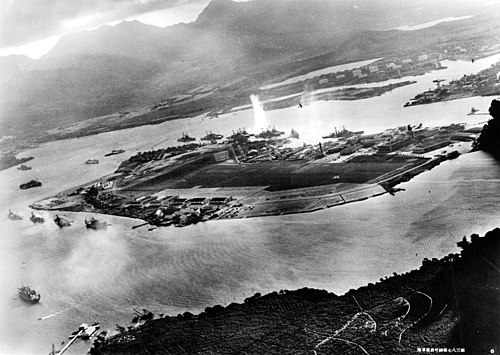
Japanese Planes attack Pearl Harbor
When Churchill heard of the attack on Pearl Harbor he was actually glad. He wrote this later,
[N]ow at this very moment I knew the United States was in the war, up to the neck and in to the death. So we had won after all! … We had won the war. England would live; Britain would live; the Commonwealth of Nations and the Empire would live. How long the war would last or in what fashion it would end no man could tell, nor did I at this moment care. … Hitler’s fate was sealed. Mussolini’s fate was sealed. As for the Japanese, they would be ground to powder. All the rest was merely the proper application of overwhelming force. The British Empire, the Soviet Union, and now the United States, … were, according to my lights, twice or even thrice the force of their antagonists. No doubt it would take a long time. … [B]ut all this would be merely a passing phase. United we could subdue everybody else in the world. May disasters, immeasurable cost and tribulation lay ahead, but there was no more doubt about the end.6
Winston Churchill turned out to be correct. The Axis was not able to defeat the combined strength of the United States, Great Britain and the Soviet Union. Japan’s attack on the United States combined with Germany’s failed attack on Russia destroyed the Axis’ chances for final victory.
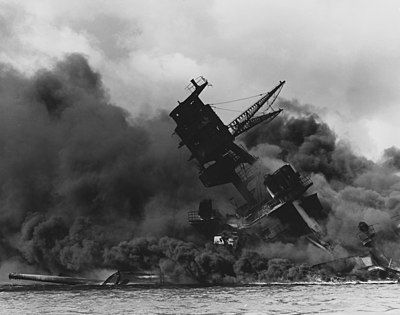
USS Arizona burns after the Japanese attack on Pearl Harbor 
Churchill, Winston. The Second World War. (London: Cassell & Co. Ltd 1948) volume 3, p. 126
3 Ibid, p. 1604 Ibid, p. 5345 Ibid, p. 528-5296 Ibid, p. 539-540

Battle of Cannae - 2226 Years Ago Today

Hannibal

2226 years ago today Hannibal defeated the Roman army almost twice his size at the Battle of Cannae. Hannibal commanded his men in the center of the line to fall back as the Romans attacked, which meant that eventually his army formed a semi-circle around the Roman forces. The Romans were defeated, and almost annihilated. The Romans are estimated to have lost 48,000 men, almost twice the number of Americans who were killed during the War for Independance.


Because of the incredible victory, Cannae has become synonymous with a complete and total victory. General Dwight D. Eisenhower, supreme commander of the Allied forces in WW2 said, "Every ground commander seeks the battle of annihilation; so far as conditions permit, he tries to duplicate in modern war the classic example of Cannae."

Learn more about the battle here.

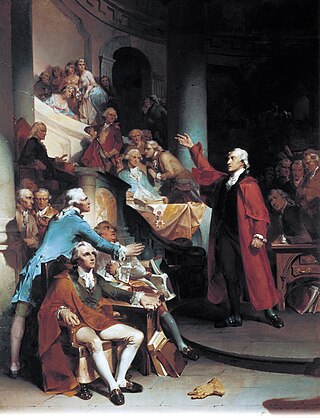
"Give me Liberty or Give me Death!" 235 years ago


235 years ago today, Patrick Henry gave his famous speech to the Virginia House of Burgesses which ended in "Give Me Liberty Or Give Me Death!" He was speaking in favor of the Virginia militia so that they could defend themselves from the tyranny of England. Here is what he said:


No man thinks more highly than I do of the patriotism, as well as abilities, of the very worthy gentlemen who have just addressed the House. But different men often see the same subject in different lights; and, therefore, I hope it will not be thought disrespectful to those gentlemen if, entertaining as I do opinions of a character very opposite to theirs, I shall speak forth my sentiments freely and without reserve. This is no time for ceremony. The question before the House is one of awful moment to this country. For my own part, I consider it as nothing less than a question of freedom or slavery; and in proportion to the magnitude of the subject ought to be the freedom of the debate. It is only in this way that we can hope to arrive at truth, and fulfill the great responsibility which we hold to God and our country. Should I keep back my opinions at such a time, through fear of giving offense, I should consider myself as guilty of treason towards my country, and of an act of disloyalty toward the Majesty of Heaven, which I revere above all earthly kings.

Mr. President, it is natural to man to indulge in the illusions of hope. We are apt to shut our eyes against a painful truth, and listen to the song of that siren till she transforms us into beasts. Is this the part of wise men, engaged in a great and arduous struggle for liberty? Are we disposed to be of the number of those who, having eyes, see not, and, having ears, hear not, the things which so nearly concern their temporal salvation? For my part, whatever anguish of spirit it may cost, I am willing to know the whole truth; to know the worst, and to provide for it.

I have but one lamp by which my feet are guided, and that is the lamp of experience. I know of no way of judging of the future but by the past. And judging by the past, I wish to know what there has been in the conduct of the British ministry for the last ten years to justify those hopes with which gentlemen have been pleased to solace themselves and the House. Is it that insidious smile with which our petition has been lately received? Trust it not, sir; it will prove a snare to your feet. Suffer not yourselves to be betrayed with a kiss. Ask yourselves how this gracious reception of our petition comports with those warlike preparations which cover our waters and darken our land. Are fleets and armies necessary to a work of love and reconciliation? Have we shown ourselves so unwilling to be reconciled that force must be called in to win back our love? Let us not deceive ourselves, sir. These are the implements of war and subjugation; the last arguments to which kings resort. I ask gentlemen, sir, what means this martial array, if its purpose be not to force us to submission? Can gentlemen assign any other possible motive for it? Has Great Britain any enemy, in this quarter of the world, to call for all this accumulation of navies and armies? No, sir, she has none. They are meant for us: they can be meant for no other. They are sent over to bind and rivet upon us those chains which the British ministry have been so long forging. And what have we to oppose to them? Shall we try argument? Sir, we have been trying that for the last ten years. Have we anything new to offer upon the subject? Nothing. We have held the subject up in every light of which it is capable; but it has been all in vain. Shall we resort to entreaty and humble supplication? What terms shall we find which have not been already exhausted? Let us not, I beseech you, sir, deceive ourselves longer. Sir, we have done everything that could be done to avert the storm which is now coming on. We have petitioned; we have remonstrated; we have supplicated; we have prostrated ourselves before the throne, and have implored its interposition to arrest the tyrannical hands of the ministry and Parliament. Our petitions have been slighted; our remonstrances have produced additional violence and insult; our supplications have been disregarded; and we have been spurned, with contempt, from the foot of the throne! In vain, after these things, may we indulge the fond hope of peace and reconciliation. There is no longer any room for hope. If we wish to be free—if we mean to preserve inviolate those inestimable privileges for which we have been so long contending—if we mean not basely to abandon the noble struggle in which we have been so long engaged, and which we have pledged ourselves never to abandon until the glorious object of our contest shall be obtained—we must fight! I repeat it, sir, we must fight! An appeal to arms and to the God of hosts is all that is left us!

They tell us, sir, that we are weak; unable to cope with so formidable an adversary. But when shall we be stronger? Will it be the next week, or the next year? Will it be when we are totally disarmed, and when a British guard shall be stationed in every house? Shall we gather strength by irresolution and inaction? Shall we acquire the means of effectual resistance by lying supinely on our backs and hugging the delusive phantom of hope, until our enemies shall have bound us hand and foot? Sir, we are not weak if we make a proper use of those means which the God of nature hath placed in our power. The millions of people, armed in the holy cause of liberty, and in such a country as that which we possess, are invincible by any force which our enemy can send against us. Besides, sir, we shall not fight our battles alone. There is a just God who presides over the destinies of nations, and who will raise up friends to fight our battles for us. The battle, sir, is not to the strong alone; it is to the vigilant, the active, the brave. Besides, sir, we have no election. If we were base enough to desire it, it is now too late to retire from the contest. There is no retreat but in submission and slavery! Our chains are forged! Their clanking may be heard on the plains of Boston! The war is inevitable—and let it come! I repeat it, sir, let it come.

It is in vain, sir, to extenuate the matter. Gentlemen may cry, Peace, Peace—but there is no peace. The war is actually begun! The next gale that sweeps from the north will bring to our ears the clash of resounding arms! Our brethren are already in the field! Why stand we here idle? What is it that gentlemen wish? What would they have? Is life so dear, or peace so sweet, as to be purchased at the price of chains and slavery? Forbid it, Almighty God! I know not what course others may take; but as for me, give me liberty or give me death!


St. John's Church in Richmond where Henry gave his speech

20 Years of Marriage

And the Lord God said, "It is not good that the man should be alone; I will make him an help meet for him." Genesis 2:18


On October 9 our family celebrated the beginning of our family, the wedding of Dan and Kendra on October 8, 1988. This was our 20th anniversary, a very significant milestone in our family. If you have been following our blog, you will remember Dan and I celebrated on our own with a trip to Bermuda in January of this year, so we wanted to include the children in the celebration when the actual day arrived.

We chose the 9th to celebrate because the 8th fell on a Wednesday, which is when our local church body gathers for prayer. It was very sweet to have our brothers and sisters in Christ pray for our marriage and blessings on our family on the actual anniversary. Then on Thursday evening, we took the family to the Melting Pot, a fondue restaurant, for a 4 course dinner. We started with cheese fondue for vegetables, apples, and bread; then salad; followed by chicken, beef, fish, and shrimp cooked in oil or broth; and finished with a white chocolate and dark chocolate fondue with rice crispy treats, strawberries, bananas, fudge brownies, and cheesecake. I can safely say nobody left hungry!

I am so thankful for the wonderful husband my Father in heaven provided for me. I do not deserve the way he washes me and the rest of the family in the word twice each day and prays for our family and patiently teaches many things to the children. I am so thankful for how he leads us in righteousness and his zeal for the Lord far surpasses mine. I am excited to see what the next 20 years has in store for our family.

"Therefore shall a man leave his father and mother, and shall cleave unto his wife: and they shall be one flesh." Genesis 2:24