The Mysterious Islands Premiere


Tuesday night we went to a premiere of The Mysterious Islands at the Carolina Theater in Durham. Over 800 people attended. It was very well done, and it is very interesting and exciting. The Mysterious Islands is the story of a team from Vision Forum that went to the Galapagos Islands off South America. They did this because the Galapagos is where Charles Darwin went and got the ideas for the theory of evolution. 2009 is Charles Darwin's 200th birthday, and the 150th anniversary of his book, On the Origin of Species where he first set out his theory of evolution. The movie shows how evolution is scientifically impossible through the animals of the Galapagos. It also shows that evolution led to the bloodiest century in the last millennium, through people like Margret Sanger and Adolf Hitler. Evolution caused all this bloodshed because people were attempting to speed up natural selection by killing off 'lesser' human races. The film was very well done, and we would recommend it. For more information, visit their website. For pictures see Mr. Phillip's post.


At the far end of the world, there exists a strange and unusual chain of islands, resting above vast tectonic plates.

This is the world of the Galápagos Archipelago, home to salt-spitting marine iguanas, flightless cormorants, and giant tortoises that can live to be more than 150 years of age. It is also the birthplace of Darwinism, for here in 1835, a young Charles Darwin began to formulate a theory which would turn the world upside down. More than a century and a half later, these mysterious islands remain at the center of a controversy that has shaped the way modern men perceive science, religion, and life itself. The unique ingredients found on the Galápagos have led many of Darwin’s followers to describe it as Darwin’s Eden — a “laboratory of evolution.”

Now, for the 200th anniversary of Darwin’s birth and the 150th of his seminal work, On the Origin of Species, Doug Phillips leads a team of Christian scientists and investigators to this “ground zero” in the war of the worldviews. Seen through the eyes of 16-year-old Joshua Phillips, who joins his father and noted researchers like Dr.John Morris of the Institute for Creation Research, The Mysterious Islands is the story of one boy’s search for answers to the great controversy of the modern world. It is a refreshing father-and-son adventure that combines cinematically breathtaking footage with high adventure. The quest: to determine whether the Galápagos Islands are a laboratory of evolution, or a testimony to creation.

This beautiful, ninety-minute documentary takes viewers deep beneath the ocean waves, among hundreds of white-tip sharks, into volcanic craters with giant lizards, and to the unusual habitat of the Blue-footed booby. Featuring the only team of Creationists and Christian scientists to shoot a documentary on the Galápagos in 2009 — Darwin’s anniversary year — the film brings a fresh perspective on the Theory of Evolution and presents stunning cinematography of one of the most desolate and fascinating locations in the world.


For more information on The Mysterious Islands, visit their website.

Reformation Celebration Dinner

On Friday October 31 our church had a dinner celebrating the reformation at Forks Cafeteria, in Wake Forest. We ate dinner and then five of the young men at our church talked about the five Solas of the Reformation, which are: Sola Scriptura, which means by Scripture alone, Solo Christo, which means by Christ alone, Soli Deo Gloria, which means Glory to God alone, Sola Fide,which means by Faith alone, and Sola Gratia, which means by Grace alone. After one of them talked, Mr. Brown led us in a song about the Sola, and then Daddy talked about how it effects us today. After that we had a time where the people could share what they were thankful for, and then people fellowshipped until it was time to leave.

One way that we have benefited from the reformation is that we can have assurance of our salvation by the gift of faith, and not live in superstition and fear like the Roman Catholics. We can be thankful that we do not have to rely on our good works for salvation, because we would never be sure we had done enough. Daddy also said we have light bulbs and electricity today because of the Reformation.


Lexington and Concord: Who Won?

by Stephen Horn based on Paul Revere’s Ride by David Hackett Fischer

Paul Revere


The Battle of Lexington and Concord was the first battle fought between the Militia and the Regulars in the First War for American Independence. The Regulars were commanded by Francis Smith and were on a mission to destroy the military stores in Concord, and also to catch Sam Adams and John Hancock. The American spies in Boston found out about this and sent out messengers to tell the militia to be ready. There were great quantities of military stores at Lexington and Concord, which the Americans needed to resist the British. They also wanted to catch Sam Adams and John Hancock who were two leaders of the War for American Independence. The Regulars lost because they failed to accomplish their mission, they were driven back, and they had more casualties.

The first reason the Regulars lost that we will discuss is that they did not fulfill their mission. The main reason for this is that although it was a top secret operation, the word of it got out, and most of the military stores had been moved. Sam Adams and John Hancock had already left from there, but they had not left for long when the British came to Lexington. After having routed the Lexington militia, they forced one of the residents to tell where a few brass cannons were buried, which the Americans had not been able to remove. They burned the wooden parts of these, along with a few other military stores. They had expected to be able to destroy more than this. This fire spread to some of the buildings in the town, which both the towns people and the Regulars soldiers were trying to put out. This and some other incidents were strange, and they showed that they still considered themselves the same people. This fire had the effect of making the Militia in Concord come out against them, as the Militia thought the Regulars were burning the town.

Concord Bridge


The Regulars had driven back the few militiamen at Lexington, but the Militia who had gathered at Concord drove the Regulars back. They were stationed at a bridge and commanded to hold it. When the Regulars saw the Militia advancing, they tried to pull up the planks on the bridge, which maddened the militia who were from around there. The Regulars were commanded to form into street formation, which was designed to concentrate the fire of a large number of men into a small area. They got confused and disorganized while getting into this formation. Only the front ranks could fire, but they did not show their usual discipline. They only fired a few ragged volleys, which were aimed high and did not do much damage. The militia’s volleys on the other hand were aimed carefully, and took much effect. The Regulars were trained to fire in volleys in front of them, and not at specific targets. The militia were mostly men who had to hunt for their food, so they were good shots, and they fired at individual targets which brought better results. In the first volley from the Militia at Concord four of the eight Regular officers were killed. The Militia drove the Regulars out of the town. The Militia were reinforced by more Militia from other parts, and they ambushed the Regulars wherever they could as they retreated. A few of these traps were sprung too soon, but many of them were fatal to the Regulars and disheartened them. The Militia decided on a plan to harass them where there was a circle of men around the front of the column who would fire, and then retreat, load and fire again, and keep repeating. This plan worked well. Many of the Regulars were thinking of surrendering, as one Lieutenant Barker of the Regulars said, “We must have laid down our arms, or been picked off by the rebels at their pleasure.”1 When they came to Lexington Green they found a brigade of Reinforcements waiting for them there, and also a cannon. This cannon did not have many rounds, since an artillery wagon which was sent for had been ambushed and captured by some men who were too old for the Militia. The British finally made it back to Boston.


Another reason why the British lost was because they suffered more casualties. The total of the men killed wounded or missing was 300 for the Regulars, but only 93 for the Militia. The reasons for this were mainly that they only fired ragged volleys, and never altogether, and also what was mentioned previously about the militia being better shots. The Regulars had left Boston with 700 men. Only 300 of them had deployed to drive off 77 militia who had gathered at Lexington. At Concord, only 100 of them were at the bridge, when they were driven back by the 400 militia. All of the casualties were not from these engagements though, many of them were from ambushes on the march back. By the end of the day, there were 3,800 Militia, and 1,500 Regulars. The reinforcements for the Regulars might of changed the tide of the battle, if they would have come sooner, but they still saved the rest of the British force.


The British lost because they did not fulfill their mission, they were driven back, and they suffered more casualties. This battle showed that the British troops were not invincible, and they could be beaten by the American militia. This was the first battle of the war, but it had been clear that there was going to be a war before that. The battles of Lexington and Concord did not start the war. The British returned defeated, and with their mission unaccomplished. The Regulars had to be reinforced, or they would have been destroyed. The British might have retreated with fewer casualties if they would have been able to hold the militia back at the bridge until the reinforcement Brigade came up.

1 David Hackett Fischer, Paul Revere’s Ride (New York: Oxford University Press, 1994) p. 232

The Mysterious Islands Premiere


Our church is hosting a premiere of the Mysterious Islands on November 17th. You can see the trailer below:


Valley Tour CDs Now Available!

The MP3 CD from the Valley Tour is now available for sale! To purchase it, please click here.

Join Dan and Joshua Horn in the study of one of the most important campaigns of the American Civil War: Stonewall Jackson's Shenandoah Valley Campaign. Learn about the battles, strategy, important men and the causes of the Civil War.

Reforming the Church - Family Integrated Church Life Conference

We went to a conference done by NCFIC last Saturday. First there was a message by Scott Brown on "The Implications of the Sufficiency of Scripture." This talk was about how we should apply the sufficiency of scripture. Then after that there was a talk by my dad on "Dealing with a Culture at War Against Church and Family." This was about how we need to resist the influences of the culture. Then Mr. Tsantles gave a talk about "Establishing Biblical Church Life." He talked about his experience of coming to a family integrated church. Then Mr. Churchill gave a talk on "The Role of Fathers in Church and Family Life." This talk was about what a father needs to do.

After that we ate lunch. After lunch Steve Breagy gave a talk on "The Discipleship of Children." This talk is about how to disciple your children in the family and the church. Then my dad did a talk on "Applying the Regulative Principle of Worship." In this talk he went through our church service, and told how each thing our church does is from the Bible. Then Mr. Brown finished up by doing a talk on "The Family's Relationship to the Church." This talk was about how the church relates to the family and how the family relates to the church. I enjoyed the conference very much. I did not have a favorite because I liked them all. We forgot to bring the camera, so we do not have any pictures from it.

Character Qualtities of Lucy Buck

Rachel in front of Bel Air, Lucy Buck's House

During the Civil War, Lucy Buck lived in Front Royal, VA. She kept a journal, which contains a good description of the battle of Front Royal. Since there are few examples of godly characters today,we should look at what some of her character traits were, and also the biblical basis for those traits. We will discuss her love of family, bravery, and trust in God.
One of her character traits is her love of her family. This is a biblical trait to have, because the Bible says in John 13:35: "By this shall all men know that ye are my disciples, if ye have love one to another."1 One example of that in her journal is how much she enjoyed the letters from her brothers while they were fighting in the war, like when she wrote,
We were sitting by the candle in Grandma's room tonight when Father came from the office bringing a paper and two letters ... I was almost beside myself with joy at their arrival particularly when upon reading Irvie's we learned that he had been promoted to the rank of captain ... Dear boy! I hate the idea of his being exposed to the dangers conseqent upon active service and am so sorry he and Alvin will be seperated, but he has one kind Protector as Omnipotent to save on the field of battle as in the quiet of home, and as Alvin has gone onto Bragg's army ... I sincerely hope he may succeed for he richly deserves it to, I'm sure.2
This also shows her trust in the sovreignty of God as well as her love for her family. We see another example of this is when she wrote,
Father came in this evening bringing a letter from dear Irvie ... Poor fellow, he was in the late dreadful battle – how glad I am thatwe were unconscious of it till it was all over. He writes very despondingly and seems almost to wish himself back with Alvin whom he says has returned thither. He says our friends all escaped unhurt and almost as if by a miracle. The battle must have been much more deadly than we had thought for. Must write to him soon.3
This show that she was not only concerned for the safety of her brother, but also for her friends. From these examples we see how important her family was to her, and her love for her brother.
Another character trait we wll discuss is her bravery. God frequently reminds us in the Bible not to fear because he is our protector, such as in Deuteronomy 31:6:
Be strong and of a good courage, fear not, nor be afraid of them: for the LORD thy God, he it is that doth go with thee; he will not fail thee, nor forsake thee.4
Here we see why it is good to be brave and have courage. An example of Lucy Buck's courage and love of strangers is when after the battle of Front Royal happened she wrote,
We descended all of us to the basement for protection ... The house was exposed to a cross fire and we were all really in much more danger than we were at the time aware of – at any rate I could not bear the idea of being entombed ingloriously in the cellar while our deliverers were gallantly endangering their lives in our defense – it was not to be thought of for an instant – I must witness if not assist in the struggle. So Nellie and I went on the porch with a pitcher of water with the contents of which we refreshed our soldiers as they would ever and anon stop in their chase weary and thirsty ... I did not feel the least fear as the missiles of death screamed and shrieked around – the sound was rather pleasantly exhilarating and I watched the discharges with positive enjoyment – did not for one instant doubt our success in driving the varmints out.5
Here we see that she was not afraid even in times of great danger, but was ready to comfort the soldiers as much as she could.
The last trait we will discuss is her trust in God. This is a good character trait because God is our protector and defense, so we should trust in him like the Bible says in Psalms 5:11:
But let all those that put their trust in thee rejoice: let them ever shout for joy, because thou defendest them: let them also that love thy name be joyful in thee. 6
We see how Lucy Buck exhibits this when she said,
Our army seemed to have melted away or were within the coils of a mighty serpent that must soon crush them – oh it was all disheartening enough! – and I have wondered how we ever struggled through such depths of gloom. But the day I trust has gone on our midnight, how it has all so changed I do not understand, but surely God has been with us. 'Tis he that arrested the tide of Union successes and nerved and inspired our men to such deeds of daring heroism. Oh! – may we never forget to whom we owe it all and weakly give to erring impotent man the need of thanksgiving and praise that belongs but to the Maker!7
Here we see that she is thankful for what God has done, and realizes that it could not have been done without his help. This is clearly an example of her belief in the sovreignty of God.
We have seen how Lucy Buck exhibits three specific charachter qualities which are love of family, bravery, and trust in God, through her words penned in Sad Earth, Sweet Heaven. These are important qualities to have because of their biblical basis, which we have also discussed. Young ladies should try to emmulate these qualities in their lives today.


1 John 13:35, KJV
2 Buck, Lucy Rebecca Sad Earth, Sweet Heaven (Buck Publishing Company, Birmingham, Alabama: 1993) p. 158-159
3 Ibid p. 171
4 Deuteronomy 31:6 KJV
5 Sad Earth Sweet Heaven, p. 79
6 Psalms 5:11 KJV
7 Sad Earth Sweet Heaven, p. 138

John Brown Video


To view in HD click here.

John Brown's Raid on Harper's Ferry


Today is the 150th anniversary of John Brown's Raid on Harper's Ferry, which in many ways helped caused the Civil War. This week people are celebrating how he was a martyr who died to free the slaves. This is actually not true. Brown was a very evil man. Before the raid on Harper's Ferry, he stole what would now be about a million dollars, but he was so persuasive that he convinced the man he stole it from later to lend him money. He was also a lunatic. At one point while he was in Kansas, he took a group of people out during the night and went to all the cabins of the area and murdered in cold blood everyone who was for slavery. Also it just so happened that after that murder Brown and his sons had nice new saddles. There is lost more to say, but we don't have space here to tell all of it. My father did a great talk on our trip to the Shenandoah Valley last month, and sometime we will have them available for sale.

John Brown was encouraged to raid Harper's Ferry by the "Secret Six", a group of six prominent Bostonians who were abolitionists and Unitarians. The raid was not a very smart idea. He had 21 men, 16 white and 5 black. He chose Harper's Ferry because at that time it was a large arsenal and weapon factory where about 100,000 guns were stored. His plan was to get the weapons and leave, and then he excepted the slaves to flock to him from their plantations. First of all, he did not have any way to transport the 100,000 weapons. Secondly, if the slaves did come to him, it would just be a mob. Brown had never commanded more than 30 men, and the slaves probably did not know how to use the weapons. It would have been a bigger disaster than it was.

Inside the engine house


As to the actual raid, it went well to start with. He captured the arsenal, but then he made a big mistake by not leaving. The militia of the area gathered and attacked him. He ended up trapped in the fire engine house with only four men. The next day Col. Robert E. Lee and Lt. Jeb Stuart came up from Washington with 88 marines, and stormed the engine house at the point of the bayonet and captured it. John Brown and his men were tried for murder and slave insurrection and were convicted. They were hung on December 2nd. There is much interesting history about the raid which I studied before we went to the Shenandoah Valley.

It was very neat to be able to go to the site of the raid in September with the people from our church and see what actually happened there. Much of the town is the same as it was then, and it is a very neat location. Here are a few pictures.


Us in front of "John Brown's Fort"

The Bridge which Brown used to get to Harper's Ferry


The town


The original location of John Brown's Fort (it was moved)


The Potomac River. Harper's Ferry is here the Potomac and Shenandoah rivers meet

We are planning to produce a documentary on Jackson's Valley Campaign of 1862 from the video of the tour, but we will see if it happens.

Blogging the Reformers: Queen Margaret de Navarre

The Book in her hand is probably a Bible

Margaret was born on April 11th, 1492. Her brother was Francis I, King of France. In 1525 she married Henry, King of Navarre. Navarre was a small country between Spain and France which is now part of France. She had influence over her brother, and she tried to move him toward the Reformation. She also defended and protected many Reformers. Margaret desired to reform the church, but she did not want to break with Rome. She was not perfect, but she was a Christian and God used her in the Reformation of France. She died in France on December 21st, 1549. D'Aubigne says of her, “Such was Margaret in the midst of the court; the goodness of the heart, the purity of her life, and the abundance of her works spoke eloquently to those about her of the beauty of Christ.” 1

1 J. H. Merle D'Aubigne, History of the Reformation in Europe in the Time of Calvin (Harrisonburg, VA: Sprinkle Publications, 2000) volume 1, book II, p. 419

Blogging the Reformers: William Farel


William Farel was born in 1489 in France. At the age of 20 he entered the Sorbonne in Paris. He became friends with Jacques Lefèvre, a Christian who desired to reform the church. He was saved in 1519, but within a year was forced to flee Paris. He preached at various cities, and then came to Geneva in 1532. He was very instrumental in the Reformation in Geneva, and many people were saved through his preaching. In 1536 he convinced John Calvin to stay and help him in Geneva rather than going into seclusion for study. He said, “May God curse your repose ! may God curse your studies, if in such a great necessity as ours you withdraw and refuse to give us help and support!”1 He was a very fiery, powerful and eloquent preacher. D'Aubigne said of him:

“His desire to enlighten his contemporaries was intense, his heart intrepid, his zeal indefatigable, and his ambition for God's glory without bounds. ... He was not a great writer ... but when he spoke he was almost without an equal. ... His much eloquence, his lively apostrophes, his bold remonstrances, his noble images, his action frank, expressive, and sometimes threatening, his voice that was often like thunder, and his fervent prayers, carried away his hearers.”2


1 J. H. Merle D'Aubigne, History of the Reformation in Europe in the Time of Calvin (Harrisonburg, VA: Sprinkle Publications, 2000) volume 3, book ix, p. 461

2 Ibid, volume 2, book v, p. 199-200

Blogging the Reformers: John Tausen

John Tausen was born in Denmark 1494. His father was a poor farmer, and John assisted him in his youth. He desired to study, and through hard work he was able to become a monk at the age of 19. He realized the errors of the Roman Catholic church through his study. In 1517 he was sent out to go attend the university of his choice, except Wittenberg where Luther was. Eventually he went to Wittenberg anyway. He was saved there and returned to Denmark in 1521.
Tausen was a gifted preacher, and preached the gospel to the monks and the people around him. At one time he was imprisoned and he preached to the people through the window of his prison cell. King Fredrick appointed him as the preacher in Copenhagen, the capital. There he preached, and many people were converted. He defended the Reformation ably in debates with the Catholics. After the death of Fredrick he was sentenced to death, but the people rioted and he was pardoned. Tausen was the leader of the Reformation in Denmark. He died in 1561.

Blogging the Reformers: King Fredrick I of Denmark


Fredrick was born on October 7th, 1451. He was a member of the House of Oldenburg. At that time the Scandinavians in the countries of Denmark, Sweden and Norway were under the same king. After Fredrick’s father, Christian I, died, Christian II, Fredrick's nephew became king. Christian II was not a Christian, though at times he pretended to be Protestant, he was just being a hypocrite. He was a very cruel king, and in 1523 he was forced to abdicate the throne by the nobles. His uncle Fredrick succeeded him. When Fredrick was younger he was a priest, but he realized that the Catholic theology was wrong and was converted to the Reformation. He was kind, tranquil, peaceful and prudent, and was not cruel like his nephew Christian. When he accepted the throne he had to promise that he would protect the Roman Church from heretics. He promised, but he did not arrest the Protestants, and allowed them to preach. With his encouragement and support, the Reformation prospered and many were converted through the preaching of John Tausen and others. Fredrick died on April 10th, 1533 at the age of sixty-two after reigning ten years. With his help the reformation was in the ascendancy in Scandinavia, even though the bishops still preserved their power.

How Theodore Roosevelt became Successful through Writing The Naval War of 1812

Theodore Roosevelt

Theodore Roosevelt began writing The Naval War of 1812 while he was at Harvard in 1879. It was his first book, and he published it in 1881 after much study, just after being elected to the New York State Assembly. He was 23 years old at the time. This book quickly became the authoritative work on the subject, and Roosevelt became recognized as a historian. The writing of this book made people think he would be a good historian and eventually an elected official. There were several reasons for this, and today we will look at his unbiasedness, diligence and fame.

The Naval War of 1812 was the first relatively unbiased book on that subject. Previous accounts had been written, but they had been biased to their particular sides. Roosevelt says,
“It is to be regretted that most of the histories written on the subject, on either side of the Atlantic, should be of the 'hurrah' order of literature, with no attempt whatever to get at the truth, but merely to explain away the defeats or immensely exaggerate the victories suffered or gained by their own side.”1
Throughout the book Roosevelt shows how the previous accounts twist, ignore or intentionally change facts. He says that it does no good to tell history that is not true. One of the most important things we get from studying history is knowing and therefore being able to avoid the faults of those who came before. If we skip the mistakes of our particular side, then we defeat the purpose for studying history at all. It is important that all historians be as relatively unbiased as possible, and Roosevelt fits that criteria. It is also important for people who are running for office to be unbiased, because otherwise they would not judge justly between different persons or ideas. Being unbiased is one of the most important qualifications for an elected official.

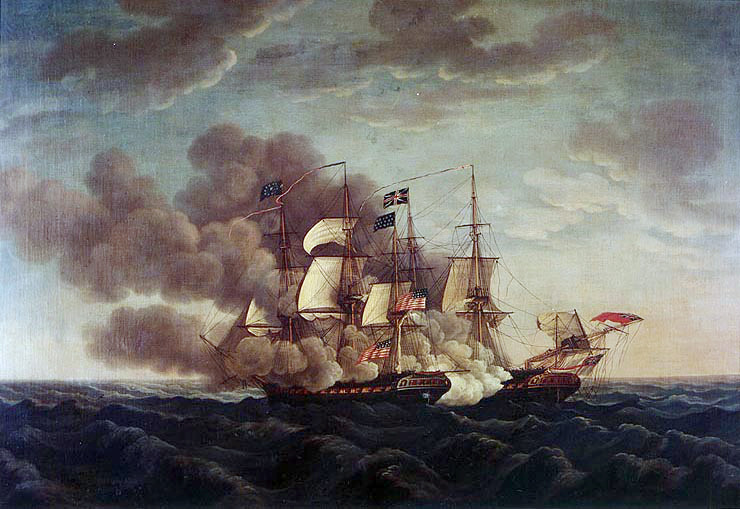
USS. Constitution vs. HMS. Guerriere


As Roosevelt wrote The Naval War of 1812, he carefully researched all the previous accounts of the war. He also delved into the archives at Washington and searched through the ships' logs and letters of the captains. He did this so that he would be as sure as possible that his story was correct. It is important that history books be well researched so that they will correctly portray what happened. Roosevelt did this, and though some of his details have been proved wrong, he still was very accurate. Roosevelt’s method of analyzing the battles has influenced all works on naval history that came after. He compared the different strengths of ships and fleets to help decide whether the loser was defeated by greater strength, or their own cowardice or lack of training. He carefully studied the naval tactics, and made tables of the relative strengths. Roosevelt's book effected later scholars through his carefully researched facts and conclusions, and also through the methods that he used. One historian said, "Roosevelt’s study of the War of 1812 influenced all subsequent scholarship on the naval aspects of the War of 1812 and continues to be reprinted. More than a classic, it remains, after 120 years, a standard study of the war."2 Diligence and accuracy are important characteristics for elected officials because it is necessary that they work hard in their positions, and make sure that they know everything possible on certain issues.

Battle of Lake Erie


The third quality that we will consider is the prestige and fame that this book gave him. We have already seen how this book was so influential to other historians. By writing this book Roosevelt became a famous historian. When someone is running for political office it is very important that people recognize their name, and know something about them. Thereby they would be able to decide better whether or not to vote for them. By writing The Naval War of 1812, Roosevelt made himself more famous, and therefore advanced his chances to get elected.
After writing The Naval War of 1812, Theodore Roosevelt continued throughout his life to write history. He was also a soldier, rancher, statesman, and, most notably, President of the United States. His famous books on history, including The Naval War of 1812, helped him in politics. Besides giving him much of his income, they showed people some of the qualities that he had, which we have mentioned here, such as unbiasedness and diligence. Roosevelt's writing of The Naval War of 1812, greatly influenced both his political career, and future historical works.


1. Roosevelt, Theodore The Naval War of 1812 (New York: The Modern Library, 1999) p. 205

2. Crawford, Michael J.. "The Lasting Influence of Theodore Roosevelt’s 'Naval War of 1812'". ijnhonline.org. International Journal of Naval History. http://www.ijnhonline.org/volume1_number1_Apr02/article_crawford_roosevelt_1812.doc.htm Retrieved 2009-08-11.

Treasure Hunt Winners


On the Tour we did a treasure hunt. It was a lot of fun to put together, and we hope everyone had fun doing it. To do the treasure hunt you had to get information from the talks, translate a lot of Morse code, do a Caesar Cipher and more.

First Place - Brittany Muse


Second Place - Nathaniel Sides


Third Place - Watson Family

Video of Marching at McDowell Battlefield

Here is a video of us marching at McDowell on the tour.

Marching at McDowell Battlefield from Joshua Horn on Vimeo.

The Valley Campaign Tour - Day 6

The next day, everybody went back home. On our way back, we stopped at Pamplin Park outside of Petersburg, VA, which is a museum, and some breastworks which they made to look how the real ones would have. The battle that was fought there is called the Battle of the Breakthrough, and although it was important, and caused Lee to retreat and led to the surrender, it is not well known because the general who commanded at a large skirmish became the commander of the whole army, and he had friends in high places who said that what he did was the important thing, not what was actually the important one. It was a good museum, and in all it was very interesting.

Joshua, Rachel, and behind a statue in front of the museam

A replica of a 3 inch rifled cannon

Looking through the hole in the breastworks for the cannon

A reproduction of what a winter hut would look like

The outside of the original entrenchments

The Valley Campaign Tour - Day 5

On the fifth day, which was the last day of our tour, we started out by going to the Turner Ashby Monument, where he was shot. Daddy did a talk on Turner Ashby's life and his service in the war.

Then we went to Washington & Lee Chapel, which was where Lee was president of the university after the war, and he is buried under the chapel. Then we went to the Stonewall Jackson House in Lexington, which was where Jackson and Anna lived in Lexington while he taught at the Virginia Military Institute. It was the only house he ever owned.

Then we went to VMI, and a cadet led a tour of VMI and told us about the buildings and such. During lunch at the Memorial Gardens in VMI, Daddy did a talk on State's Rights. If you ever go there, beware of a replica of Michelangelo's David, which they told us about on the tour. Then we went to Jackson's Grave in Lexington, and Daddy talked about Jackson's character there. Then we went to the closing dinner, where Joshua did a talk on the rest of the Civil War, and Daddy talked about the consequences of the Civil War.

Stonewall Jackson's grave marker

Four Cannons the cadets used for artillery practice when Jackson taught there. They were name Matthew, Mark, Luke, and John (Jackson's statue is in the background)

A statue of George Washington

The Cadet that did our tour at VMI

Daddy talking at the Ashby Monument

The Valley Campaign Tour - Day 4

On the fourth day, we started by going to the New Market Battlefield. This was not in Jackson's 1862 Valley campaign, but we went there because the VMI cadets fought there and the museum was highly recommended. Daddy did a talk on Economics Before the Civil War before our tour. Then the tour guide came out, and marched us to the battlefield, where she told us about the battle.

This battlefield was one of the nicest we went to, mostly because a couple hundred of the VMI cadets fought there, and they turned the tide of the battle, and now VMI takes care of and owns the battlefield. The battle was between General John Breckenridge for the Confederates, and General Franz Sigel for the Unions. The middle of the Confederates was caving in, so they put in the cadets to sure it up. The Unions had about twice as many men as the Confederates, but by Sigel's poor handling of them, only half of them were fighting the Confederates.

He got excited, and since he was a German immigrant, he started to give his commands in German. He gave the command to charge, but because of this, only one regiment got the order to charge, and so they charged, and the rest of the regiments followed in a broken and disorderly manner. Breckenridge ordered his men to charge too, and they advanced in a steady organized line, and drove the Unions away.

Then we went to Prospect Hill Cemetery in Front Royal, where we could see all around us, and Joshua described the battle of Front Royal. He also did a talk on the battle of Winchester, which was between Front Royal and the next battle, where Jackson routed what was left of Bank's army at Winchester. We also stopped at Bel Aire, which was Lucy Buck's home, since Rachel read some excerpts from her diary on the way to Front Royal and Daddy talked about some of her character qualities, like courage and hospitality.

Then we went to Cross Keys, which was just a field, most of which was being farmed and you could not go in it. There, Joshua gave a talk on the battle, and Daddy gave a talk on Richard Ewell. Then we went to the Frank Kemper House, which is where Turner Ashby's body was viewed after his death, and it was near Jackson's Headquarters while his army was in Port Republic.

The tour guide also talked about a Union Calvary raid there just before the battle of Port Republic and they almost captured Stonewall Jackson, and probably would have if he had not been in his blue US Army uniform, which made them think he was a federal officer.

After that, we went to a hill called the "Coaling" (because they burned wood to make charcoal there), which was important in the battle of Port Republic. The Union had some cannons up there, and once the Confederates took it after a few charges the Union retreated. It was the last battle in Jackson's Valley Campaign of 1862. Afterwards, Lee called him to Richmond to help participate in the battle of the Seven Days.

An original sword in the Frank Kemper House

Daddy talking at the Coaling

Joshua talking at Prospect Hill Cemetery

A barn which was subjected to crossfire at the battle of New Market

My Replica Pistol

ENN: The Craters of Normandy

Vision Forum posted the Everyday News report we did while we were in Europe.
from here.

ENN: The Craters of Normandy from Joshua Horn on Vimeo.


The quality is not the best because we did not have much time while we were there.