Showing posts with label book report. Show all posts

Scott vs Amundsen: A Study in Polar Exploration

Two of the greatest expeditions in the history of Polar exploration was the race between Amundsen and Scott to reach the South Pole, 100 years ago during the winter of 1911/1912. Although there were similarities between these expeditions, there were also many fundamental differences.
Captain Robert Falcon Scott
Captain Robert Falcon Scott was an English navy officer and explorer. His first expedition was on the Discovery, which included setting a new point of the Farthest South ever reached by man. He returned on the Terra Nova in an attempt to reach the South Pole.
Roald Amundsen
Roald Amundsen was an explorer from Norway. While growing up he desired to become an explorer, and after participating in the first expedition to spend the winter in Antarctica, he led his own expedition to be the first to sail the Northwest Passage. While he was planning a journey to sail over the North Pole, the news was announced that two other explorers claimed to have already reached it. So he secretly changed his plans and sailed south to race Scott to be the first to reach the South Pole.

Similarities

1. Trust in God
Although it appears that neither Scott or Amundsen were Christians, both frequently mentioned in their writings the workings of Providence. Scott's men wrote saying they were willing to die if it was their time. Edward Wilson wrote, “[I]f the end comes to me here or hereabout … All will be as it is meant to be.” Henry Bowers wrote this to his mother just before dying next to Scott, “my trust is still in Him and in the abounding Grace of my Lord and Savior whom you brought me to trust in...” There is a saying that there are no atheists in foxholes, and there were no atheists in Antarctica either. When men are constantly faced with danger and death, they recognize their dependence on God, even if they do not follow Him fully.

2. Courage
Both men were very courageous, although in different ways. It took courage to even venture into Antarctica, far from hope of relief in case anything went wrong. When faced with hard decisions along his journey, Amundsen boldly took the hard course, not faltering or wasting time attempting to find an easier course. Scott, on his fateful journey, set an example of courage that the English would look up to for years. In one of his last letters he wrote, “We are showing that Englishmen can still die with a bold spirit, fighting it out to the end... I think this makes an example for Englishmen of the future.”
The Terra Nova

Differences

1. Motives
Amundsen explored because he loved exploration, but Scott explored because he wanted promotion. As a young man Amundsen heard of the stories of the explorers like Sir John Franklin and Fridtjof Nansen, and wished to follow their footsteps and become an explorer. Scott, a mediocre navy officer, heard of the planning of the Discovery expedition and saw it as a way to gain promotion and riches.
Nansen, Amundsen's hero and supporter
2. Preparation
The different motives of these two men resulted in vastly different methods of preparation. Amundsen gradually worked up to leading an expedition over a decade, first taking long ski trips in his native country of Norway, working on whaling ships which navigate the icy northern seas, and finally participating in someone else's expedition. Scott, on the other hand, was appointed directly to command a large expedition, and only spent a few weeks hearing about what Amundsen had learned first hand for years. On his Discovery expedition Scott admitted this, saying, "Our ignorance was deplorable."

Additionally, Amundsen spent many hours reading the works of previous explorers and analyzing everything to see what he could learn. Scott did not learn from his own experiences, much less those of others. He kept repeating the same mistakes over and over again. On previous journeys he had suffered from not bringing enough provisions, but he made the same mistake in this trip. In his ill fated expedition to reach the pole, he basically followed in the path of Shackleton, but he did not even bring a copy of Shackleton's book. He had to borrow one from another member of the expedition. Amundsen, on the other hand brought along a large polar library to study.

Scott's expedition to the South Pole had scientific aims as well, while Amundsen really did not, but this in no way excuses a lack of preparation.
One of Amundsen's dog sled teams
3. Technology
One of the biggest differences in Scott and Amundsen's journeys was the method of travel they used. Amundsen used dogsleds, while Scott used man hauling. Scott was biased against dog sleds because on the Discovery expedition they were a failure because no one knew how to use them. In the end, Scott did recognize that dog sleds were much quicker and more efficient, but he objected to them because at times the dogs had to be killed. So instead of killing a few dogs, he ended up killing himself because he could not reach his supply depots. He tried horses, but they were completely unsuited for the polar conditions, which he could have learned from the experiences of others. In England some, such as Scott's champion Sir Clements Markham, thought that it was more glorious to march without the assistance of dogs, saying, “People do not understand the greatness of [Scott's] achievement. The sledge journeys without dogs are quite unequalled. It is a very much easier matter when Peary or Nansen or Sverdrup make dogs drag their things, while they stroll along.”
Scott manhauling
The effort required to travel is demonstrated by two quotes. When Amundsen's party arrived, Bjalland, one of the best skiers in the world, wrote, “the skiing was brilliant.” When Scott arrived he said, “Great – God this is an awful place and terrible enough for us to have laboured to it without the reward of priority…Now for the run home and a desperate struggle to get the news through first. I wonder if we can do it.”
Amundsen carefully laying a depot
4. Planning
Amundsen made detailed plans far in advance of setting out on the journey, giving himself plenty of extra provisions in case he hit bad weather. Scott made complicated, last minute plans, making many mistakes in small details that cost him much time and labor. For example, an important element of both of their plans was to leave supply depots on the journey to the South Pole which they would pick up on the way back. Amundsen, having read of other men having problems finding the depots they had left, put markers to the left and right of his depots, giving himself a several mile range to hit. He also built markers at intervals along his route so he could always see one, so he would not have trouble following his tracks. Scott, on the other hand, built only depots, making the same mistake that others had before him, wasting time and effort.

Scott's worst mistake in planning was his provisions. He made allowance for only four days of bad weather in a four month journey, an amount which the journals of previous explorers would have told him was far too low. He ended up dying because of lack of supplies because he hit a blizzard. He was only eleven miles from the next supply depot. Nansen, an explorer himself and Amundsen's mentor, said, “Let no one come and prate about luck. Amundsen's triumph is that of the strong and far seeing.”
One of Scott's depots
5. Leadership
The two men had very different leadership styles. Scott was a naval officer, and a mediocre one at that. He led by enforcing the fact that his word was law, being secretive about his plans, and refusing to listen to suggestions from others. Amundsen, although it was still very clear that he was the leader, was open about his plans, allowed suggestions to be made, intermingled with the men, and shared the worst chores with them. However, both men did have good leadership qualities and both made leadership mistakes.
Amundsen's party at the Pole
6. Popularity
Amundsen ended up reaching the pole first, and returning successfully, with little suffering besides. But when he returned to Europe he was quickly forgotten in favor of Scott, who had died after losing the race to the pole. Although Amundsen was a better explorer, Scott was a better writer. Amundsen's stories did not have the drama which Scott was able to convey. One historian said, “Amundsen had made the conquest of the Pole into something between an art and a sport. Scott had turned Polar exploration into an affair of heroism for heroism's sake.” Scott's popularity in England was much helped by the fact that he did not come back. He had been defeated by Amundsen, and England preferred a dead lion to a live donkey. Even today, Scott remains much more popular than Amundsen, remaining for many the iconic British hero.
Scott finding he had been beaten by Amundsen

Blogging the Reformers: John Leclerc

The Cathedral in Metz. Source.

In the 16th century, one of the cities which the French Reformation began in was Meaux. John Lecelrc, a wool-carder, became the pastor there. He had learned theology through the lectures of the doctors, reading the Bible and some other books. Eventually he made some placards denouncing the pope as an Antichrist, and posted them on the cathedral. The townspeople were very angry and he was thrown into prison. He was condemned and was led through the streets to be beaten by the people. After this punishment he was released, and then he moved to Metz.

While he was in Metz he again did a brave, perhaps rash, act against the Catholics. On the night before one of the large festivals where the citizens would worship their idols, John Lecelrc when to the chapel and smashed all of the images. The next day when the worshipers arrived at the church, they found their idols broken in pieces. They ran out and found Lecelrc in the town. He admitted to breaking the idols, and told them they must worship God alone. They decided to burn him to death. They brought him to the scaffold and took heated pincers and lacerated him and pulled his nose off. As they were doing it he recited the passage that says, “Their idols are silver and gold, the work of men's hands. They have mouths, but they speak not...”1 After torturing him he was burnt with a slow fire. He was one of the first martyrs of France.

1. Psalm 115

Blogging the Reformers - Fredrick Elector of Saxony


Fredrick was born January 17th 1463 to the Elector of Saxony. At that time Germany was ruled by an emporer, but was composed of many different states which were very independent. Saxony was one of the major provinces of Germany. Fredrick suceeded his father in 1486, at the age of 23, and he continued in that position for 39 years. He was known as Fredrick the Wise, and was a good ruler.

However, his most important role began near the end of his life as he protected the Protestant Reformation. Martin Luther began the Reformation while he was a teacher at Wittenburg University, which Fredrick had founded. It became a place which was very influential through the teaching of Luther and others. When the Pope and the Emporer ordered Luther to be arrested and executed, Fredrick saved his life by hiding him in Wartburg Castle for several years. He refused to obey the Pope's orders to kill Luther and prevented others from doing so. Though he did not abandon all of the false doctrines of the Catholic church, he inclined toward the Reformation and God used him to protect Luther and the other leaders of the movement in Germany. He died May 5th, 1525. D'Aubigne said this of his death:


Meanwhile the cause of the Reformation itself appeared as if it would perish in the gulf that had swalled up the liberties of the people. ... [T]he aged elector of Saxony, that man whom God had raised up to defend the Reformation against all dangers from without, descended to the tomb. ... The doctrine of the Gospel was no longer to him that sword which attacks error, following it up wherever it may be found, and after a vigorous contest tripumphing over it at last; it fell upon his heart like the dew, or the gentle rain, filling it with hope and joy. Fredrick had forgotten the present world: he saw nothing but God and eternity.1


1. J. H. Merle D'Aubigne. History of the Reformation in the Sixteenth Century. (Harrisonburg, Virginia: Sprinkle Publications, 2003) volume 3, book 10, p. 199-200

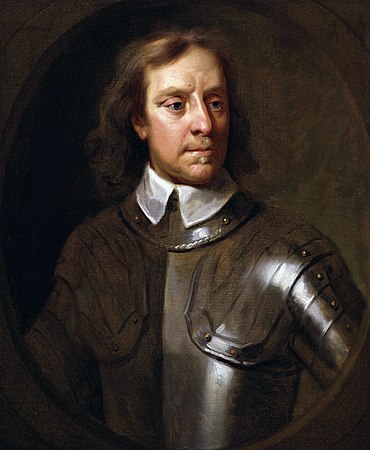
Blogging the Reformers: Oliver Cromwell

Oliver Cromwell was born in Huntingdon, England on April 25, 1599. His family was in the lower class of gentry, and he remained fairly obscure for the first part of his life. He married Elizabeth Bourchier on August 22, 1620 at 21 years of age. They had nine children. He was saved sometime later, and became a zealous Puritan. One biographer said, “He was henceforth a Christian man, not on Sundays only, but on all days, in all places, and in all cases.” Another said, “Oliver Cromwell was now a real Christian: he remained one until his last breath; and, if we except a few moments of trouble, to which the most godly men are subject, he persevered in faith and confidence till his course of mortality was completed.”

Read more here.

Blogging the Reformers: John Alasco

John Alasco was born into one of the most influential families of Poland in 1499. At the age of 25 he was a Roman Catholic, but had heard of the Reformation and wished to examine it more fully. Therefore he traveled to Europe, and arrived in Zurich in 1525 to see Zwingli. He said to him, “Apply yourself, to the study of the sacred writings.”1 He later went to see Erasumus, and stayed in his house while he was there. Erasmus also gave him the advice to study the scriptures. Alasco therefore learned Hebrew and Greek and studied the scriptures. But when the king of Poland heard that he was with Erasmus, he ordered him to return to Poland and associate with nobility, since he was the heir to the throne. While in Poland, he was convinced to sign a document saying that he was a Catholic, but later he became a clear Protestant. He lost the kingdom and left Poland for the sake of Christianity. D'Aubigne said, “Alsco does not stand in the first rank of the men of the Reformation. But in one respect he surpassed them all ... He knew better than any one what it was to sacrifice for Jesus Christ the world...”2 He left Poland, and ministered in Friesland, the Netherlands, England and other places. He died on January 8th, 1560.

1 J. H. Merle D'Aubigne, History of the Reformation in Europe in the Time of Calvin (Harrisonburg, VA: Sprinkle Publications, 2000) volume 7, book xiii, p. 435

2 Ibid, p. 451

Blogging the Reformers: Baudichion de la Maisonneuve

Baudichion de la Maisonneuve was one of the leading men of Geneva in the 16th century. He was very influential in bringing the Reformation to Geneva and defending the city's liberty. He was one of the first men in Geneva to be converted to the Reformed religion. Later in the Reformation his house became one of the meeting places for the Huguenots. The Reformation in Geneva was not peaceful. Several times mobs attacked the Huguenots in Maisonneuve's house. In 1534 he was arrested in France and sentenced to be executed, but finally after the request of the town of Berne, Switzerland the king ordered him to be released and allowed him to return home. He was appointed captain-general of Geneva, and led the army to battle against their enemies. D'Aubigne said that he was “a man of noble and exalted character, bold, welcome everywhere, braving without measure all the traditions of old times, often turbulent, and the person who, more perhaps than any other, served to clear in Geneva the way by which the Reformation was to enter.”1

1 J. H. Merle D'Aubigne, History of the Reformation in Europe in the Time of Calvin (Harrisonburg, VA: Sprinkle Publications, 2000) volume 1, book I, p. 142

Blogging the Reformers: Aime Levet

Aime Levet was an apothecary in Geneva in the 16th century. When Antoine Froment first came and brought the Gospel to Geneva, Levet was against it, but eventually his heart softened. In 1533 he was won over to Christianity by his wife, and he became one of the leading Huguenots. The religious meetings were frequently held in his house. When Froment was attacked by a mob, Levet hid him in his house. A few months after Levet’s salvation the bishop of Geneva forced him and many other Huguenots to flee, but a troop of soldiers pursued and caught him. After beating him, they threw him in prison without a trial. After the overthrow of the bishop, he was released and continued to spread the Reformation. In 1536 he was elected one of the four syndics, or magistrates, of Geneva.

Blogging the Reformers - Alexander Alesius

Alexander Alesius, or Ales, was born in Scotland on April 23rd, 1500. He graduated from St. Leonard's University in St. Andrews at the age of 15. He was convinced of Catholic scholastic theology and he desired to debate with the Reformers. For this purpose he visited Patrick Hamilton, who had been a student in St. Andrews. After many debates, he said, “I thought that I should bring Hamilton back to the doctrine of Rome, and instead of that he has brought me to acknowledge my own error.”1 After watching Hamilton be burned at the stake for his beliefs a short time later, he became thoroughly convinced of the truth of the Reformation. The prior at St. Andrews tried to trap Alesius by having him preach, afterwards he brought in soldiers to arrest him. When Alesius begged him not to shed innocent blood he was about to stab him, and then when he fell on the ground and pleaded for mercy the prior kicked him so hard that he fainted. The prior then threw him in the dungeon. The king himself ordered him to be released and the prior promised to do so, but as soon as the king left he threw him into prison again. Eventually his fellow canons were able to get in the prison and release him, and he fled to Europe. He spent the rest of his life in Germany and England, continuing to teach the reformed truth. He died on March 17th, 1565.

1 J. H. Merle D'Aubigne, History of the Reformation in Europe in the Time of Calvin (Harrisonburg, VA: Sprinkle Publications, 2000) volume 6, book x, p. 52

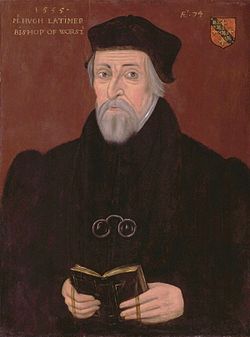
Blogging the Reformers - Hugh Latimer


Hugh Latimer was born in a poor family in England somewhere between 1480 and 1494. He attended Cambridge University and became a priest. At some point in his life he accepted the Reformed doctrine and became one of the leaders of the movement in England. King Henry VII made him one of his chaplains. He preached boldly before the king and his court, and even rebuked the king in his sermons. He said to the king, “Would you have me preach nothing concerning a king in the king's sermon?”1 Eventually after a time there he decided to leave the court and go to his parish, which he did. He was a great preacher, a powerful orator, and he effected many people through his preaching. He was appointed bishop of Worcester by the king, but he resigned years later after he opposed the king's Catholic false doctrine. The king threw him into prison until he died, and then his son Edward released him and he continued to preach. However when Bloody Mary came to the throne, she tried him for his beliefs and he was burned on October 16th, 1555 along with two other leaders of the English Reformation, Thomas Cranmer and Nicholas Ridley. As he was about to be burnt, he said to Nicholas Ridley, “Be of good comfort, Master Ridley, and play the man; we shall this day light such a candle, by God's grace, in England, as I trust shall never be put out.”2

1 J. H. Merle D'Aubigne, History of the Reformation in Europe in the Time of Calvin (Harrisonburg, VA: Sprinkle Publications, 2000) vol. 3, book vi, p. 51
2 John Foxe. Foxe's Book of Martyrs (New York: Eaton & Mains, 1911) p. 309

Military Mistakes of World War 1 - Part 2

Mistakes of World War 1
  1. Part 1
  2. Part 2


by Joshua Horn
View Part 1

In part one we examined three of the mistakes of World War I, one of the biggest wars in world history. These were the German navy's failure to attack at the beginning of the war, the Allies' frontal attacks and the Allied defeat at the battle of the Dardanelles. Today we will examine three more of the mistakes of World War I, the continued attacks of the Allies, the German U-boat war and the German frontal attacks. All these mistakes, and many more, contributed to create one of the bloodiest wars of human history. World War I changed Europe forever. In Britain alone one third of the male population were casualties. We should learn from these costly mistakes of history so that we will not make similar errors.

Read More

Blogging the Reformers: Mathurin Cordier

Mathurin Cordier was born in 1540. He was a French teacher. He did not just teach because of ambition, he desired for his students to actually learn. He was one of the best teachers in France. He taught John Calvin when he was fourteen. Calvin later said, “O Master Mathurin, O man gifted with learning and great fear of God! When my father sent me to Paris, while still a child ... it was God's will that I should have you for my teacher, in order that I might be directed in the true path and right mode of learning; and having first commenced the course of study under your guidance, I advanced so far that I can now in some degree profit the Church of God.”1 Though neither of them were saved at the time, Cordier later was saved and fled to Geneva where Calvin was the preacher. The professor then studied under his former pupil. He died in Geneva in 1564, the same year as Calvin.

Blogging the Reformers: Thomas Cromwell, Earl of Essex


Thomas Cromwell was the servant of Henry VIII, king of England. He was born in lowly estate in 1485, and was raised by the king to be one of the principle men of the kingdom. He was a Protestant, and worked to establish the true religion in England. He was the king's chief minister for eight years, and served him faithfully. His main mistake was to be to faithful to Henry even when he turned against the gospel. Henry was very inconsistent and variable throughout his reign. At one point Henry would incline towards the Protestants, and at another toward the Catholics. In 1540 the Catholics convinced him to arrest Cromwell because he was one of the best proponents of the gospel. The charges presented against him were clearly falsehoods, so the Catholics decided to proceed without trial. Even though Cromwell had always been faithful to him, Henry ordered him to be beheaded. As his hour of death drew near, Cromwell wrote, “Lord! Into thy hands I commend my soul; Lord Jesu! Receive my Spirit! Amen.”1 He was beheaded on July 28th, 1540. Henry later realized that he had executed his most faithful servant, and regretted it until his death.

1 J. H. Merle D'Aubigne, History of the Reformation in Europe in the Time of Calvin (Harrisonburg, VA: Sprinkle Publications, 2000) volume 4, book XV, p. 224

Military Mistakes of World War I – Part 1

Mistakes of World War 1
  1. Part 1
  2. Part 2

by Joshua Horn
based on The Great War by Winston Churchill


World War I began in 1914. It quickly spread throughout all of Europe, and much of Africa and the Middle East. It was one of the bloodiest wars of human history, with 37 million casualties. In Great Britain alone there were over 1 million dead, one third of the British male population were casualties. Until World War II it was called the Great War and the War to End All Wars. The war had a great lasting effect. In England and France the people believed that after that war there would be nothing worth fighting for again. This greatly contributed to World War II. There were many mistakes made on the Central Powers' side which caused the war to be lost and on the Allied side caused it to be greatly prolonged. Today we will look at three of the mistakes: the German navy's failure to attack, the Allies’ destructive frontal assaults and the battle of the Dardanelles.

Read More

How Theodore Roosevelt became Successful through Writing The Naval War of 1812

Theodore Roosevelt

Theodore Roosevelt began writing The Naval War of 1812 while he was at Harvard in 1879. It was his first book, and he published it in 1881 after much study, just after being elected to the New York State Assembly. He was 23 years old at the time. This book quickly became the authoritative work on the subject, and Roosevelt became recognized as a historian. The writing of this book made people think he would be a good historian and eventually an elected official. There were several reasons for this, and today we will look at his unbiasedness, diligence and fame.

The Naval War of 1812 was the first relatively unbiased book on that subject. Previous accounts had been written, but they had been biased to their particular sides. Roosevelt says,
“It is to be regretted that most of the histories written on the subject, on either side of the Atlantic, should be of the 'hurrah' order of literature, with no attempt whatever to get at the truth, but merely to explain away the defeats or immensely exaggerate the victories suffered or gained by their own side.”1
Throughout the book Roosevelt shows how the previous accounts twist, ignore or intentionally change facts. He says that it does no good to tell history that is not true. One of the most important things we get from studying history is knowing and therefore being able to avoid the faults of those who came before. If we skip the mistakes of our particular side, then we defeat the purpose for studying history at all. It is important that all historians be as relatively unbiased as possible, and Roosevelt fits that criteria. It is also important for people who are running for office to be unbiased, because otherwise they would not judge justly between different persons or ideas. Being unbiased is one of the most important qualifications for an elected official.

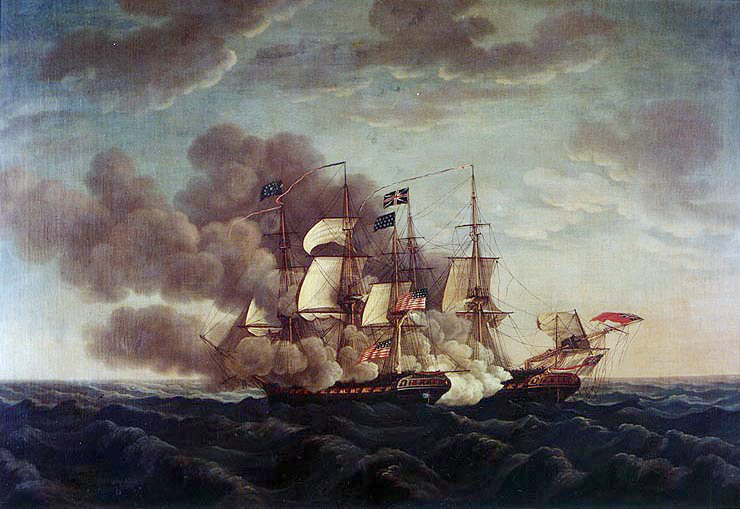
USS. Constitution vs. HMS. Guerriere


As Roosevelt wrote The Naval War of 1812, he carefully researched all the previous accounts of the war. He also delved into the archives at Washington and searched through the ships' logs and letters of the captains. He did this so that he would be as sure as possible that his story was correct. It is important that history books be well researched so that they will correctly portray what happened. Roosevelt did this, and though some of his details have been proved wrong, he still was very accurate. Roosevelt’s method of analyzing the battles has influenced all works on naval history that came after. He compared the different strengths of ships and fleets to help decide whether the loser was defeated by greater strength, or their own cowardice or lack of training. He carefully studied the naval tactics, and made tables of the relative strengths. Roosevelt's book effected later scholars through his carefully researched facts and conclusions, and also through the methods that he used. One historian said, "Roosevelt’s study of the War of 1812 influenced all subsequent scholarship on the naval aspects of the War of 1812 and continues to be reprinted. More than a classic, it remains, after 120 years, a standard study of the war."2 Diligence and accuracy are important characteristics for elected officials because it is necessary that they work hard in their positions, and make sure that they know everything possible on certain issues.

Battle of Lake Erie


The third quality that we will consider is the prestige and fame that this book gave him. We have already seen how this book was so influential to other historians. By writing this book Roosevelt became a famous historian. When someone is running for political office it is very important that people recognize their name, and know something about them. Thereby they would be able to decide better whether or not to vote for them. By writing The Naval War of 1812, Roosevelt made himself more famous, and therefore advanced his chances to get elected.
After writing The Naval War of 1812, Theodore Roosevelt continued throughout his life to write history. He was also a soldier, rancher, statesman, and, most notably, President of the United States. His famous books on history, including The Naval War of 1812, helped him in politics. Besides giving him much of his income, they showed people some of the qualities that he had, which we have mentioned here, such as unbiasedness and diligence. Roosevelt's writing of The Naval War of 1812, greatly influenced both his political career, and future historical works.


1. Roosevelt, Theodore The Naval War of 1812 (New York: The Modern Library, 1999) p. 205

2. Crawford, Michael J.. "The Lasting Influence of Theodore Roosevelt’s 'Naval War of 1812'". ijnhonline.org. International Journal of Naval History. http://www.ijnhonline.org/volume1_number1_Apr02/article_crawford_roosevelt_1812.doc.htm Retrieved 2009-08-11.

Book Report on The Pioneers


by Joshua Horn

The Pioneers contains two of Ballantyne's shorter stories. The first is The Pioneers. It is the tale of Reuben Guff and his son Lawrence as they travel on voyages of discovery in the northern wilderness of Canada in the 1780s. They first go to explore the wilderness with their faithful Indian friend Swiftarrow. Their adventure is cut short when the discover a Indian settlement which was destroyed by smallpox. In 1784 they set off again with the 'King of Pioneers' Alexander Mackenzie, one of the great explorers of Canada. They travel up a great river to discover whether it leads to the Pacific Ocean. They sail along the river in canoes amidst many dangers from ice, the natives and their own men, and they finally discover that the river leads to the Arctic Ocean. Several years later they go on an even more hazardous journey on the Peace River through the Rocky Mountains. They courageously ascend the river braving many dangers and hardships. This story does not contain as much dialog as some of Ballantyne's others, but it is still interesting as it tells the real life adventures in this oft-forgotten chapter of history.

The second story in this book is called, Fast in the Ice. It tells of a voyage of discovery to search for the North Pole. The commander of the Hope is Captain Harvey, and his crew includes his nephew Tom Gregory, Davy Butts, Sam Baker, and many other wonderful characters. When they arrive the the Arctic regions they have many adventures and Ballantyne tells how God protected them through their dangers. Their ship gets stuck fast in the ice during the winter, and they have to live through temperatures at times 60° below zero! They meet with Eskimos, hunt bears and walruses and fight hunger. Finally after many dangerous times the ship comes free in the summer, but the next day it is crushed in the ice and sinks, leaving the men stranded in the Arctic. Ballantyne tells much interesting information about the 'floes' and icebergs, the lives of the Eskimos and how they hunt the wild animals. This story was very interesting, and I would definitely recommend it.

Buy The Pioneers
Read online:
The Pioneers
Fast in the Ice

The Mistakes of the Federal Commanders at Cross Keys and Port Republic


Stonewall Jackson


by Joshua Horn
from Conquering the Valley by Robert Krick


On June 8th, 1862, the Confederate army in the Shenandoah Valley, commanded by Stonewall Jackson, was camped near Port Republic, a small village near the convergence of South River and North River into the South Fork of the Shenandoah. Two Federal armies commanded by Maj. Gen. John C. Fremont and Maj. Gen. James Shields respectively were converging on Jackson from two different directions. Richard Ewell, Jackson's second in command, faced Fremont north of Port Republic, near a small crossroads called Cross Keys, and Shield's army was preparing to move toward Jackson at Port Republic from the east. In the next two days, June 8th and 9th, the Confederates fought and won two battles. If the Confederates had lost these battles, Richmond would have been captured, and the war would have been over. These victories were won primarily because of the mistakes that the Union Generals made. We will now look at those mistakes in detail.

On June 8th the Federal army under Fremont moved out to attack Ewell, whose troops were placed in a strong position on a wooded hill overlooking a stream. General Trimble, commanding the brigade on the right, obtained permission from Ewell to advance his troops to a strong position across the creek. Soon after he moved there, they saw a single Union regiment, the 8th New York, moving toward them across the field. The Federals advanced and drove in the Confederate skirmishers. Skirmishers are a thin line of men in front of a larger body, to alert the main body of any enemies that are ahead. As the Federals marched across the field, suddenly the hidden Confederates jumped up from behind a wooden fence and poured in a volley. The 8th NY was destroyed. They suffered more than 250 casualties, making that volley one of the deadliest in the entire war. This regiment suffered these loses because of a simple mistake that their commanding officer made. He should have sent ahead two or more companies as skirmishers. If the 8th NY would have done this, they would have been alerted of the presence of Confederates ahead, and would not have suffered these terrible casualties.


On the center and left, after heavy artillery duel, two Union brigades moved forward and engaged in a firefight with the Confederates. By this time Fremont's left was being driven back by repeated attacks by Trimble, and he decided to stop the attack after a short time. This was virtually the end of the battle of Cross Keys. Fremont attacked the left and center very badly. There was no chance that the Unions could take the Confederate's strong position on the ridge by simply marching up to it and opening fire. Fremont was too cautious in his attack. He should have attempted a flanking movement, or at least charged the Confederate line vigorously. He did nether, and consequently lost the battle of Cross Keys.


A Civil War Battle

On the night of June 7/8, Jackson decided to pull Ewell from in front of the defeated Fremont, and concentrate his entire army on the advance force of Shield's army, under the command of General Erastus B. Tyler. On the morning of June 8th, Jackson's army began to move slowly across a rickety wagon bridge built during the night. The soldiers could only cross in single file, and so the troops were very slow in crossing. As soon as the Stonewall Brigade crossed the bridge, Jackson sent them forward. Tyler had placed his cannons in a very good position on a hill called the Coaling. There they could sweep the plain below across which the Confederates were advancing. Jackson split the Stonewall Brigade into two groups, sending half to capture the Coaling, and half to make a feint on the plain. Tyler therefore moved his troops into position between the Coaling and the Shenandoah River. This was a mistake. Instead of positioning his troops to resist the Confederate feint, he should have put many more troops to guard the Coaling.

The next problem is that Tyler used his reserves, the 84th and 110th Pennsylvania, unwisely. As the Confederates attacked different portions of the line, he moved the reserves to the threatened part of his line. But when the reinforcements reached the threatened part, the crisis was already over. Therefore when the Confederates attacked the Coaling in strength, the reserves were on the other side of the battlefield. If the 84th and 110th PA had been on the scene, the Confederates would probably have lost the battle. Tyler did not realize that the Coaling was the key to the location, and so he did not focus his reserves on that area.


The last mistake that the Union generals made at the battles of Cross Keys and Port Republic was Fremont's. After Jackson pulled back Ewell's troops from in front of Fremont, he pursued very slowly. The troops and officers even had time to make breakfast. They did not march the five miles to Port Republic until noon, and by then the Confederates had burned the bridge over the North River, which meant that Fremont was stranded on the other side within sight of Tyler's retreated army. If Fremont had pursued vigorously, the Federals could have easily destroyed Jackson's army, which was having trouble enough with just Tyler. This one mistake of not pursuing cost the Unions the battle.


We have just examined five of the Union commander's mistakes at the battles of Port Republic and Cross Keys. These are that the 8th New York Regiment moved toward the Confederate position without skirmishers, that Fremont did not attack Ewell's center vigorously, that General Tyler did not put enough troops on the Coaling, misused his reserves, and finally Fremont pursued the Confederates slowly. These mistakes resulted in the defeat of the Federal armies, which greatly outnumbered Jackson. This defeat had great implications on the war. At this time as Jackson was fighting in the Shenandoah Valley, Gen. George B. McClellan was sieging Lee at Richmond. If Jackson had been defeated at Port Republic, he could not have reinforced Lee and defeated McClellan during the Seven Day's battle. If Fremont and Tyler had defeated Jackson, the war would have ended much sooner. The battles of Port Republic and Cross Keys are great examples of how little things can have great impact.


1 Krick, Robert K. Conquering the Valley (Baton Rouge, LA: Louisiana State University Press, 2002) p. 179

The Three most Important things that Patrick Henry did for the Establishment of the United States

Click here to buy the book: The True Patrick Henry

Patrick Henry was a man who was one of the most eloquent orators at the time of the American War for Independence. In his youth, “He was 'thoughtful,' 'mild,' 'benevolent,' 'humane.'”1 When he was young he certainly was not a model for boys with his slovenly dress and slothfulness, but when he was old he was one of the fire brands in the American War for Independence. Three of the most important things he did were, his speech at the Continental Congress, his presence at the Convention, and his criticism of the Constitution of the United States.

The first of his acts that we will discuss is his celebrated speech in St. Johns Church on the 23rd of March, 1775. This is what Patrick Henry himself said about it, “My heart was hot within me, and while I was thus musing the fire kindled, and at last I spake with my tongue.”2 In this speech he explained that if the people of America did not want to be slaves they would have to fight the British and drive them out. “Is life so dear, or peace so sweet, as to be purchased at the price of chains and slavery? Forbid it Almighty God!”3 These were Patrick Henry's words about what he thought that the colonists should do. After his speech, “No applause followed. For some seconds there was silence. Henry's former opponents were dumb; and they were without the wish to be otherwise than dumb.”4 They did not have an answer for what he had said. He inspired many people with this burst of fire from his mouth. “The war is inevitable. And let it come! I repeat it, sir; let it come!”5 These were the words that he spoke about what he thought about the war. He did not think it could be avoided without going into complete slavery. He spoke about those who wanted to wait, “They tell us, sir, that we are weak—unable to cope with so formidable an adversary. But when shall we be stronger? Will it be the next week, or the next year? Will it be when we are totally disarmed, and when a British guard shall be stationed in every house? Shall we gather strength by irresolution and inaction?”6 He thought that if America was going to be a free people they had to fight then or she would never have another chance at liberty. “There is no retreat but in submission and slavery.”7 He said that the only things to do other than fighting and slavery were only illusions of hope. He said that, “I wish to know what there has been in the conduct of the British Ministry, for the last ten years, to justify those hopes with which gentlemen have been pleased to solace themselves and the House. Is it that insidious smile with which our petition has been lately received? Trust it not, sir; it will prove a snare to your feet. Suffer not yourselves to be betrayed with a kiss.”8

Another of his important contributions was his presence and his eloquence at the convention. Henry was one of the main contributors in writing the Declaration of Independence, and he was very helpful. Before the Declaration of Independence almost everyone realized the need for one, and Henry saw it too. Henry saw, “that the work of the Convention was to be constructive, and that the unity of the action was a prerequisite to success. To him the Committee of Safety was a failure. Better government was needed.”9 The man appointed to be the president of the convention was one of Henry’s enemies, and he did not fight back for this reason. He believed that the unity of the convention was more important than his beliefs. He knew that the country needed a government, and he also knew that it could not happen in disunity of the makers. “Then, in the Committee of the Whole, at Henry’s request, General Thomas Nelson introduced some ‘rough resolutions’ (still preserved, in Henry’s handwriting enjoining the Virginia delegates in Congress ‘to procure an immediate, clear, and full Declaration of Independence’”10 “‘The party of Henry’ was never better led than now. It cooperated with Pendleton in all pressing matters, and did not raise its voice for independence until the 14th of May, when the delegates were free to give the measure their full and solemn consideration.”11 He was not only helpful in the writing of the Declaration of Independence but also in the writing of the Constitution of the United States.
The next thing important Henry did was his criticism of the Constitution of the United States. “Nor should we forget that Henry’s hostility to the Federal Constitution served a beneficial purpose. It was necessary to put the new instrument through fire in order to test it and temper it. Henry certainly put it through fire. Not only that, he forced the adoption of the first ten amendments, and so, practically, was one of the great makers of the Constitution.”12 Henry was not for the Constitution, and he fought against it, but in the end he was for the Constitution, because it needed to have the dross removed. He did not want a Constitution, so he fought against it, which in the end helped what he had been fighting against. Henry, in looking at the Constitution thought that the government would swallow up all of the state’s rights, which it did at the time of the Civil War. What he feared has happened, a government which is too big. He thought that the Constitution gave the federal government too much power, so they could do anything. What Henry feared has happened, even though he thought it would come through obedience to the Constitution, but it actually came through the breaking of the Constitution.
Here we have a discussion of how his speech at the Continental Congress, his presence at the Convention, and Henry's criticism of the Constitution Of the United States are the most important things he did in his life towards the making of The United States of America. It is hard to say which is the most important of his actions because they all have good things which resulted from them. His speech could easily be said of that it was the most important because it lit up the American War for Independence. But truly, it was only a spark to what was already there. He was one of the important men of the American War for Independence for this, but he probably is not the most important. His criticism of the Constitution, and his work on the Declaration of Independence were important, but not quite as important as his speech.
1Gorge Morgan, The True Patrick Henry, 1st ed. (Virginia: American Foundation Publications) p.25
2 As quoted in Ibid, p. 189
3As quoted in Ibid, p. 191
4Ibid, p. 191
5As quoted in Ibid, p. 191
6As quoted in Ibid, p. 191
7As quoted in Ibid, p. 191
8As quoted in Ibid, p. 189-90
9Ibid, p. 257
10Ibid, p. 258
11Ibid, p. 258
12Ibid, p. 329

The Logical Fallacies in Erasmus’ Arguments

Martin Luther, Author of The Bondage of The Will


by Joshua Horn

from Bondage of the Will by Martin Luther

buy The Bondage of the Will


In 1525 Martin Luther published a book entitled, De Servo Arbitrio, or in English, Bondage of the Will. He wrote it in response to On Free Will by Desiderus Erasmus. In his book, Erasmus argued that man has free will and he must chose to be saved. Luther replied to him in Bondage of the Will and pointed out many flaws in his arguments. Three of the most important flaws were that Erasmus twisted scripture to meet his own interpretation, that he rejected the Bible rather than split with the Pope, and lastly that he contradicted himself in his definition for free will.

The first of Erasmus’ flaws was that he frequently twisted scripture to match his own opinions. When he deals with the text where God says that he hardened Pharaoh's heart1, he claims that God really meant that Pharaoh hardened his own heart. Luther says, “When God says: ‘I will harden the heart of Pharaoh’, you change the persons, and take it thus: ‘Pharaoh hardens himself by my long-suffering’!”2 When the Bible says this, I am the vine, ye are the branches: He that abideth in me, and I in him, the same bringeth forth much fruit: for without me ye can do nothing,”3 Erasmus says that “‘nothing’ may mean the same as ‘a little imperfect something.’”4 This is clear twisting of the words of scripture. If you take that nothing means ‘an imperfect little something’, than most of the doctrines of the Bible fall apart. From these two examples it is clear that Erasmus was forced to twist the words of scripture to make them fit with his position.

Erasmus’ second logical fallacy is that he would rather give up the scriptures than contradict the Pope. He was so afraid of contention that he was willing to give up what he knew was true rather than fight for it. Luther says this to Erasmus, “For your teaching is designed to induce us, out of consideration for Popes, princes, and peace, to abandon and yield up … the sure word of God. But when we abandon that, we abandon God, faith, salvation, and all Christianity!”5 The Bible says in Matthew 10:28, “And fear not them which kill the body, but are not able to kill the soul: but rather fear him which is able to destroy both soul and body in hell.6 The basic problem is that Erasmus feared man more than God.

Erasmus admitted in his book that free will is a slave to sin and can not will to do anything good. He says that, “the human will after sin is so depraved that it has lost its freedom and is forced to serve sin, and cannot recall itself to a better state.”7 But later in the book he claims that a human can will to seek God! This is a clear contradiction. Luther says this, “You say that ‘free-will’ is a power of the human will by which a man can apply himself to good; but here you say, and and approve of its being said, that man without grace cannot will good.”8 Erasmus realized that free will could not do any good, but he still contradicted himself and said that it is man who chooses to be saved.

We have just seen Erasmus' three most important mistakes. They are that he twisted the words of scripture, that he rejected the Bible rather than split with the Pope, and thirdly that he contradicted himself in his definition of free will. After Luther pointed out Erasmus' fallacies and destroyed his arguments, there were no good arguments left for free will. Many people today who defend free will have the same problems and make the same logical fallacies as Erasmus did when arguing with Martin Luther. Being able to recognize these problems can help us defend the Biblical doctrine of the will.

1 Exodus 7:13, etc.

2Martin Luther, Bondage of the Will (Grand Rapids, Michigan: Baker Book House Company, 2003) trans. J. I. Packer and O.R. Johnston, p. 195

3 John 15:5, KJV

4 Bondage of the Will, p. 260

5 Ibid, p. 91

6 Matthew 10:28, KJV

7 As quoted in Bondage of the Will, p. 145

8 Ibid, p. 145


Buy The Bondage of the Will Here

Blogging the Reformers: Philibert Berthelier

J. H. Merle D'Aubigne

This year I am reading History of the Reformation in the Time of Calvin by J. H. Merle D'Aubigne because this year is the 500th aniversary of the birth of John Calvin. We are also planning on attending the Reformation 500 Celebration by Vision Forum Ministries. For a book report on this book, I am writing a paragraph on the important reformation figures that D'Aubigne writes about in his book. My first one is on Philibert Berthelier.


Philibert Berthelier

Philibert Berthelier was a Swiss Patriot in the town of Geneva in the 16th century. He defended the liberties of the city of Geneva against the Duke of Savoy, who wished to unlawfully rule the city. When he was about the be arrested, he fled Geneva and went to Friburg, a Swiss city, to ask if they would protect Geneva. In this he was successful, and the city of Geneva made a treaty with Friburg. He later returned to Geneva, and was arrested by the bishop, who hoped that by killing him he would destroy the desire for independence in Geneva. Berthelier said,


I am accused of being a marplot because I ask for justice; - a good-for-nothing, because I defend liberty against the enterprises of usurpers; - a conspirator against the bishop's life, because they conspire against mine.1


When he was about to be killed, he trusted in the Lord, even though he was a Catholic2. He was beheaded by the bishop of Geneva on August 23, 1519, and his head was hung on a tree as a warning to the other Genevans. D'Aubigne says this, “[Bethelier's] death has not been useless to the universal cause of civilization.”3


1 As quoted in J. H. Merle D'Aubigne, History of the Reformation in Europe in the Time of Calvin (Harrisonburg, VA: Sprinkle Publications, 2000) v. 1 p. 143

2 Ibid, p. 191-192

3 Ibid, p. 198


Three of Knox's most important traits that were used by God in the Scottish Reformation and how were they used


based on Trumpeter of God by William Stanford Reid

The author of Trumpeter of God is William Stanford Reid. John Knox was a godly man who was one of the important reformers in the Scottish Reformation. One of the things that he is most known for is his book, The First Blast of the Trumpet Against the Regime of Monstrous Women. He is also known for his conversations with Mary Queen of Scots about the sermons he had preached before her. Some of the most important characteristics to the Scottish Reformation he showed in his life were respect for authority, boldness, and trust in God. It seems that without these characteristics the Reformation in Scotland would not have been nearly as useful as it was, but it is clear that God provided it with John Knox who was one of the main figures in it.


John Knox's first trait that will be discussed is respect for authority. This was one of the traits that was important to John Knox in his conversations with Mary Queen of Scots. John Knox was one of the of people who agreed that Mary should be dethroned for not doing her duty towards the people, but he also said that she should be restored to her throne if she repented. This is what he said:

And therefore it shall be profitable to your Majesty to consider what is the thing your Grace's subjects look to receive of your Majesty, and what it is that ye ought to do unto them by mutual contract. They are bound to you and that not but in God. Ye are bound to keep the laws unto them. Ye crave of them service: they crave of you protection and defense against wicked doers. Now, Madam, if ye shall deny your duty unto them . . . think ye to receive full obedience of them? I fear Madam, ye shall not.1

Knox is saying why he thinks that she should be dethroned and his beliefs on her responsibility. In his first conversation with her about him preaching against princes rejoicing over the destruction of Christians which she believed was against her:

When Mary heard of his criticisms she promptly summoned Knox to Holyrood, where, surrounded by some of her court including Moray, Morton, and Lethington, and the guards who had reported his statements, she accused him of speaking irrelevantly of her, of stirring up the people against her, and exceeding the bounds of his text. Thereupon he proceeded to outline to her his sermon in which he had made no direct reference to her. Apparently realizing that she had no ground for complaint, she then spoke more kindly to him saying that if she did anything of which he did not approve he should come to her privately.2

Knox did not refuse to come to her, or tell her that he was right even if he did say things against her, but instead he kindly shows her how he was not speaking directly to her. Here it is seen that he respected the authority in his defense and in what he was being called about to do. Even though Knox respected the authority, he still was very bold in preaching the gospel and speaking the truth to Queen Mary.


The second characteristic was that John Knox was bold before Queen Mary and would not stop preaching when she told him to. “Knowing that [Mary's command for him to speak privately] would inhibit [Knox's] freedom to preach, he pointed out that he was called to the public ministry not to wait at princes' doors to whisper in their ears. If she wished to hear his views on any matter she could do so by attending the services in St. Giles.” 3 He would only speak the truth and not what people wanted him to say but what God wanted him to say. If he saw a problem with something he would preach a sermon on it; He did not care if whoever had the problem wanted him to preach against it even if it was the Queen. Queen Mary did not like this because if he saw a problem in her then he would preach a sermon against it and she did not like this because he revealed her sins to her and all of the rest of the nation. He believed that the church was a separate sphere of authority from the church and the civil government could not control the church. He did not think that the ruler should be able to make him be quiet or limit what he could preach. Because of this reason Mary tried to get him to stop preaching but he believed that God wanted him to speak the truth and was not afraid of Queen Mary's threats.


Here it is also see that John Knox trusted in God when Queen Mary threatened him so he was not afraid. After Queen Mary had threatened him, “some were surprised at his lack of fear, but his reply was, 'I have looked in the faces of many angry men, and yet have not been afraid above measure'. Mary had again failed to silence the one whom she regarded as the chief obstacle to her plans to re-establish [Roman-Catholicism] in Scotland.”4 This shows that he was not afraid of the threats by Mary, and also because the Parliament was in favor of him they would not let Queen Mary carry out her threats against him. The reason for this was that he feared God and he did not fear man's threats. He was not a man to preach what the rulers wanted him to. Mary did not like him speaking but there was no way that she could shut him up.


Here is an explanation of why respect for authority, boldness, and trusting in God were the most important traits that were useful to him in the Scottish Reformation and his conversations with Queen Mary. The respect for authority was one of the most useful traits in his conversations with Queen Mary, but he would not of been as useful to the Reformation if he had not preached his message with boldness. He would not have had so much boldness had it not been for his belief in God and his trust in him to protect him from his enemies. Because of this it seems that his trust in God was the most important trait because if he did not have it he would not have had the ability to be bold because he would not have had anything to trust in and Mary would not have called him if he had not spoken bold things which offended her.

  • 1William Stanford Reid, Trumpeter of God (New York: Charles Scribner's Sons), 229 Quoting John Knox

  • 2William Stanford Reid, Trumpeter of God (New York: Charles Scribner's Sons), 227

  • 3William Stanford Reid, Trumpeter of God (New York: Charles Scribner's Sons), 227

  • 4William Stanford Reid, Trumpeter of God (New York: Charles Scribner's Sons), 227-8


Click Here to buy Trumpeter of God: A Biography of John Knox