Showing posts with label writing. Show all posts

Scott vs Amundsen: A Study in Polar Exploration

Two of the greatest expeditions in the history of Polar exploration was the race between Amundsen and Scott to reach the South Pole, 100 years ago during the winter of 1911/1912. Although there were similarities between these expeditions, there were also many fundamental differences.
Captain Robert Falcon Scott
Captain Robert Falcon Scott was an English navy officer and explorer. His first expedition was on the Discovery, which included setting a new point of the Farthest South ever reached by man. He returned on the Terra Nova in an attempt to reach the South Pole.
Roald Amundsen
Roald Amundsen was an explorer from Norway. While growing up he desired to become an explorer, and after participating in the first expedition to spend the winter in Antarctica, he led his own expedition to be the first to sail the Northwest Passage. While he was planning a journey to sail over the North Pole, the news was announced that two other explorers claimed to have already reached it. So he secretly changed his plans and sailed south to race Scott to be the first to reach the South Pole.

Similarities

1. Trust in God
Although it appears that neither Scott or Amundsen were Christians, both frequently mentioned in their writings the workings of Providence. Scott's men wrote saying they were willing to die if it was their time. Edward Wilson wrote, “[I]f the end comes to me here or hereabout … All will be as it is meant to be.” Henry Bowers wrote this to his mother just before dying next to Scott, “my trust is still in Him and in the abounding Grace of my Lord and Savior whom you brought me to trust in...” There is a saying that there are no atheists in foxholes, and there were no atheists in Antarctica either. When men are constantly faced with danger and death, they recognize their dependence on God, even if they do not follow Him fully.

2. Courage
Both men were very courageous, although in different ways. It took courage to even venture into Antarctica, far from hope of relief in case anything went wrong. When faced with hard decisions along his journey, Amundsen boldly took the hard course, not faltering or wasting time attempting to find an easier course. Scott, on his fateful journey, set an example of courage that the English would look up to for years. In one of his last letters he wrote, “We are showing that Englishmen can still die with a bold spirit, fighting it out to the end... I think this makes an example for Englishmen of the future.”
The Terra Nova

Differences

1. Motives
Amundsen explored because he loved exploration, but Scott explored because he wanted promotion. As a young man Amundsen heard of the stories of the explorers like Sir John Franklin and Fridtjof Nansen, and wished to follow their footsteps and become an explorer. Scott, a mediocre navy officer, heard of the planning of the Discovery expedition and saw it as a way to gain promotion and riches.
Nansen, Amundsen's hero and supporter
2. Preparation
The different motives of these two men resulted in vastly different methods of preparation. Amundsen gradually worked up to leading an expedition over a decade, first taking long ski trips in his native country of Norway, working on whaling ships which navigate the icy northern seas, and finally participating in someone else's expedition. Scott, on the other hand, was appointed directly to command a large expedition, and only spent a few weeks hearing about what Amundsen had learned first hand for years. On his Discovery expedition Scott admitted this, saying, "Our ignorance was deplorable."

Additionally, Amundsen spent many hours reading the works of previous explorers and analyzing everything to see what he could learn. Scott did not learn from his own experiences, much less those of others. He kept repeating the same mistakes over and over again. On previous journeys he had suffered from not bringing enough provisions, but he made the same mistake in this trip. In his ill fated expedition to reach the pole, he basically followed in the path of Shackleton, but he did not even bring a copy of Shackleton's book. He had to borrow one from another member of the expedition. Amundsen, on the other hand brought along a large polar library to study.

Scott's expedition to the South Pole had scientific aims as well, while Amundsen really did not, but this in no way excuses a lack of preparation.
One of Amundsen's dog sled teams
3. Technology
One of the biggest differences in Scott and Amundsen's journeys was the method of travel they used. Amundsen used dogsleds, while Scott used man hauling. Scott was biased against dog sleds because on the Discovery expedition they were a failure because no one knew how to use them. In the end, Scott did recognize that dog sleds were much quicker and more efficient, but he objected to them because at times the dogs had to be killed. So instead of killing a few dogs, he ended up killing himself because he could not reach his supply depots. He tried horses, but they were completely unsuited for the polar conditions, which he could have learned from the experiences of others. In England some, such as Scott's champion Sir Clements Markham, thought that it was more glorious to march without the assistance of dogs, saying, “People do not understand the greatness of [Scott's] achievement. The sledge journeys without dogs are quite unequalled. It is a very much easier matter when Peary or Nansen or Sverdrup make dogs drag their things, while they stroll along.”
Scott manhauling
The effort required to travel is demonstrated by two quotes. When Amundsen's party arrived, Bjalland, one of the best skiers in the world, wrote, “the skiing was brilliant.” When Scott arrived he said, “Great – God this is an awful place and terrible enough for us to have laboured to it without the reward of priority…Now for the run home and a desperate struggle to get the news through first. I wonder if we can do it.”
Amundsen carefully laying a depot
4. Planning
Amundsen made detailed plans far in advance of setting out on the journey, giving himself plenty of extra provisions in case he hit bad weather. Scott made complicated, last minute plans, making many mistakes in small details that cost him much time and labor. For example, an important element of both of their plans was to leave supply depots on the journey to the South Pole which they would pick up on the way back. Amundsen, having read of other men having problems finding the depots they had left, put markers to the left and right of his depots, giving himself a several mile range to hit. He also built markers at intervals along his route so he could always see one, so he would not have trouble following his tracks. Scott, on the other hand, built only depots, making the same mistake that others had before him, wasting time and effort.

Scott's worst mistake in planning was his provisions. He made allowance for only four days of bad weather in a four month journey, an amount which the journals of previous explorers would have told him was far too low. He ended up dying because of lack of supplies because he hit a blizzard. He was only eleven miles from the next supply depot. Nansen, an explorer himself and Amundsen's mentor, said, “Let no one come and prate about luck. Amundsen's triumph is that of the strong and far seeing.”
One of Scott's depots
5. Leadership
The two men had very different leadership styles. Scott was a naval officer, and a mediocre one at that. He led by enforcing the fact that his word was law, being secretive about his plans, and refusing to listen to suggestions from others. Amundsen, although it was still very clear that he was the leader, was open about his plans, allowed suggestions to be made, intermingled with the men, and shared the worst chores with them. However, both men did have good leadership qualities and both made leadership mistakes.
Amundsen's party at the Pole
6. Popularity
Amundsen ended up reaching the pole first, and returning successfully, with little suffering besides. But when he returned to Europe he was quickly forgotten in favor of Scott, who had died after losing the race to the pole. Although Amundsen was a better explorer, Scott was a better writer. Amundsen's stories did not have the drama which Scott was able to convey. One historian said, “Amundsen had made the conquest of the Pole into something between an art and a sport. Scott had turned Polar exploration into an affair of heroism for heroism's sake.” Scott's popularity in England was much helped by the fact that he did not come back. He had been defeated by Amundsen, and England preferred a dead lion to a live donkey. Even today, Scott remains much more popular than Amundsen, remaining for many the iconic British hero.
Scott finding he had been beaten by Amundsen

Causes of the Civil War


For those who are interested, I just published a post on state's rights on my Civil War Blog. You can see other posts on the causes of the Civil War here.

As we have discussed on this blog before, slavery was the main issue that caused the Deep South States to secede, but secession did not necessarily mean war. This is a major misunderstanding about the Civil War today. When the North was considering whether or not to attack the South, the question was no longer about slavery. The question was whether or not the Southern states had a right to be allowed to leave the Union peacefully. The South viewed the United States as a confederation in which the states joined together for mutual protection. They joined freely, so they thought they could leave freely. However, the North believed that the states surrendered their sovereignty and could never regain it. It was this difference of understanding that caused the South to fight for freedom and the North to preserve the indissolvable Union.

Read More.

Blogging the Reformers: Jean Merle D’Aubigné

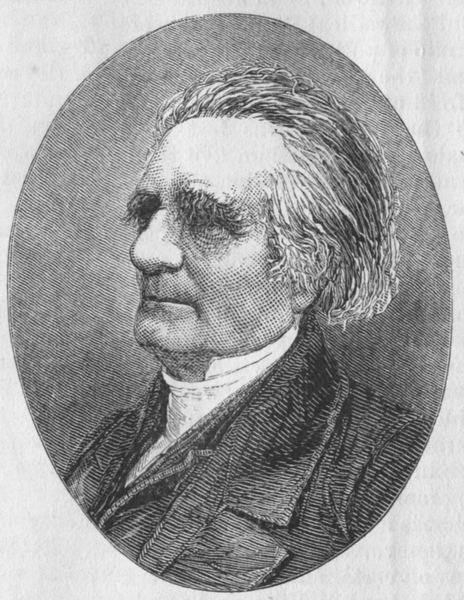
D'Aubigne

Jean-Henri Merle D'Aubigne was born on August 16th 1794. He lived in Geneva, where the great reformer John Calvin had lived 250 years before. But by the 1800s Calvin's reformation was gone and had been replaced by Unitarianism and other heresies. He was saved while studying for the ministry, and was ordained in 1817. In 1817 on the 300th of anniversary of the Reformation he visited Wartburg Castle where Martin Luther was kept. There he decided that he eventually wanted to write a history of the Reformation. He was a preacher in Hamburg and Brussels until 1831 when he returned to Geneva. There he assisted the establishment of a reformed theological seminary in Geneva. He was professor of Church History there for 41 years until his death. He was a great preacher in Geneva and was one of the leaders of the the reformation there. While he was in Geneva he wrote his two major books on the Reformation, a five volume History of the Reformation of the Sixteenth Century and an eight volume History of the Reformation in Europe in the Time of Calvin. He traveled all over Europe to study the original source documents. These books were very important in the history of the church. “For the first time, the Reformation, with all the various and boundless benefits which it has conferred upon the world, is beginning to be, in some measure, comprehended by mankind.” 1 A historian wrote that his writings “had a wider circulation, at least in the English translations, than any other book on church history.”2 D’Aubigne’s writings are still a great way to learn about church history. You can buy them here.

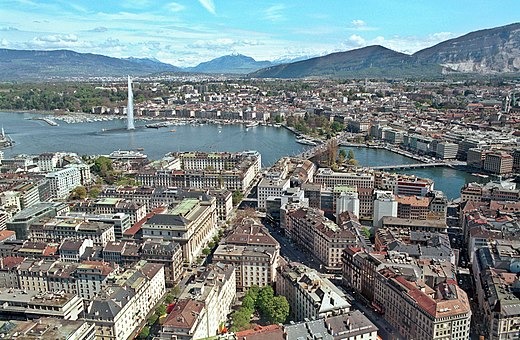
Geneva Today

1 J. H. Merle D'Aubigne, The Life and Writings of J. H. Merle D'Aubigne – The History of the Reformation in the Sixteenth Century (Harrisonburg, VA: Sprinkle Publications, 2001) volume 1, p. XV
2 http://www.visionforum.com/hottopics/articles/2005-04-14_001.aspx

Military Mistakes of World War 1 - Part 2

Mistakes of World War 1
  1. Part 1
  2. Part 2


by Joshua Horn
View Part 1

In part one we examined three of the mistakes of World War I, one of the biggest wars in world history. These were the German navy's failure to attack at the beginning of the war, the Allies' frontal attacks and the Allied defeat at the battle of the Dardanelles. Today we will examine three more of the mistakes of World War I, the continued attacks of the Allies, the German U-boat war and the German frontal attacks. All these mistakes, and many more, contributed to create one of the bloodiest wars of human history. World War I changed Europe forever. In Britain alone one third of the male population were casualties. We should learn from these costly mistakes of history so that we will not make similar errors.

Read More

How Theodore Roosevelt became Successful through Writing The Naval War of 1812

Theodore Roosevelt

Theodore Roosevelt began writing The Naval War of 1812 while he was at Harvard in 1879. It was his first book, and he published it in 1881 after much study, just after being elected to the New York State Assembly. He was 23 years old at the time. This book quickly became the authoritative work on the subject, and Roosevelt became recognized as a historian. The writing of this book made people think he would be a good historian and eventually an elected official. There were several reasons for this, and today we will look at his unbiasedness, diligence and fame.

The Naval War of 1812 was the first relatively unbiased book on that subject. Previous accounts had been written, but they had been biased to their particular sides. Roosevelt says,
“It is to be regretted that most of the histories written on the subject, on either side of the Atlantic, should be of the 'hurrah' order of literature, with no attempt whatever to get at the truth, but merely to explain away the defeats or immensely exaggerate the victories suffered or gained by their own side.”1
Throughout the book Roosevelt shows how the previous accounts twist, ignore or intentionally change facts. He says that it does no good to tell history that is not true. One of the most important things we get from studying history is knowing and therefore being able to avoid the faults of those who came before. If we skip the mistakes of our particular side, then we defeat the purpose for studying history at all. It is important that all historians be as relatively unbiased as possible, and Roosevelt fits that criteria. It is also important for people who are running for office to be unbiased, because otherwise they would not judge justly between different persons or ideas. Being unbiased is one of the most important qualifications for an elected official.

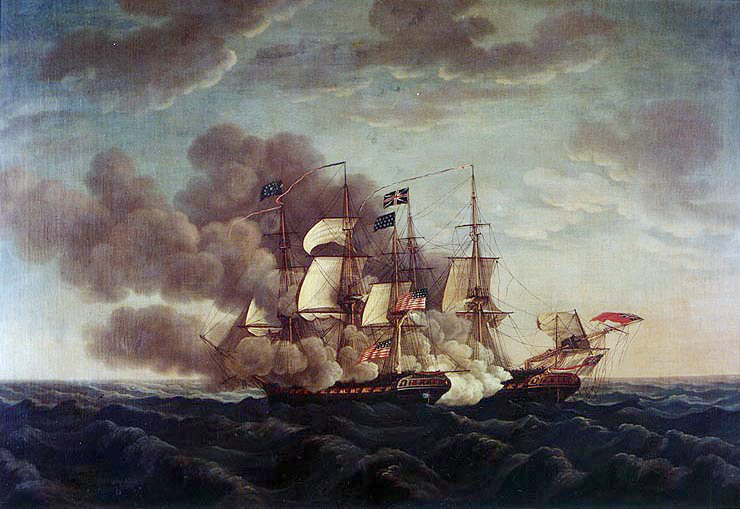
USS. Constitution vs. HMS. Guerriere


As Roosevelt wrote The Naval War of 1812, he carefully researched all the previous accounts of the war. He also delved into the archives at Washington and searched through the ships' logs and letters of the captains. He did this so that he would be as sure as possible that his story was correct. It is important that history books be well researched so that they will correctly portray what happened. Roosevelt did this, and though some of his details have been proved wrong, he still was very accurate. Roosevelt’s method of analyzing the battles has influenced all works on naval history that came after. He compared the different strengths of ships and fleets to help decide whether the loser was defeated by greater strength, or their own cowardice or lack of training. He carefully studied the naval tactics, and made tables of the relative strengths. Roosevelt's book effected later scholars through his carefully researched facts and conclusions, and also through the methods that he used. One historian said, "Roosevelt’s study of the War of 1812 influenced all subsequent scholarship on the naval aspects of the War of 1812 and continues to be reprinted. More than a classic, it remains, after 120 years, a standard study of the war."2 Diligence and accuracy are important characteristics for elected officials because it is necessary that they work hard in their positions, and make sure that they know everything possible on certain issues.

Battle of Lake Erie


The third quality that we will consider is the prestige and fame that this book gave him. We have already seen how this book was so influential to other historians. By writing this book Roosevelt became a famous historian. When someone is running for political office it is very important that people recognize their name, and know something about them. Thereby they would be able to decide better whether or not to vote for them. By writing The Naval War of 1812, Roosevelt made himself more famous, and therefore advanced his chances to get elected.
After writing The Naval War of 1812, Theodore Roosevelt continued throughout his life to write history. He was also a soldier, rancher, statesman, and, most notably, President of the United States. His famous books on history, including The Naval War of 1812, helped him in politics. Besides giving him much of his income, they showed people some of the qualities that he had, which we have mentioned here, such as unbiasedness and diligence. Roosevelt's writing of The Naval War of 1812, greatly influenced both his political career, and future historical works.


1. Roosevelt, Theodore The Naval War of 1812 (New York: The Modern Library, 1999) p. 205

2. Crawford, Michael J.. "The Lasting Influence of Theodore Roosevelt’s 'Naval War of 1812'". ijnhonline.org. International Journal of Naval History. http://www.ijnhonline.org/volume1_number1_Apr02/article_crawford_roosevelt_1812.doc.htm Retrieved 2009-08-11.

Blogging the Reformers: Philibert Berthelier

J. H. Merle D'Aubigne

This year I am reading History of the Reformation in the Time of Calvin by J. H. Merle D'Aubigne because this year is the 500th aniversary of the birth of John Calvin. We are also planning on attending the Reformation 500 Celebration by Vision Forum Ministries. For a book report on this book, I am writing a paragraph on the important reformation figures that D'Aubigne writes about in his book. My first one is on Philibert Berthelier.


Philibert Berthelier

Philibert Berthelier was a Swiss Patriot in the town of Geneva in the 16th century. He defended the liberties of the city of Geneva against the Duke of Savoy, who wished to unlawfully rule the city. When he was about the be arrested, he fled Geneva and went to Friburg, a Swiss city, to ask if they would protect Geneva. In this he was successful, and the city of Geneva made a treaty with Friburg. He later returned to Geneva, and was arrested by the bishop, who hoped that by killing him he would destroy the desire for independence in Geneva. Berthelier said,


I am accused of being a marplot because I ask for justice; - a good-for-nothing, because I defend liberty against the enterprises of usurpers; - a conspirator against the bishop's life, because they conspire against mine.1


When he was about to be killed, he trusted in the Lord, even though he was a Catholic2. He was beheaded by the bishop of Geneva on August 23, 1519, and his head was hung on a tree as a warning to the other Genevans. D'Aubigne says this, “[Bethelier's] death has not been useless to the universal cause of civilization.”3


1 As quoted in J. H. Merle D'Aubigne, History of the Reformation in Europe in the Time of Calvin (Harrisonburg, VA: Sprinkle Publications, 2000) v. 1 p. 143

2 Ibid, p. 191-192

3 Ibid, p. 198