Mistakes of World War 2 - 1943-1945


This article is the last in a series on the most important mistakes that were made during the Second World War. By 1943 most of the mistakes had already been made which caused the Axis’ downfall. But they did make mistakes in the last part of the war that would influence the world for years to come.
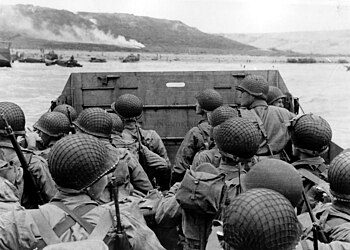
Americans Land in Normandy
Fighting to the Last
In 1944 the British and Americans landed in Normandy, France. After gaining a beachhead there they began to drive the German armies across France, Holland and Germany. At the same time, the troops that had landed in Italy in 1943 continued to push the Germans north in Northern Italy. At this point Hitler had two choices. He could order his troops at certain points to fall back so that they could organize and strike with a hard counter-attack, or he could stubbornly hold on to every inch of ground. He chose the second. This meant that although the Allies might have difficulty in conquering territory, they would not have to resist heavy and unexpected counter-attacks. He made this mistake continually as the war wound to a close. He refused to let his troops give up even an inch of ground, and instead he lost it all. He ordered one commander who desired to fall back to a stronger line, “The Fuehrer expects, now as before, the utmost steadiness in the fulfillment of your present mission to defend every inch of the North Italian areas entrusted to your command.”1 Hitler’s incorrect strategy led to the defeat of his armies, and he committed suicide on April 30th, 1945. Germany surrendered unconditionally on May 8th.
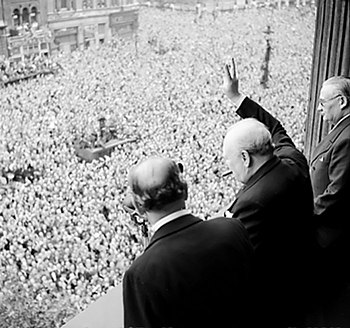
Winston Churchill with crowds on V-E day
Communism
At the beginning of the war the Soviet Union was unfavorable to the British. They were siding with Germany, and almost became an ally with them against Great Britain. But then when Germany attacked them, they wanted to become an ally to the nation they were planning to attack a few weeks before. The British decided to ignore the political, social and religious differences between them and join with them to destroy Germany. But by the end of the war it became clear that unless the United States and England did something to stop it, Russia would make much of Europe their Communist puppets.

Polish Soldier Fighting the Germans during the Warshaw Uprising
One of the first issues that came up was regarding Poland. Poland was one of the the first nations that Germany conquered, and many influential Poles fled to London and established a government there. But when the Soviets liberated Poland they set up a Polish Committee of National Liberation which were really just their puppets. England and the United States did not want communism to be imposed on the Poles, and the Russians agreed at the Yalta Conference to incorporate members of the London government into the new Polish government so that it would better represent the wishes of the people. They also agreed to allow Allied observers to enter Poland to report on what was happening there. However, they ignored their promises and set up a completely communism government in Poland.

These issues continued with the other nations of western Europe. The Russian strategy was described by Stalin when he said, “This war is not as in the past; whoever occupies a territory also imposes his own social system on it. Everyone imposes his own system as far as his army can reach. It cannot be otherwise.”2 Therefore what Winston Churchill described as an “Iron Curtain” came upon Germany because of the alliance that had been made in the heat of war and the failure of the other Allies to deny to Russia the right to overwhelm the other nations.

These problems between the United States and the Soviet Union resulted in the Cold War. While there were military conflicts which resulted from it, the United States and Russia never entered into a full scale World War. The problems existed until 1991 when the Soviet Union collapsed. All this conflict can be traced back to decisions that were made in the aftermath of World War II.

A Street in Berlin
Conclusion
These mistakes from World War II that we have examined through this series of essays are not just interesting facts from a conflict that happened many years ago. Situations like these will happen again, and at that time it will serve us well to remember the mistakes that were made by leaders of the past. Those who fail to learn from the mistakes of their predecessors are destined to repeat them.


1. The Second World War – Triumph and Tragedy (vol. 6) by Winston Churchill (Boston, Houghton Mifflin Company, 1953) p. 522
2. A History of Modern Russia: From Nicholas II to Vladimir Putin by Robert Service Source. p. 305

The Mistakes of World War 2 - 1942

Mistakes of World War 2
  1. Causes of the War
  2. The Mistakes of 1939-1940
  3. The Mistakes of 1941
  4. The Mistakes of 1942
  5. The Mistakes of 1943-1945
  6. More coming soon
The Three Leaders of the Allies: Joseph Stalin Franklin Roosevelt and Winston Churchill


This article is the fourth part in a series on the greatest mistakes of World War II. At this point in the war it is 1942 and America, Great Britain and the Soviet Union are united against Germany, Italy and Japan. Many of the great mistakes of the war had already been made, but there were still mistakes that the Axis made that shortened their life, even if they were already doomed to defeat. I will discuss three mistakes that were made in 1942 – the failure of the Germans to press the attack by the U-boats, the Japanese attacks in the Pacific, and Hitler’s refusal to retreat from Africa.

Pennsylvania and Fredericksburg Battlefield

Last week my father and I went up to help bring my grandfather home after his knee replacement surgery. We stayed there for a few days, and had lunch with Dr. James, who is a friend of my grandparents. He was a college professor and was a beach master at several landings in the Pacific during World War II. On the way home from lunch we stopped at the War College in Carlyle, PA where they have built replicas of military fortifications throughout the nation's history. Here are some pictures from that:

Civil War era cannon
A Blockhouse
World War I trenches
World War II tank
Me in the Vietnam camp
On the way home we stopped at Fredericksburg Battlefield. During the Civil War the Confederates occupied the heights above the town of Fredericksburg, and the Unions charged up a long plain towards a stone wall with a sunken road at the top. The Confederates destroyed thousands of men and they did not even make it to within 100 yards of the wall, but they continued to launch waves of attackers for hours. It was probably the most one-sided victory of the war. We were not able to visit the other half of the battlefield where Jackson held off a much more viable Union attack.

Daddy in the Sunken Road
A house from the time of the battle with holes still in the wall from the bombardment
A Monument to a Confederate who gave water to wounded soldiers
The Stone Wall
The impact of a cannon ball hitting a stone pillar

Blogging the Reformers: Martin Luther


Martin Luther was born on November 10th, 1483 in Germany. His father was a miner, but he wanted Martin to be a lawyer, so he sent him to the university. But on July 2nd, 1505 as he was riding through a thunderstorm, he was scared by the lightening and thunder so he vowed that if God protected him, he would become a monk. He survived the storm and entered the monastery against his father's wishes. As a monk he worked hard to gain righteousness through good works.

Luther's German Bible
Martin Luther became a doctor at the University of Wittenberg in 1512, and he remained a doctor there for the rest of his life. He began to resist the Catholic church in the matter of indulgences. John Tetzel was traveling through Germany selling indulgences, saying that the pope would forgive your sins if you bought them. Luther disagreed, and he wrote 95 theses in Latin against them and nailed them to the church door as was customary. They were translated into German, and quickly spread all over the country. The 95 theses acknowledged the supremacy of the pope, but Luther gradually began to see that the pope was opposed to the truth of the Bible. He also began to teach justification by faith alone. The pope excommunicated Luther in January 1521 because Luther refused to recant his writings. In April he was ordered to appear before Charles the Emperor at the town of Worms to defend his beliefs. When ordered to recant his writings there, he said,
Unless I am convinced by the testimony of the Scriptures or by clear reason (for I do not trust either in the pope or in councils alone, since it is well known that they have often erred and contradicted themselves), I am bound by the Scriptures I have quoted and my conscience is captive to the Word of God. I cannot and will not recant anything, since it is neither safe nor right to go against conscience. May God help me. Amen.
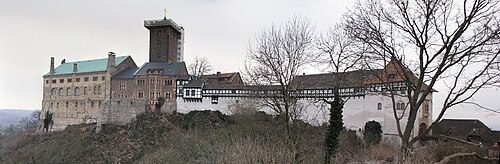
After the Diet of Worms Charles ordered that Luther be arrested. But on the way back to Wittenberg, he was captured by Fredrick the Elector and confined in Wartburg Castle to protect him from his enemies. While there he translated the New Testament into German. In 1522 he returned to Wittenberg and continued to preach and reform the church. He married Katharina von Bora after helping rescue her from a convent, and they had several children. He also finished his translation of the Old Testament into German. He died on February 18th, 1546. He had a great effect in Germany, but his writings were translated and he had a great effect wherever the Reformation penetrated.

Wartburg Castle. Source.

Blogging the Reformers: John Elector of Saxony

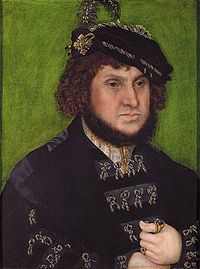
John was born June 30th, 1468 to the Elector of Saxony. His brother was Fredrick the Wise, who ruled Saxony for 39 years. Fredrick was Protestant, and supported Martin Luther and the Reformation. After Fredrick died in 1525, John succeeded him as the Elector. He was Protestant as well and was one of the political leaders of the Reformation in Germany. At the Diet of Augsburg in 1530 he stood up the the Emperor and refused to abolish the preaching of the word of God in Saxony. He was called John the Steadfast, and God used him to defend the Reformation in Germany. He died on August 16th, 1532, and was buried in the Castle Church in Wittenberg.

Civil War 150 Blog


I am starting a new blog on the Civil War for the sesquicentennial (150th anniversary.) Throughout the years of the war I will write posts about what happened at that time 150 years ago. You can visit it here. You can also sign up for email updates:

Blogging the Reformers: John Wickliffe

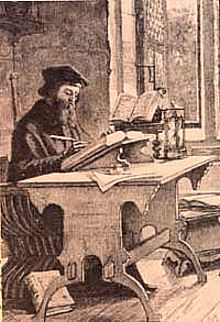
Wickliffe at work
John Wickliffe was born in 1324 in Yorkshire, England. He was saved after reading the Bible when he was frightened at the thought of death when the Black Death, which killed half the human race, arrived in London. He began to proclaim his faith to others, and he was an eloquent preacher and teacher. He became popular when he was preaching against the pope who claimed to rule England. In 1379 he became sick and four priests came to attempt to make him recant. He told them, “I shall not die, but live; and again declare the evil deeds of the friars.”1 His ministry began with attacking the pope and turned to preaching the gospel to everyone and then he permanently gave the people the word of God with his translation of the Bible. He translated it from Latin because he did not know Hebrew or Greek. It had a great effect even though it had to be copied by hand because the printing press had not yet been invented.

After translating the Bible he continued to teach the people. The church was angered because he disagreed with the doctrine transubstantiation - that Christ was killed whenever they did the mass. He was not punished because there were two people who claimed to be pope and they were too busy fighting each other. In 1384 he was paralyzed as he was administering the Lord’s Supper and he died two days later on December 31st, 1384. He was the first Reformer and a great leader of the English Reformation. D’Aubigne said, “If Luther and Calvin are the fathers of the Reformation, Wickliffe is its grandfather.”2
Wickliffe preaching
1. J. H. Merle D’Aubigne, History of the Reformation of the Sixteenth Century, (Harrisonburg, Virginia: Sprinkle Publications, 2003) vol 5, p 93
2. Ibid, p. 104

NCFIC Love the Church Conference Day 2

Friday, the second day of the conference, was the most intense. There was one breakout session before lunch, and two following lunch. I would have like to go to some of the breakouts, but I was assigned to manage the sound in the Hispanic breakout room. Also, the Kendall family sang all three days of the conference. Rachel and some of here friends were working at the Reforming to Scripture book table through the whole conference, but none of us thought about taking any pictures of it.
Mr Pollard preaching
Mr. Pollard reading from the Bible
Josue Raimundo preaching in Spanish
Listening to Paul Washer preach in Spanish
The Kendall children singing
Joel Beeke preaching
 

Snow in North Carolina

Last night it snowed for the second time where we live! We were going to post some pictures the first time it snowed, but we were too busy getting ready for the Love the Church Conference, so I will post them now.
The snow falling

The snow still falling

A view from our attic


Snow on trees the next morning


Our backyard covered in snow

NCFIC Love the Church Conference: Day 1

Last Thursday, we left at 6:30 am to drive to the Love the Church conference put on by NCFIC. We had to get there a few hours before the conference started so that Rachel could set up the Reforming to Scripture Book table, and also Joshua and I had to go to a volunteers meeting. The first message was around 5:00 pm. Mr. Brown had each of the keynote speakers come up on stage and give a summary of the messages they were going to preach. There were only a few keynotes the first night. I liked Mr. Phillips's message the first night, which was about the gates of Hades not prevailing against the church of God. Below are a few of the pictures from the conference.

The crowd during one of the breaks between messages


Jacob Burnhardt, one of the NCFIC interns, playing the piano


Mr. Phillips preaching


Two of the recording and duplicating volunteers


Joel Beeke preaching

Blogging the Reformers: John Leclerc

The Cathedral in Metz. Source.

In the 16th century, one of the cities which the French Reformation began in was Meaux. John Lecelrc, a wool-carder, became the pastor there. He had learned theology through the lectures of the doctors, reading the Bible and some other books. Eventually he made some placards denouncing the pope as an Antichrist, and posted them on the cathedral. The townspeople were very angry and he was thrown into prison. He was condemned and was led through the streets to be beaten by the people. After this punishment he was released, and then he moved to Metz.

While he was in Metz he again did a brave, perhaps rash, act against the Catholics. On the night before one of the large festivals where the citizens would worship their idols, John Lecelrc when to the chapel and smashed all of the images. The next day when the worshipers arrived at the church, they found their idols broken in pieces. They ran out and found Lecelrc in the town. He admitted to breaking the idols, and told them they must worship God alone. They decided to burn him to death. They brought him to the scaffold and took heated pincers and lacerated him and pulled his nose off. As they were doing it he recited the passage that says, “Their idols are silver and gold, the work of men's hands. They have mouths, but they speak not...”1 After torturing him he was burnt with a slow fire. He was one of the first martyrs of France.

1. Psalm 115

Beach

Two weeks ago we went to Duck, NC, which is near Kitty Hawk on the Outer Banks. We arrived Thursday afternoon. Friday morning we went to the Wright Brothers Memorial. It is on the hill from which they conducted glider tests, which was next to where they lived while they were down there and where they first flew. There was also a museum about the history of the Wright Brothers before and after they invented and flew the first airplane. After that we went to Jockey's Ridge, which is a bunch of sand dunes. It was fun to walk on and climb and roll down the dunes. Jockey's Ridge is also where people fly hang-gliders, but we did not do that. After that, we went to where the first colony, Roanoke, was located. There we saw a recreation of the earthworks which they had there. Finally, we went to a used book store. We could not stay very long because it was closing time.

On Saturday, Mommy and Rachel went shopping while Joshua and I played Axis & Allies and Daddy started writing Communion of Christ's Body. After lunch we went down to the beach. Even though the water was cold, Joshua and I swam in it while Mommy, Daddy, and Rachel took a walk on the beach. After that we packed up and came home.
A model of the Wright brother's plane while they were preparing it for take-off
Joshua and I at the Wright Memorial
The stone marking where the first flight was made from
In this photo you can see the markers for the distance of each flight. If you zoom in you can see how far the fourth marker is
Daddy, Mommy, and Rachel climbing a dune at Jockey's Ridge
Joshua and I racing down one of the dunes
A sand dune

A recreation of the earthworks at Roanoke

Sunset at our Condo

A Model of one of the Wright Flyers

Blogging the Reformers - Fredrick Elector of Saxony


Fredrick was born January 17th 1463 to the Elector of Saxony. At that time Germany was ruled by an emporer, but was composed of many different states which were very independent. Saxony was one of the major provinces of Germany. Fredrick suceeded his father in 1486, at the age of 23, and he continued in that position for 39 years. He was known as Fredrick the Wise, and was a good ruler.

However, his most important role began near the end of his life as he protected the Protestant Reformation. Martin Luther began the Reformation while he was a teacher at Wittenburg University, which Fredrick had founded. It became a place which was very influential through the teaching of Luther and others. When the Pope and the Emporer ordered Luther to be arrested and executed, Fredrick saved his life by hiding him in Wartburg Castle for several years. He refused to obey the Pope's orders to kill Luther and prevented others from doing so. Though he did not abandon all of the false doctrines of the Catholic church, he inclined toward the Reformation and God used him to protect Luther and the other leaders of the movement in Germany. He died May 5th, 1525. D'Aubigne said this of his death:


Meanwhile the cause of the Reformation itself appeared as if it would perish in the gulf that had swalled up the liberties of the people. ... [T]he aged elector of Saxony, that man whom God had raised up to defend the Reformation against all dangers from without, descended to the tomb. ... The doctrine of the Gospel was no longer to him that sword which attacks error, following it up wherever it may be found, and after a vigorous contest tripumphing over it at last; it fell upon his heart like the dew, or the gentle rain, filling it with hope and joy. Fredrick had forgotten the present world: he saw nothing but God and eternity.1


1. J. H. Merle D'Aubigne. History of the Reformation in the Sixteenth Century. (Harrisonburg, Virginia: Sprinkle Publications, 2003) volume 3, book 10, p. 199-200