Showing posts with label mistakes. Show all posts

Mistakes of World War 2 - 1943-1945


This article is the last in a series on the most important mistakes that were made during the Second World War. By 1943 most of the mistakes had already been made which caused the Axis’ downfall. But they did make mistakes in the last part of the war that would influence the world for years to come.
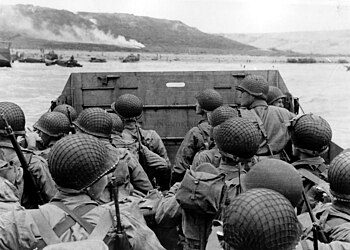
Americans Land in Normandy
Fighting to the Last
In 1944 the British and Americans landed in Normandy, France. After gaining a beachhead there they began to drive the German armies across France, Holland and Germany. At the same time, the troops that had landed in Italy in 1943 continued to push the Germans north in Northern Italy. At this point Hitler had two choices. He could order his troops at certain points to fall back so that they could organize and strike with a hard counter-attack, or he could stubbornly hold on to every inch of ground. He chose the second. This meant that although the Allies might have difficulty in conquering territory, they would not have to resist heavy and unexpected counter-attacks. He made this mistake continually as the war wound to a close. He refused to let his troops give up even an inch of ground, and instead he lost it all. He ordered one commander who desired to fall back to a stronger line, “The Fuehrer expects, now as before, the utmost steadiness in the fulfillment of your present mission to defend every inch of the North Italian areas entrusted to your command.”1 Hitler’s incorrect strategy led to the defeat of his armies, and he committed suicide on April 30th, 1945. Germany surrendered unconditionally on May 8th.
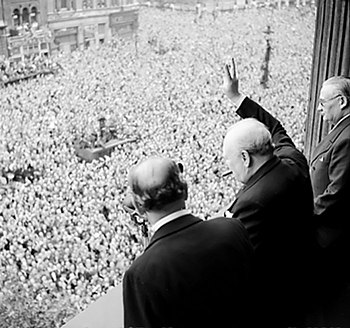
Winston Churchill with crowds on V-E day
Communism
At the beginning of the war the Soviet Union was unfavorable to the British. They were siding with Germany, and almost became an ally with them against Great Britain. But then when Germany attacked them, they wanted to become an ally to the nation they were planning to attack a few weeks before. The British decided to ignore the political, social and religious differences between them and join with them to destroy Germany. But by the end of the war it became clear that unless the United States and England did something to stop it, Russia would make much of Europe their Communist puppets.

Polish Soldier Fighting the Germans during the Warshaw Uprising
One of the first issues that came up was regarding Poland. Poland was one of the the first nations that Germany conquered, and many influential Poles fled to London and established a government there. But when the Soviets liberated Poland they set up a Polish Committee of National Liberation which were really just their puppets. England and the United States did not want communism to be imposed on the Poles, and the Russians agreed at the Yalta Conference to incorporate members of the London government into the new Polish government so that it would better represent the wishes of the people. They also agreed to allow Allied observers to enter Poland to report on what was happening there. However, they ignored their promises and set up a completely communism government in Poland.

These issues continued with the other nations of western Europe. The Russian strategy was described by Stalin when he said, “This war is not as in the past; whoever occupies a territory also imposes his own social system on it. Everyone imposes his own system as far as his army can reach. It cannot be otherwise.”2 Therefore what Winston Churchill described as an “Iron Curtain” came upon Germany because of the alliance that had been made in the heat of war and the failure of the other Allies to deny to Russia the right to overwhelm the other nations.

These problems between the United States and the Soviet Union resulted in the Cold War. While there were military conflicts which resulted from it, the United States and Russia never entered into a full scale World War. The problems existed until 1991 when the Soviet Union collapsed. All this conflict can be traced back to decisions that were made in the aftermath of World War II.

A Street in Berlin
Conclusion
These mistakes from World War II that we have examined through this series of essays are not just interesting facts from a conflict that happened many years ago. Situations like these will happen again, and at that time it will serve us well to remember the mistakes that were made by leaders of the past. Those who fail to learn from the mistakes of their predecessors are destined to repeat them.


1. The Second World War – Triumph and Tragedy (vol. 6) by Winston Churchill (Boston, Houghton Mifflin Company, 1953) p. 522
2. A History of Modern Russia: From Nicholas II to Vladimir Putin by Robert Service Source. p. 305

The Mistakes that Caused World War 2


      World War I, the bloodiest war in human history up to that time, ended in 1918. Germany and Austria had finally been driven back and defeated by the Allies (England, France, America, Russia and others.) The Allies were tired of war. Tens of thousands of British and French men had been killed for mere feet of ground. The casualties had been terrible. In England one out of every three males were casualties. The Allies believed that there would never be another World War because they had fought and won the "War to End All Wars." To make certain of that, they put stringent barriers in the Treaty of Versailles to make sure Germany would never be a threat again. Twenty years later, the same Allies were again fighting Germany. Today we will examine what mistakes that they made to cause the Second World War.


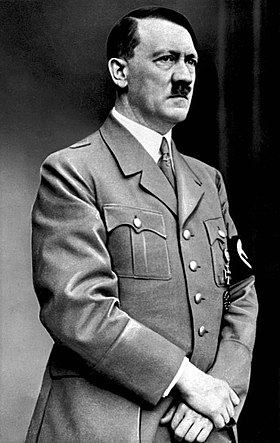
Adolf Hitler, the leader of Germany

      One of the most important mistakes that the Allies made between the World Wars was that they allowed Germany to rebuild their army. In the Treaty of Versailles, Germany was allowed only 100,000 soldiers, a 30 ship navy, no conscription (draft), no officer's school, no submarines, and no airforce. They claimed that they obeyed this requirement at the beginning, but they disobeyed it in hiding. For example, they still fostered a civilian air foce that they would be able to turn into a military one. The Allies disarmed themselves, but they allowed Germany to gradually build up their military and violate the requirements of the treaty without any punishments. Winston Churchill said, "Once Hitler's Germany had been allowed to rearm without active interference by the Allies and former associated Powers, a second World War was almost certain."1 In 1932 Germany announced that it would no longer abide by the treaty ristrictions on armaments, and much of the Allied press agreed, because they thought that it was unfair for only the Germans to be required to disarmed. In 1935 Hitler instituted compulsory military conscription, and later England agreed that Germany should be allowed to expand its navy. Up until 1934, the Allies were still strong enough that they could have avoided a war by requiring Germany to disarm, but they did not. Instead, they remained at ease while the Germans built up a military stronger than their own. Winston Churchill said, "[T]he strict enforcement at any time till 1934 of the Disarmament Clauses of the Peace Treaty would have guarded indefinitely, without violence or bloodshed, the peace and safety of mankind. "2


Hitler reviewing his troops

      The other main problem was that the Allies allowed Germany to annex and attack other nations without resisting until it was too late. In 1936 Hitler ordered the Rhineland to be occupied, which was supposed to be a demilitarized zone on the border of Germany. The Allies did nothing. In 1938-1939 Germany annexed Austria and attacked Czechoslovakia. By this time the Allies had already allowed Germany to gain an army, but it was still weaker than their own. If they had wished, they could have used their greater force to threaten Germany and avert a greater war. It should have been clear to them that although each time Hitler said that this was all the land he wanted, his desire was to conquer the world. But instead they allowed Germany's aggression and refused to stop them. But finally the English prime mister realized what was happening and declared that they would not allow Germany to take over Poland, their next target. He said,
"Is this the last attack upon a small State or is it to be followed by another? Is this in fact a step in the direction of an attempt to dominate the world by force?"3 
England promised their support to Poland if it was attacked. But they had already made their mistake, and were destined for a long war. They had refused to act when the German army was weak, and now would have to fight it when it was strong. Churchill said, "Here is a catalogue of surrenders, at first when all was easy and later when things were harder, to the ever-growing German power. But now at last was the end of British and French submission. Here was the decision at last, taken at the worst possible moment on the least satisfactory ground, which must surely lead to the slaughter of tens of millions of people."4


      These were the mistakes that the Allies made that led up to and caused the Second World War. They should be a lesson to us not to be lazy and allow things that will surely lead us into war. Churchill said,
"Still, if you will not fight for the right when you can easily win without bloodshed; if you will not fight when your victory will be sure and not too costly; you may come to the moment when you will have to fight with all the odds against you and only a precarious chance of survival. There may even be a worse case. You may have to fight when there is no hope of victory, because it is better to perish than to live as slaves."5


1 Churchill, Winston. The Second World War. (London: Cassell & Co. Ltd 1948) volume 1
2 Ibid,  p. 13
3 Ibid,  p. 270
4 Ibid,  p. 271-272
5 Ibid,  p. 272

The Most Common and Disastrous Military Mistakes of History


by Joshua Horn
From 100 Decisive Battles by Paul K. David
In the Bible we learn that God controls every aspect of history. He preordains every victory and defeat that has happened, and will happen, in all of time. God often uses the mistakes that military commanders make, to change the course of history. Now we will examine three of the most common mistakes of military commanders: the problem of relying on numbers too heavily, hesitating whether to attack or not, and not being prepared for an attack by the enemy at any time.
The first common blunder we will consider is relying on numerical superiority and prestige instead of their actual fighting power or tactical superiority. For example, in the battle of Crécy, in 1346, the French had more than five times as many men as the English, but the English longbowmen easily slaughtered the French knights. The proud French knights believed that they could not be stopped by archers, and so they charged headlong at the prepared English position. Another example is the defeat of the Russian fleet by the Japanese at the battle of Tsushima in 1905. The outdated Russian ships were easily defeated by the newer Japanese vessels. The Russians had relied too much on their prestige as having one of the most powerful navies in the world. This mistake of relying too much on numerical superiority has occurred during many battles in history.
Many times battles are lost because of a hesitation on the part of the generals. One example of this is in the Battle of Gettysburg in the American Civil War. On the first day of the battle, July 1, 1863, the Confederate army stumbled upon a few Union brigades. They attacked, and after a hard fight drove the Unions off of the hill. General Richard S. Ewell, who commanded the Confederate forces who were leading the attack, instead of attacking and pressing the retreating Federal army, could not decide whether to attack the Union position, which he probably would have carried. This hesitation on his part probably cost the Confederacy the battle, and possibly even the war. Another example of this same mistake is in the battle of Dunkirk in 1940 during World War II. For some reason, Adolf Hitler delayed pressing his attack on the British at Dunkirk, who he had surrounded, which allowed the British army to escape back to Britain. This allowed England to have trained troops to defeat Hitler's attack in the Battle of Britain. If Hitler had not decided to hold off on his attack on Dunkirk for three days, Britain might very well be part of Germany to this day.
The third common strategic blunder is not always being prepared for an attack. Many times generals feel too secure and do not set out guard to watch for an approaching enemy. One example of this is in the battle of San Jacinto in the war for Texan independence. Santa Anna, the commander of the Mexicans, believed that he had the Texan army trapped between two rivers, and so he allowed his army to take a nap during the midday heat. Sam Houston ordered his outnumbered army of Texans forward against the Mexicans. They were completely surprised, and were easily routed and defeated. George Washington used a similar tactic during his attack on Trenton in the winter of 1776. He chose to attack on the day after Christmas, when the Hessian garrison was sound asleep from parties the night before. He crossed the icy river when no one expected him to be able to, and his army easily overcame the surprised Hessians. This victory at Trenton gave a moral boost to the Americans, and it gave encouragement to soldiers to join the American army, so that they could continue the war. Many surprise attacks such as these two have changed the course of wars, and ultimately of history. One of the most important principles of war is to not let yourself be surprised, and battles and wars have been lost by not paying attention to it.
We have just looked at three of the most common mistakes in military history. These are relying on numerical superiority, not being always prepared for an attack, and hesitating at the critical moment of the battle. God has used them many times in the course of history, and many battles and wars have been lost because the generals did not consider what military mistakes God had ordained to happen in the past, and did not watch out for those mistakes in their own generalship. These mistakes have occurred many times throughout the course of history, and God will probably use them many times more before the end of the world.
Buy the Book - 100 Decisive Battles: From Ancient Times to the Present