Blogging the Reformers: Thomas Cranmer


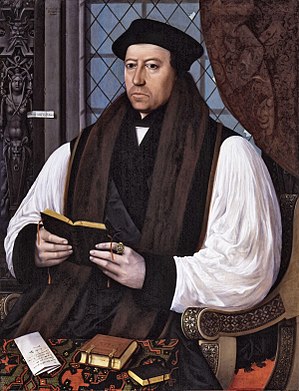
Thomas Cranmer was born in England in 1489. He attended Jesus College in Cambridge, and later taught there. He assisted King Henry VIII in 1527 to make a theological argument for why he could divorce the queen. In 1532 Henry appointed him Archbishop of Canterbury to assist him in reforming the church. The king was not a Christian, but to increase his own power he broke from the Pope and appointed himself as head of the church. At some points he would lean toward the Reformation, and at others toward the Catholics. During his 22 years as Archbishop, Cranmer worked to advance the Reformation, but he was timid and at times went along with the king against the Reformation. In 1553 he was arrested by the Catholic Queen “Bloody” Mary and was tried for heresy. He was convicted to be burnt, but eventually recanted all Lutheran doctrine and acknowledged the pope as head of the church. Instead of absolving him, Mary commanded him to be burnt anyway. Before his execution, he was given the opportunity to preach. He wrote a sermon in which he again recanted, but instead of giving the sermon he renounced the recantations and said that he would rather be burnt than recant. He was pulled from the pulpit and taken to be burnt. As he was burning, he stuck his right hand into the fire because it was the one which he used to sign the recantation. He died March 21, 1556.

D'Aubigne on Cranmer
“Cranmer moved forward slowly: he modified an evangelical movement by a clerical concession. When he had taken a step forward, he stopped suddenly, and apparently drew back; not from cowardice, but because his extreme prudence so urged him. The boldness of a Farel or a Knox is in our opinion far more noble; and yet this extreme moderation saved Cranmer and protestantism with him. ... God gives to every people and to every epoch the man necessary to it. Cranmer was this man for England, at the time of her separation from the papacy.” 1


Cranmer's Last Sermon
“And now forasmuch as I am come to the last end of my life, whereupon hangeth all my life past, and all my life to come, either to live with my master Christ for ever in joy, or else to be in pain for ever with the wicked in hell, and I see before mine eyes presently, either heaven ready to receive me, or else hell ready to swallow me up; I shall therefore declare unto you my very faith how I believe, without any color of dissimulation: for now is no time to dissemble, whatsoever I have said or written in times past.

First, I believe in God the Father Almighty, Maker of heaven and earth, etc. And I believe every article of the Catholic faith, every word and sentence taught by our Savior Jesus Christ, His apostles and prophets, in the New and Old Testament.
And now I come to the great thing which so much troubleth my conscience, more than any thing that ever I did or said in my whole life, and that is the setting abroad of a writing contrary to the truth, which now here I renounce and refuse, as things written with my hand contrary to the truth which I thought in my heart, and written for fear of death, and to save my life, if it might be; and that is, all such bills or papers which I have written or signed with my hand since my degradation, wherein I have written many things untrue. And forasmuch as my hand hath offended, writing contrary to my heart, therefore my hand shall first be punished; for when I come to the fire it shall first be burned.

And as for the pope, I refuse him as Christ's enemy, and Antichrist, with all his false doctrine."2


1 J. H. Merle D'Aubigne, History of the Reformation in Europe in the Time of Calvin (Harrisonburg, VA: Sprinkle Publications, 2000) volume 5, book viii, p. 54

2 Foxe, John Foxe's Book of Martyrs (New York: Eaton and Mains, 1911) Google Books. p. 384-385

Blogging the Reformers: Oliver Cromwell

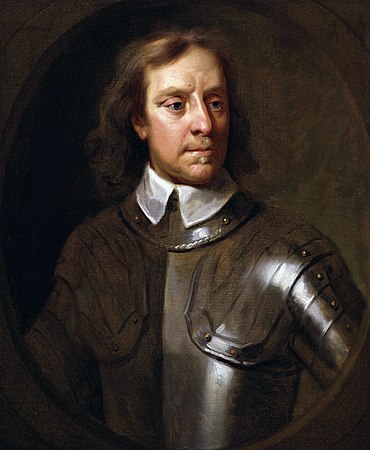
Oliver Cromwell was born in Huntingdon, England on April 25, 1599. His family was in the lower class of gentry, and he remained fairly obscure for the first part of his life. He married Elizabeth Bourchier on August 22, 1620 at 21 years of age. They had nine children. He was saved sometime later, and became a zealous Puritan. One biographer said, “He was henceforth a Christian man, not on Sundays only, but on all days, in all places, and in all cases.” Another said, “Oliver Cromwell was now a real Christian: he remained one until his last breath; and, if we except a few moments of trouble, to which the most godly men are subject, he persevered in faith and confidence till his course of mortality was completed.”

Read more here.

More Snow Pictures


Blogging the Reformers: John Alasco

John Alasco was born into one of the most influential families of Poland in 1499. At the age of 25 he was a Roman Catholic, but had heard of the Reformation and wished to examine it more fully. Therefore he traveled to Europe, and arrived in Zurich in 1525 to see Zwingli. He said to him, “Apply yourself, to the study of the sacred writings.”1 He later went to see Erasumus, and stayed in his house while he was there. Erasmus also gave him the advice to study the scriptures. Alasco therefore learned Hebrew and Greek and studied the scriptures. But when the king of Poland heard that he was with Erasmus, he ordered him to return to Poland and associate with nobility, since he was the heir to the throne. While in Poland, he was convinced to sign a document saying that he was a Catholic, but later he became a clear Protestant. He lost the kingdom and left Poland for the sake of Christianity. D'Aubigne said, “Alsco does not stand in the first rank of the men of the Reformation. But in one respect he surpassed them all ... He knew better than any one what it was to sacrifice for Jesus Christ the world...”2 He left Poland, and ministered in Friesland, the Netherlands, England and other places. He died on January 8th, 1560.

1 J. H. Merle D'Aubigne, History of the Reformation in Europe in the Time of Calvin (Harrisonburg, VA: Sprinkle Publications, 2000) volume 7, book xiii, p. 435

2 Ibid, p. 451

The Three Most Influential Changes in the British Navy From AD. 660-1815

by Stephen Horn
based on The Safeguard of the Sea and The Command of the Ocean by N.A.M. Rodgers

The seas were an influential part of the British Nation. They were used for raids and invasions by other nations, and since Britain is an island its ships were an important part of its defense system. Some of the important changes that were made to ships during AD 660-1815 were the removal of infantry from the ships, the addition of cannon, and the additions in sails and masts. All of these changed the ships and their warfare. Around 660, the ship was the Viking ship, with one mast, and oars for when there was no wind. The main way the ships fought was with the soldiers on board. Around 1815, the ships were mainly men o’ war, with three masts and many sails. The main weapon on these was their cannon, men only boarding a small minority of the time.

Read More

Snow in North Carolina

On Friday and Saturday it snowed 6 inches here! Here are some pictures:


Stephen shoveling snow

More pictures are here.

If you have not seen it yet, you can see the video we put up before of us sledding here.

New Hampshire Conference: Day 2-3

Sorry that we have not completed this post. The next day we had breakfast, and Daddy did Living the Gospel in which he said that you should live the gospel out in your life when you share it with others. Then he did Defending the Gospel. His main point was that every false argument has to contradict itself at some point. Then we had lunch and there were a few hours of free time. Daddy was preparing his next talk, and we talked to people and played broom ball on a frozen pond. Daddy's last message was Sharing the Gospel and he talked about telling people the gospel. Then after dinner we left, and Daddy, Stephen and I went to the pastor's house to spend the night, while the rest of our team went to another elder's house. The next morning we went to church, and ate lunch at one of the elder's house, then left for home. We arrived at home very early the next morning.

Blogging the Reformers: Peter Viret

Peter Viret was born in Orbe, Switzerland in 1511. At twelve years of age he went to the University of Paris to study as a Catholic. There he met William Farel, who he would later work with in Geneva. When he returned to Orbe, the city was in conflict between Roman Catholicism and the Gospel. There he was saved and preached the gospel. In 1534 he went to Geneva, and was one of the leaders of the Reformation there along with William Farel, Antonio Froment and John Calvin. He suffered persecution there from the Catholics. At one point he was badly wounded during a riot by the Catholics, and then became very ill after they convinced a woman to poison his soup. He recovered after almost dieing, but felt the effects of the poison his entire life. He became the pastor of Lausanne in 1541, and continued there for 22 years. At different times he was also a pastor at Berne, Geneva, Orbe, and other towns. One man said, “He handled the Scripture well, and he was gifted with eloquence which charmed the people.”1 He died in Switzerland in 1571.

1 J. H. Merle D'Aubigne, History of the Reformation in Europe in the Time of Calvin (Harrisonburg, VA: Sprinkle Publications, 2000) volume 7, book xi, p. 12

Sledding

It has snowed 6 inches here, and we were able to sled. Here is some video that we took:

Sledding 2010 from Joshua Horn on Vimeo.

Civil War Cavalry Skirmish

View HD here.


Here is a rough edit of some of the video from the reenactment that we went to a few months ago.

Blogging the Reformers: Baudichion de la Maisonneuve

Baudichion de la Maisonneuve was one of the leading men of Geneva in the 16th century. He was very influential in bringing the Reformation to Geneva and defending the city's liberty. He was one of the first men in Geneva to be converted to the Reformed religion. Later in the Reformation his house became one of the meeting places for the Huguenots. The Reformation in Geneva was not peaceful. Several times mobs attacked the Huguenots in Maisonneuve's house. In 1534 he was arrested in France and sentenced to be executed, but finally after the request of the town of Berne, Switzerland the king ordered him to be released and allowed him to return home. He was appointed captain-general of Geneva, and led the army to battle against their enemies. D'Aubigne said that he was “a man of noble and exalted character, bold, welcome everywhere, braving without measure all the traditions of old times, often turbulent, and the person who, more perhaps than any other, served to clear in Geneva the way by which the Reformation was to enter.”1

1 J. H. Merle D'Aubigne, History of the Reformation in Europe in the Time of Calvin (Harrisonburg, VA: Sprinkle Publications, 2000) volume 1, book I, p. 142

Blogging the Reformers: Aime Levet

Aime Levet was an apothecary in Geneva in the 16th century. When Antoine Froment first came and brought the Gospel to Geneva, Levet was against it, but eventually his heart softened. In 1533 he was won over to Christianity by his wife, and he became one of the leading Huguenots. The religious meetings were frequently held in his house. When Froment was attacked by a mob, Levet hid him in his house. A few months after Levet’s salvation the bishop of Geneva forced him and many other Huguenots to flee, but a troop of soldiers pursued and caught him. After beating him, they threw him in prison without a trial. After the overthrow of the bishop, he was released and continued to spread the Reformation. In 1536 he was elected one of the four syndics, or magistrates, of Geneva.

New Hampshire Conference: Day 1

On Friday, January 8, we got up at 3:00 am to go to a conference that my dad was speaking at in Rindge, New Hampshire. It was hosted by a church up there. Four other people from our church came with us. We arrived at 5:00 pm. We ate Dinner at 6:00 pm, and Daddy's 1st message was at 7:30 pm. It was an evangelism conference, so he gave a talk was on "Knowing the Gospel." It was a good message. We were going to record it, but the recorder was in the camera bag, and we left it at home, so we do not have the recordings or any pictures.

Blogging the Reformers - Alexander Alesius

Alexander Alesius, or Ales, was born in Scotland on April 23rd, 1500. He graduated from St. Leonard's University in St. Andrews at the age of 15. He was convinced of Catholic scholastic theology and he desired to debate with the Reformers. For this purpose he visited Patrick Hamilton, who had been a student in St. Andrews. After many debates, he said, “I thought that I should bring Hamilton back to the doctrine of Rome, and instead of that he has brought me to acknowledge my own error.”1 After watching Hamilton be burned at the stake for his beliefs a short time later, he became thoroughly convinced of the truth of the Reformation. The prior at St. Andrews tried to trap Alesius by having him preach, afterwards he brought in soldiers to arrest him. When Alesius begged him not to shed innocent blood he was about to stab him, and then when he fell on the ground and pleaded for mercy the prior kicked him so hard that he fainted. The prior then threw him in the dungeon. The king himself ordered him to be released and the prior promised to do so, but as soon as the king left he threw him into prison again. Eventually his fellow canons were able to get in the prison and release him, and he fled to Europe. He spent the rest of his life in Germany and England, continuing to teach the reformed truth. He died on March 17th, 1565.

1 J. H. Merle D'Aubigne, History of the Reformation in Europe in the Time of Calvin (Harrisonburg, VA: Sprinkle Publications, 2000) volume 6, book x, p. 52

Stephen Walking on Ice


Yesterday at our Grandmother's house the ice on her pond was thick enough to walk on. This is very rare for North Carolina. (Safety Note: The ice should be at least three inches thick to walk on, and you should not test it in the middle of the pond. :) We actually had already tested it)

Blogging the Reformers - Juan Diaz

Juan Diaz was a Spaniard who went to Paris to study at the Sorbonne in 1532. He was saved by reading the scriptures in the original languages, and discussing them with James Enzinas. In 1545 he left Paris and went to Geneva. After speaking with Calvin there, he went to the Reformed churches in Germany and elsewhere. When his brother Alonzo heard that he had become a Protestant he was very angry. Though he loved his family, Alonzo would rather that they die than be a heretic. Therefore he went to Germany to attempt to convert Juan back to Catholicism, but Juan said, “I am ready to suffer anything for the sake of publicly confessing the doctrine which I have embraced.”1 Alonzo was convinced that he could not convert him back to the Roman faith, so the next morning, March 27th 1546, he went to his house with his servant early in the morning. He sent his servant into the house with a letter while he waited outside. While Juan was reading the letter, the servant crept up behind him with a hatchet and plunged it into his head. Alonzo and his servant fled as fast as they could, and Juan died an hour later. For this murder, Alonzo was raised to high honor by the Emperor Charles V.

1 As quoted in J. H. Merle D'Aubigne, History of the Reformation in Europe in the Time of Calvin (Harrisonburg, VA: Sprinkle Publications, 2000) volume 8, book XIV, p. 109

Blogging the Reformers - Hugh Latimer


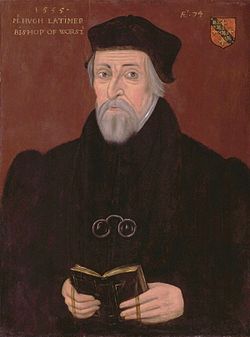
Hugh Latimer was born in a poor family in England somewhere between 1480 and 1494. He attended Cambridge University and became a priest. At some point in his life he accepted the Reformed doctrine and became one of the leaders of the movement in England. King Henry VII made him one of his chaplains. He preached boldly before the king and his court, and even rebuked the king in his sermons. He said to the king, “Would you have me preach nothing concerning a king in the king's sermon?”1 Eventually after a time there he decided to leave the court and go to his parish, which he did. He was a great preacher, a powerful orator, and he effected many people through his preaching. He was appointed bishop of Worcester by the king, but he resigned years later after he opposed the king's Catholic false doctrine. The king threw him into prison until he died, and then his son Edward released him and he continued to preach. However when Bloody Mary came to the throne, she tried him for his beliefs and he was burned on October 16th, 1555 along with two other leaders of the English Reformation, Thomas Cranmer and Nicholas Ridley. As he was about to be burnt, he said to Nicholas Ridley, “Be of good comfort, Master Ridley, and play the man; we shall this day light such a candle, by God's grace, in England, as I trust shall never be put out.”2

1 J. H. Merle D'Aubigne, History of the Reformation in Europe in the Time of Calvin (Harrisonburg, VA: Sprinkle Publications, 2000) vol. 3, book vi, p. 51
2 John Foxe. Foxe's Book of Martyrs (New York: Eaton & Mains, 1911) p. 309

Sufficiency of Scripture: Day 3

The first keynote on the third day of the Sufficiency of Scripture conference was by Kevin Swanson on "The Sufficiency of Scripture and Family Integration." The next message was a breakout. The message in the room that I ran the sound in was Andy Davis on "The Sufficiency of Scripture for Habits of Obedience." Then there was the lunch break. After the lunch break, I was in a talk by Paul Washer on "The Importance of Biblical Family Life for the Spread of the Gospel." It was a very good message. After that was a keynote, which I did not hear. We did not go to The Mysterious Islands screening because we had seen it at the premier in Durham, NC. You can read the post about that here. You can buy the CD Set from the Sufficiency of Scripture conference here.


Daddy giving his "How can a Loving God say to...?" talk

Military Mistakes of World War 1 - Part 2

Mistakes of World War 1
  1. Part 1
  2. Part 2


by Joshua Horn
View Part 1

In part one we examined three of the mistakes of World War I, one of the biggest wars in world history. These were the German navy's failure to attack at the beginning of the war, the Allies' frontal attacks and the Allied defeat at the battle of the Dardanelles. Today we will examine three more of the mistakes of World War I, the continued attacks of the Allies, the German U-boat war and the German frontal attacks. All these mistakes, and many more, contributed to create one of the bloodiest wars of human history. World War I changed Europe forever. In Britain alone one third of the male population were casualties. We should learn from these costly mistakes of history so that we will not make similar errors.

Read More

Blogging the Reformers: John Calvin


John Calvin was born on July 10th, 1509 in a humble family. He began by studying for the priesthood, but his father later transferred him to the study of law. When he was at the University of Orleans God saved him when he was about 23 years old through the study of the scriptures. When he was saved he would study the Bible at night after studying law during the day. In 1533 he returned to Paris, and continued teaching those around him. The same year he was forced to flee because of a bold sermon he wrote for his friend Nicholas Cop, a Protestant who was rector of the university. He moved on to Switzerland, where he published the first edition of his great work, Institutes of the Christian Religion in March, 1535. In it he gave a systematic theology of the Christian religion. He continued to revise it throughout his life. He then went to Italy, and after a time was captured by the Catholics. He was rescued by some friendly soldiers, and then he traveled north again. On his was he stopped by Geneva for the night. Geneva had been recently reformed through the work of William Feral and others. Feral asked him to stay in Geneva instead of going on to Strasbourg to study. He said, “Ought the servants of Jesus Christ to be so delicate as to be frightened at warfare? ... May God curse your repose ! may God curse your studies, if in such a great necessity as ours you withdraw and refuse to give us help and support!”1 Calvin agreed, and he became a pastor at Geneva. He helped continue to work for the reform in Geneva. At that time he also helped defend true doctrine in other churches. He was an able debater against heretics. In 1538 he was banished from Geneva for three years by the enemies of the reformation, but after that time he returned. While he was banished he married Idelette de Bure. When he returned to Geneva he continued to teach and preach. He had a great effect on other reformers from other nations, and Geneva sent out hundreds of missionaries to places as far as Brazil.2 He was the most able defender of the Reformed faith from all its enemies. He died in 1564. He was one of the most prominent reformers, and he has had a great effect on many people through his writings, even to this day.

1 J. H. Merle D'Aubigne, History of the Reformation in Europe in the Time of Calvin (Harrisonburg, VA: Sprinkle Publications, 2000) volume 3, book ix, p. 460-461

2 Ray Van Neste John Calvin on Evangelism and Missions. Web. http://reformed-theology.org/html/issue04/calvin.htm Accessed December 22nd, 2009

Sufficiency of Scripture Conference Pictures

I helped take pictures at the Sufficiency of Scripture conference a few weeks ago. Here are a few that I took:


Mr. Phillips


Scott Brown


Conference Attendees


Blogging the Reformers: Mathurin Cordier

Mathurin Cordier was born in 1540. He was a French teacher. He did not just teach because of ambition, he desired for his students to actually learn. He was one of the best teachers in France. He taught John Calvin when he was fourteen. Calvin later said, “O Master Mathurin, O man gifted with learning and great fear of God! When my father sent me to Paris, while still a child ... it was God's will that I should have you for my teacher, in order that I might be directed in the true path and right mode of learning; and having first commenced the course of study under your guidance, I advanced so far that I can now in some degree profit the Church of God.”1 Though neither of them were saved at the time, Cordier later was saved and fled to Geneva where Calvin was the preacher. The professor then studied under his former pupil. He died in Geneva in 1564, the same year as Calvin.

Sufficiency of Scripture: Day 2

The first keynote on the second day was by Voddie Baucham on "The Sufficiency of Scripture for Manhood and Womanhood." The next message was by Doug Phillips on "The Sufficiency of Scripture and the Heart of NCFIC." The next five messages were break-outs. I ran sound in one of the breakout sessions, which was "Scripture is Sufficient for Women’s Ministry Part 1: Teachers of Good Things." The next breakout, "The Sufficiency of Scripture and Personal Evangelism" by Paul Washer was in my room. It was a very good talk. The last breakout for the day in my room was, "Scripture is Sufficient for Women’s Ministry Part 2: Keepers at Home," by Jeff Pollard. The next message was the keynote,"Is the Sufficiency of Scripture a Bible Doctrine?" by Dr. Joe Morecraft, which I was not able to hear. Then there was another keynote, "Scripture is Sufficient for Ministry to Youth" by Scott Brown. The last keynote was, "The Sufficiency of Scripture and the Gospel," by Paul Washer. I was able to hear most of it and it was a very good message. It made people really question whether or not they are saved, and if they really love Jesus.

Tyranny Eve

Tomorrow morning a group of men will gather on the steps of the Capital building to protest the Health care bill. I may be going. To learn more, view the video below and visit TyrannyEve.com.

A Snowman

Here is a snowman that we made today:


Sufficiency of Scripture: Day 1

We arrived in Covington, Kentucky around 2:30 am for the Sufficiency of Scripture Conference. After we ate breakfast at our hotel, we went to the Ohio Book Store. We could not stay very long because Daddy had to go to a leadership luncheon. After we ate lunch, Joshua and I took a box of our book, Sanctified by God, to the NCFIC book table. We stayed over there until the first keynote. The first keynote was by Scott Brown called "Do Not Learn the Ways of the Gentiles." After that Doug Phillips gave a message on "The Defining Battles in the War Against the Sufficiency of Scripture." The final message for the night was by Ken Ham on "Our Declining Church and Culture: the Genisis Connection and How to Continue a Godly Heritage." Joshua and I did not hear the last two because we were helping with recording. We will be posting some pictures later.

Snow in North Carolina!

Right now it is snowing in North Carolina! There is less than an inch on the ground now, but it is supposed to snow all night. My mother said she only remembered it snowing before Christmas once before in the 36 years she has lived here. We are at my father's office building in Durham right now, and here are a few pictures. We will try to post again tomorrow.


Snowflakes falling

Blogging the Reformers: Queen Joanna


Joanna was born to King Ferdinand and Queen Isabella of Spain in 1479. Her parents were Catholics and persecuted the Christians in their kingdom. Her parents married her to Phillip, Archduke of Burgundy. Around this point in her life she began to move toward the Christian religion that her parents persecuted. She refused to participate in the Roman Catholic services. In 1500 she had a son, who would later be Emperor Charles V. He would be one of the great persecutors of the Christians. In 1504 her mother Isabella died, leaving Joanna as the next heir to the throne. But since she was a Christian, her husband and father conspired to keep her from taking the throne by claiming that she was insane. She was kept in a cruel prison until her death in 1555, at the age of 76. As she was dying she refused the Roman rites, and her last words were, “Jesus Christ crucified, be with me.”1

She was buried at Granda, Spain. We visited that castle on our trip to Europe this spring. Here are a few pictures.


1 J. H. Merle D'Aubigne, History of the Reformation in Europe in the Time of Calvin(Harrisonburg, VA: Sprinkle Publications, 2000) volume 4, book XIV, p. 139

Blogging the Reformers: Thomas Cromwell, Earl of Essex


Thomas Cromwell was the servant of Henry VIII, king of England. He was born in lowly estate in 1485, and was raised by the king to be one of the principle men of the kingdom. He was a Protestant, and worked to establish the true religion in England. He was the king's chief minister for eight years, and served him faithfully. His main mistake was to be to faithful to Henry even when he turned against the gospel. Henry was very inconsistent and variable throughout his reign. At one point Henry would incline towards the Protestants, and at another toward the Catholics. In 1540 the Catholics convinced him to arrest Cromwell because he was one of the best proponents of the gospel. The charges presented against him were clearly falsehoods, so the Catholics decided to proceed without trial. Even though Cromwell had always been faithful to him, Henry ordered him to be beheaded. As his hour of death drew near, Cromwell wrote, “Lord! Into thy hands I commend my soul; Lord Jesu! Receive my Spirit! Amen.”1 He was beheaded on July 28th, 1540. Henry later realized that he had executed his most faithful servant, and regretted it until his death.

1 J. H. Merle D'Aubigne, History of the Reformation in Europe in the Time of Calvin (Harrisonburg, VA: Sprinkle Publications, 2000) volume 4, book XV, p. 224

Hilton Head - Day 2

The next day, November 29th, we drove down to Savanah, Georgia. The first place we stopped was Fort Pulaski. Fort Pulaski was a Civil War fort named after a Polish general in the revolutionary war who was wounded near Savanah and died shortly after. Fort Pulaski was captured near the beginning of the Civil War. It was designed by Robert E. Lee while he was an engineer in the army before the war. The Confederate commander surrendered the fort even though he could of held it for much longer. After that, we drove down to the river walk and ate lunch at a shrimp restaurant. We stopped by some candy places on the way back to the car and ate samples. Then we went to the visitors center, and bought a driving tour CD. It was very interesting, but all of the squares in Savanah got kind of boring. We could not take many pictures because our camera battery was almost dead. Here are some pictures that we did take:
One the fort's cannons

One of the walls of the fort

Another one of the cannons

The drawbridge of the fort

A mural of General Pulaski on the side of a monument to him in Savanah

Hilton Head - Day 1

On November 27th, we drove down to Hilton Head, SC to spend the weekend with our Grandparents. On November 28th, Thanksgiving Day, Grandma, Grandpa, Rachel and I went on the beach to take a walk, and to fly a kite which they gave us. It was fun. Daddy, Joshua and Mommy had to stay back to work on the book, Sancitified by God. It was too cold to go swimming in the ocean. When we came back, we started preparing for Thanksgiving dinner. We ate at about 2:00 pm. After that, we all went for a walk on the beach. Here are some pictures:
Our kite

My Grandmother

The ocean

The Sunset

Daddy flying the kite

From Left to Right, Grandma, Mommy and Rachel

Sanctified By God

We recently finished my father's first book, Sanctified By God: A Call to Keep the Christian Sabbath. It is currently at the printers, and will be available this weekend at the Sufficiency of Scripture conference.

We are commanded by God to "Be holy for I am holy." But the first time God declares something holy, it is not a person but a day. By setting that day apart, He set a pattern for all men everywhere to follow, and those who do not do so are rebelling against God. We are to treat the Sabbath holy as a sign that God has set us apart to Himself. This book is a call for Christians to return to keeping the Sabbath and walking as a people sanctified by God.

If you will not be at the Sufficiency of Scripture conference, you can preorder it online now. It is on our new website, ReformingToScripture.com, which is currently under construction.

Fort Branch Reenactment

On November 7th we went to a Reenactment at Fort Branch, NC. I enjoyed it. We filmed some, and also took a lot of pictures. It was good, and I would like to go to another one. At Fort Branch there are some original breastworks that the Confederates made. You can go to their website here. There was not really a battle here during the Civil War because the Confederates retreated before the Federals' advance, but they have a reenactment anyway. Here are some pictures:

A Calvary Skirmish

The Union Advance

The Confederate Battle line

A Confederate Cannon Firing

Military Mistakes of World War I – Part 1

Mistakes of World War 1
  1. Part 1
  2. Part 2

by Joshua Horn
based on The Great War by Winston Churchill


World War I began in 1914. It quickly spread throughout all of Europe, and much of Africa and the Middle East. It was one of the bloodiest wars of human history, with 37 million casualties. In Great Britain alone there were over 1 million dead, one third of the British male population were casualties. Until World War II it was called the Great War and the War to End All Wars. The war had a great lasting effect. In England and France the people believed that after that war there would be nothing worth fighting for again. This greatly contributed to World War II. There were many mistakes made on the Central Powers' side which caused the war to be lost and on the Allied side caused it to be greatly prolonged. Today we will look at three of the mistakes: the German navy's failure to attack, the Allies’ destructive frontal assaults and the battle of the Dardanelles.

Read More

The Mysterious Islands Premiere


Tuesday night we went to a premiere of The Mysterious Islands at the Carolina Theater in Durham. Over 800 people attended. It was very well done, and it is very interesting and exciting. The Mysterious Islands is the story of a team from Vision Forum that went to the Galapagos Islands off South America. They did this because the Galapagos is where Charles Darwin went and got the ideas for the theory of evolution. 2009 is Charles Darwin's 200th birthday, and the 150th anniversary of his book, On the Origin of Species where he first set out his theory of evolution. The movie shows how evolution is scientifically impossible through the animals of the Galapagos. It also shows that evolution led to the bloodiest century in the last millennium, through people like Margret Sanger and Adolf Hitler. Evolution caused all this bloodshed because people were attempting to speed up natural selection by killing off 'lesser' human races. The film was very well done, and we would recommend it. For more information, visit their website. For pictures see Mr. Phillip's post.


At the far end of the world, there exists a strange and unusual chain of islands, resting above vast tectonic plates.

This is the world of the Galápagos Archipelago, home to salt-spitting marine iguanas, flightless cormorants, and giant tortoises that can live to be more than 150 years of age. It is also the birthplace of Darwinism, for here in 1835, a young Charles Darwin began to formulate a theory which would turn the world upside down. More than a century and a half later, these mysterious islands remain at the center of a controversy that has shaped the way modern men perceive science, religion, and life itself. The unique ingredients found on the Galápagos have led many of Darwin’s followers to describe it as Darwin’s Eden — a “laboratory of evolution.”

Now, for the 200th anniversary of Darwin’s birth and the 150th of his seminal work, On the Origin of Species, Doug Phillips leads a team of Christian scientists and investigators to this “ground zero” in the war of the worldviews. Seen through the eyes of 16-year-old Joshua Phillips, who joins his father and noted researchers like Dr.John Morris of the Institute for Creation Research, The Mysterious Islands is the story of one boy’s search for answers to the great controversy of the modern world. It is a refreshing father-and-son adventure that combines cinematically breathtaking footage with high adventure. The quest: to determine whether the Galápagos Islands are a laboratory of evolution, or a testimony to creation.

This beautiful, ninety-minute documentary takes viewers deep beneath the ocean waves, among hundreds of white-tip sharks, into volcanic craters with giant lizards, and to the unusual habitat of the Blue-footed booby. Featuring the only team of Creationists and Christian scientists to shoot a documentary on the Galápagos in 2009 — Darwin’s anniversary year — the film brings a fresh perspective on the Theory of Evolution and presents stunning cinematography of one of the most desolate and fascinating locations in the world.


For more information on The Mysterious Islands, visit their website.

Reformation Celebration Dinner

On Friday October 31 our church had a dinner celebrating the reformation at Forks Cafeteria, in Wake Forest. We ate dinner and then five of the young men at our church talked about the five Solas of the Reformation, which are: Sola Scriptura, which means by Scripture alone, Solo Christo, which means by Christ alone, Soli Deo Gloria, which means Glory to God alone, Sola Fide,which means by Faith alone, and Sola Gratia, which means by Grace alone. After one of them talked, Mr. Brown led us in a song about the Sola, and then Daddy talked about how it effects us today. After that we had a time where the people could share what they were thankful for, and then people fellowshipped until it was time to leave.

One way that we have benefited from the reformation is that we can have assurance of our salvation by the gift of faith, and not live in superstition and fear like the Roman Catholics. We can be thankful that we do not have to rely on our good works for salvation, because we would never be sure we had done enough. Daddy also said we have light bulbs and electricity today because of the Reformation.


Lexington and Concord: Who Won?

by Stephen Horn based on Paul Revere’s Ride by David Hackett Fischer

Paul Revere


The Battle of Lexington and Concord was the first battle fought between the Militia and the Regulars in the First War for American Independence. The Regulars were commanded by Francis Smith and were on a mission to destroy the military stores in Concord, and also to catch Sam Adams and John Hancock. The American spies in Boston found out about this and sent out messengers to tell the militia to be ready. There were great quantities of military stores at Lexington and Concord, which the Americans needed to resist the British. They also wanted to catch Sam Adams and John Hancock who were two leaders of the War for American Independence. The Regulars lost because they failed to accomplish their mission, they were driven back, and they had more casualties.

The first reason the Regulars lost that we will discuss is that they did not fulfill their mission. The main reason for this is that although it was a top secret operation, the word of it got out, and most of the military stores had been moved. Sam Adams and John Hancock had already left from there, but they had not left for long when the British came to Lexington. After having routed the Lexington militia, they forced one of the residents to tell where a few brass cannons were buried, which the Americans had not been able to remove. They burned the wooden parts of these, along with a few other military stores. They had expected to be able to destroy more than this. This fire spread to some of the buildings in the town, which both the towns people and the Regulars soldiers were trying to put out. This and some other incidents were strange, and they showed that they still considered themselves the same people. This fire had the effect of making the Militia in Concord come out against them, as the Militia thought the Regulars were burning the town.

Concord Bridge


The Regulars had driven back the few militiamen at Lexington, but the Militia who had gathered at Concord drove the Regulars back. They were stationed at a bridge and commanded to hold it. When the Regulars saw the Militia advancing, they tried to pull up the planks on the bridge, which maddened the militia who were from around there. The Regulars were commanded to form into street formation, which was designed to concentrate the fire of a large number of men into a small area. They got confused and disorganized while getting into this formation. Only the front ranks could fire, but they did not show their usual discipline. They only fired a few ragged volleys, which were aimed high and did not do much damage. The militia’s volleys on the other hand were aimed carefully, and took much effect. The Regulars were trained to fire in volleys in front of them, and not at specific targets. The militia were mostly men who had to hunt for their food, so they were good shots, and they fired at individual targets which brought better results. In the first volley from the Militia at Concord four of the eight Regular officers were killed. The Militia drove the Regulars out of the town. The Militia were reinforced by more Militia from other parts, and they ambushed the Regulars wherever they could as they retreated. A few of these traps were sprung too soon, but many of them were fatal to the Regulars and disheartened them. The Militia decided on a plan to harass them where there was a circle of men around the front of the column who would fire, and then retreat, load and fire again, and keep repeating. This plan worked well. Many of the Regulars were thinking of surrendering, as one Lieutenant Barker of the Regulars said, “We must have laid down our arms, or been picked off by the rebels at their pleasure.”1 When they came to Lexington Green they found a brigade of Reinforcements waiting for them there, and also a cannon. This cannon did not have many rounds, since an artillery wagon which was sent for had been ambushed and captured by some men who were too old for the Militia. The British finally made it back to Boston.


Another reason why the British lost was because they suffered more casualties. The total of the men killed wounded or missing was 300 for the Regulars, but only 93 for the Militia. The reasons for this were mainly that they only fired ragged volleys, and never altogether, and also what was mentioned previously about the militia being better shots. The Regulars had left Boston with 700 men. Only 300 of them had deployed to drive off 77 militia who had gathered at Lexington. At Concord, only 100 of them were at the bridge, when they were driven back by the 400 militia. All of the casualties were not from these engagements though, many of them were from ambushes on the march back. By the end of the day, there were 3,800 Militia, and 1,500 Regulars. The reinforcements for the Regulars might of changed the tide of the battle, if they would have come sooner, but they still saved the rest of the British force.


The British lost because they did not fulfill their mission, they were driven back, and they suffered more casualties. This battle showed that the British troops were not invincible, and they could be beaten by the American militia. This was the first battle of the war, but it had been clear that there was going to be a war before that. The battles of Lexington and Concord did not start the war. The British returned defeated, and with their mission unaccomplished. The Regulars had to be reinforced, or they would have been destroyed. The British might have retreated with fewer casualties if they would have been able to hold the militia back at the bridge until the reinforcement Brigade came up.

1 David Hackett Fischer, Paul Revere’s Ride (New York: Oxford University Press, 1994) p. 232

The Mysterious Islands Premiere


Our church is hosting a premiere of the Mysterious Islands on November 17th. You can see the trailer below:


Valley Tour CDs Now Available!

The MP3 CD from the Valley Tour is now available for sale! To purchase it, please click here.

Join Dan and Joshua Horn in the study of one of the most important campaigns of the American Civil War: Stonewall Jackson's Shenandoah Valley Campaign. Learn about the battles, strategy, important men and the causes of the Civil War.