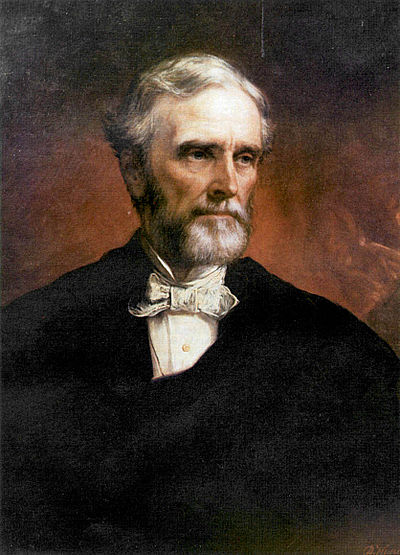
Jefferson Davis was one of the most influential American politicians in the 19th century. He was an important military figure, serving as Colonel of the Mississippi rifles in the Mexican War, and bringing in important military inventions as Secretary of State. He was the Southern leader in the Senate during the antebellum period. But his most important role came as President of the Confederate States of America, as he tried to lead a floundering new nation, guide her armies to victory and stave off defeat as along as possible. Although ultimately he was not successful, he was hailed as a hero by the South and loud cheers were given at the very mention of his name. During the war he had many enemies, but they almost unanimously rallied around him as a symbol of a political system and cultural structure that they had been forced to give up, but still cherished in their hearts. All this was possible because of four main qualities: trust in God, decisiveness, choice of men, and integrity.
 |
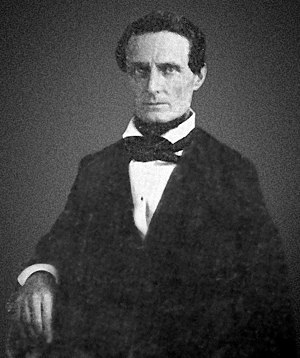
| Davis in about 1847 |
Trust in God
Throughout his life Jefferson Davis saw himself as a Christian, and attended church. But in 1862 as the Confederacy began to enter dark times, Davis turned to God even more. He was baptized in the Episcopal Church, publicly proclaiming himself to be a Christian. Jefferson Davis frequently in both public and private writings referred to God, and requested His help in their cause. As a prisoner Davis relied upon God and spent time reading the Bible and religious books. His doctor wrote:
There was no affection of devoutness of asceticism in my patient; but every opportunity I had of seeing him, convinced me more deeply of his sincere religious convictions. He was fond of referring to passages of Scripture, comparing text with text, dwelling on the divine beauty of the imagery, and the wonderful adaption of the whole to every conceivable phase and stage of human life. The Psalms were his favorite portion of the Word, and had always been. ... There were moments, while speaking on religious subjects, in which Mr. Davis impressed me more than any professor of Christianity I have ever heard. There was a vital earnestness in his discourse, a clear, almost passionate, grasp in his faith; and the thought would frequently recur, that a belief capable of consoling such sorrows as his, possessed, and thereby evidenced, a reality - a substance - which no sophistry of the infidel could discredit.1
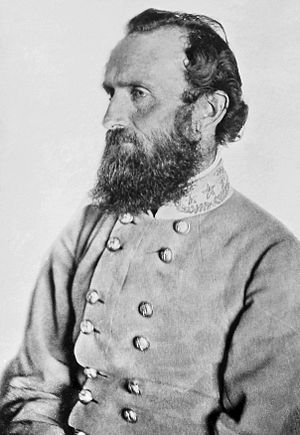
Although today Robert E. Lee and Stonewall Jackson are typically thought of as the most Christian of the Confederate leaders, Jefferson Davis was a very devout Christian as well.
 |
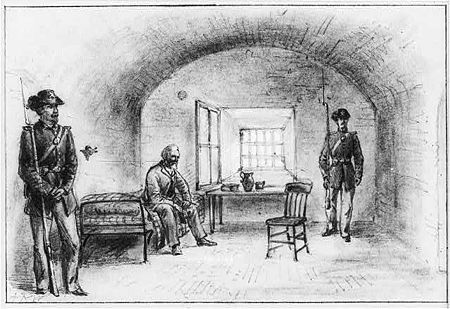
| Davis in Prison |
Decisiveness
As President of the Confederacy, Davis demonstrated decisiveness. He made mistakes, but he made them quickly. He was not rash, but he made up his mind quickly and worked to implement his decision. It is worse for a leader to be uncertain than wrong. If he was uncertain, Davis would never make a decision. Even if he leaned toward the correct solution, he would never have made up his mind and therefore would never have taken action on anything. Historian Joseph McElroy wrote:
It is doubtless true that it is more dangerous to a leader to be uncertain than to be wrong. The uncertain man confesses thereby the need to be led; and that other, when found, becomes the leader. Davis made many errors; but indecision was not among them, a fact which largely accounts for his continuing leadership, though it accounts also for many of his mistakes. As he was confident that his constitutional views were unassailable, so was he later confident with respect to his military views.2
 |
| Davis, 1853 |
Judge of Men
Davis had the ability to choose good men as his subordinates. Since he had been Secretary of War, Davis had some knowledge of the officers he would have available to him to choose from for leadership roles in the Confederate army. Unlike Lincoln, Davis did not give political appointments. Lincoln entered into his presidency with very little military knowledge, and he appointed politicians to commands for which they had no ability. Davis in general steered clear of these appointments, and although some were temporarily disappointed, it did well for the South in the long run. He wrote, “The appointing power is a public trust, to be executed for the public welfare, not a private fund with which to discharge personal obligations.”3 Instead of politicians, Davis instead appointed when possible men with military training who had experience which qualified them for their positions. He said, “If Napoleon, himself more highly endowed by nature with every military attribute than any other general of the Christian era, thought it essential to teach himself his business by incessant study, how much more is such study necessary for ordinary men.”
4
Davis was strong in likes and dislikes. He was intensely loyal to his friends, and cool towards his enemies. But perhaps Davis's greatest service to the Confederacy was his relationship with Robert E. Lee. In the first year of the war Lee did not meet with the public's approval. He had a few military reverses, and no grand successes. But Davis trusted him and still had confidence in him. When the opportunity presented itself, Davis appointed him to the command of the Army of Northern Virginia. In this position he made history as one of the greatest generals in modern times. When he had reverses, Davis did not throw him away. He remained confident in him, thus probably extending the Confederacy's life for many months.
 |
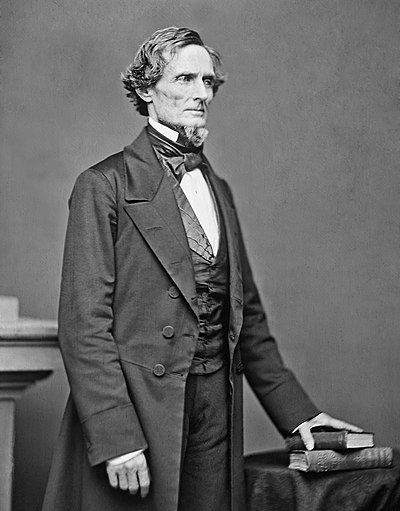
| Davis 1885 |
Integrity
One of Jefferson Davis's greatest strengths was his integrity. When he swore to uphold the Constitution, he believed that he had to obey that oath. He believed it was his duty to strictly apply his interpretation of the Constitution. He wrote:
The Constitution and laws should be masters, and public officers, like private individuals, only their servants. Beyond the lines of their strict constitutional powers such officers are as literally without authority, before the law, as the humblest citizens; for they are, in fact, private wrong-doers, and not public officers, from the moment that they have transgressed those constitutional limits.5
He had no kind words for those who said there was a higher law that they could turn to to violate the Constitution:
You have among you politicians of a philosophic turn, who preach a high morality; a system of which they are the discoverers.... They say, it is true the Constitution dictates this, the Bible inculcates that, but there is a higher law than those and they call upon you to obey that higher law of which they are the inspired givers. Men who are traitors to the compact of their fathers – men who have perjured the oaths they have themselves taken – they who wish to steep their hands in the blood of their brothers; these are the moral law-givers who proclaim a higher law than the Bible, the Constitution, and the laws of the land. This higher-law doctrine … is the most convenient of which I have ever heard – for the criminal.... What security have you for your own safety if every man of vile temper, of low instincts, of base purpose, can find in his own heart a law higher than that which is the rule of society, the Constitution and the Bible?6
This stands in sharp contrast to the view of Abraham Lincoln. He thought that the preamble of the Constitution gave the guidelines towards which he was to act, and he was at liberty to break any specific injunction while doing it. One historian has written, “He was ready to violate any specific clause of the Constitution if by so doing he could serve its main purpose; and he interpreted his powers as including anything to save the Union.”7 Many Southern politicians of the Civil War eara have been criticized for using the state's rights issue only as a pragmatic argument in their pushing for or against slavery. But this criticism does not apply to Jefferson Davis. He believed in the State's Right doctrine with all his heart, and applied it throughout his life.
After the Confederacy was crushed, Davis was imprisoned, and although the government could find no crime for which to try him, he remained there for two years. His friends begged him to ask for pardon, since it was very likely it would have been granted, but he refused. He would rather suffer many trials than even hint that the principles for which the Confederacy fought were wrong. He said:
Nothing fills me with deeper sadness than to see a Southern man apologizing for the defense we made of our inheritance. Our cause was so just, so sacred, that had I known all that has come to pass, had I known what was to be inflicted upon me, all that my country was to suffer, all that our posterity was to endure, I would do it all over again.
Although the Confederacy had been defeated, Davis hoped that the principles for which they had fought would still live on. He said, “Truth crushed to the earth will rise again … in its might, clothed with all the majesty and the power that God gave it, and so the independence of these states, the Constitution, liberty, state sovereignty, which they won in '76... can never die....”
8
 |
| Davis after the war |
1. Jefferson Davis: ex-president of the Confederate States of America : A Memoir by Varina Davis (New York: Bedford Company, Publishers, 1890) vol. 2, p. 672-673
2. Jefferson Davis: The Unreal and the Real by Robert McElroy (New York: Smithmark Publishers, 1937) p. 312-313
3. Ibid, p. 314-315
4. Ibid, p. 315
5. Ibid, p. 310
6. Ibid, p. 187-188
7. Ibid, p. 311
8. Ibid, p. 678













.jpg/500px-Fort_Donelson_river_battery_(1).jpg)


 Posts
Posts


