
Theodore Roosevelt
Theodore Roosevelt began writing The Naval War of 1812 while he was at Harvard in 1879. It was his first book, and he published it in 1881 after much study, just after being elected to the New York State Assembly. He was 23 years old at the time. This book quickly became the authoritative work on the subject, and Roosevelt became recognized as a historian. The writing of this book made people think he would be a good historian and eventually an elected official. There were several reasons for this, and today we will look at his unbiasedness, diligence and fame.
The Naval War of 1812 was the first relatively unbiased book on that subject. Previous accounts had been written, but they had been biased to their particular sides. Roosevelt says,
“It is to be regretted that most of the histories written on the subject, on either side of the Atlantic, should be of the 'hurrah' order of literature, with no attempt whatever to get at the truth, but merely to explain away the defeats or immensely exaggerate the victories suffered or gained by their own side.”1
Throughout the book Roosevelt shows how the previous accounts twist, ignore or intentionally change facts. He says that it does no good to tell history that is not true. One of the most important things we get from studying history is knowing and therefore being able to avoid the faults of those who came before. If we skip the mistakes of our particular side, then we defeat the purpose for studying history at all. It is important that all historians be as relatively unbiased as possible, and Roosevelt fits that criteria. It is also important for people who are running for office to be unbiased, because otherwise they would not judge justly between different persons or ideas. Being unbiased is one of the most important qualifications for an elected official.
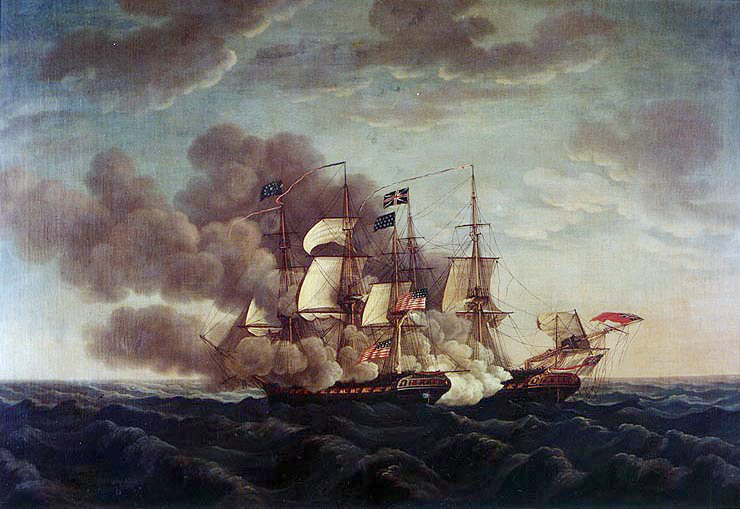
USS. Constitution vs. HMS. Guerriere
As Roosevelt wrote The Naval War of 1812, he carefully researched all the previous accounts of the war. He also delved into the archives at Washington and searched through the ships' logs and letters of the captains. He did this so that he would be as sure as possible that his story was correct. It is important that history books be well researched so that they will correctly portray what happened. Roosevelt did this, and though some of his details have been proved wrong, he still was very accurate. Roosevelt’s method of analyzing the battles has influenced all works on naval history that came after. He compared the different strengths of ships and fleets to help decide whether the loser was defeated by greater strength, or their own cowardice or lack of training. He carefully studied the naval tactics, and made tables of the relative strengths. Roosevelt's book effected later scholars through his carefully researched facts and conclusions, and also through the methods that he used. One historian said, "Roosevelt’s study of the War of 1812 influenced all subsequent scholarship on the naval aspects of the War of 1812 and continues to be reprinted. More than a classic, it remains, after 120 years, a standard study of the war."2 Diligence and accuracy are important characteristics for elected officials because it is necessary that they work hard in their positions, and make sure that they know everything possible on certain issues.

Battle of Lake Erie
The third quality that we will consider is the prestige and fame that this book gave him. We have already seen how this book was so influential to other historians. By writing this book Roosevelt became a famous historian. When someone is running for political office it is very important that people recognize their name, and know something about them. Thereby they would be able to decide better whether or not to vote for them. By writing The Naval War of 1812, Roosevelt made himself more famous, and therefore advanced his chances to get elected.
After writing The Naval War of 1812, Theodore Roosevelt continued throughout his life to write history. He was also a soldier, rancher, statesman, and, most notably, President of the United States. His famous books on history, including The Naval War of 1812, helped him in politics. Besides giving him much of his income, they showed people some of the qualities that he had, which we have mentioned here, such as unbiasedness and diligence. Roosevelt's writing of The Naval War of 1812, greatly influenced both his political career, and future historical works.
1. Roosevelt, Theodore The Naval War of 1812 (New York: The Modern Library, 1999) p. 205
2. Crawford, Michael J.. "The Lasting Influence of Theodore Roosevelt’s 'Naval War of 1812'". ijnhonline.org. International Journal of Naval History. http://www.ijnhonline.org/volume1_number1_Apr02/article_crawford_roosevelt_1812.doc.htm Retrieved 2009-08-11.




 Posts
Posts


